
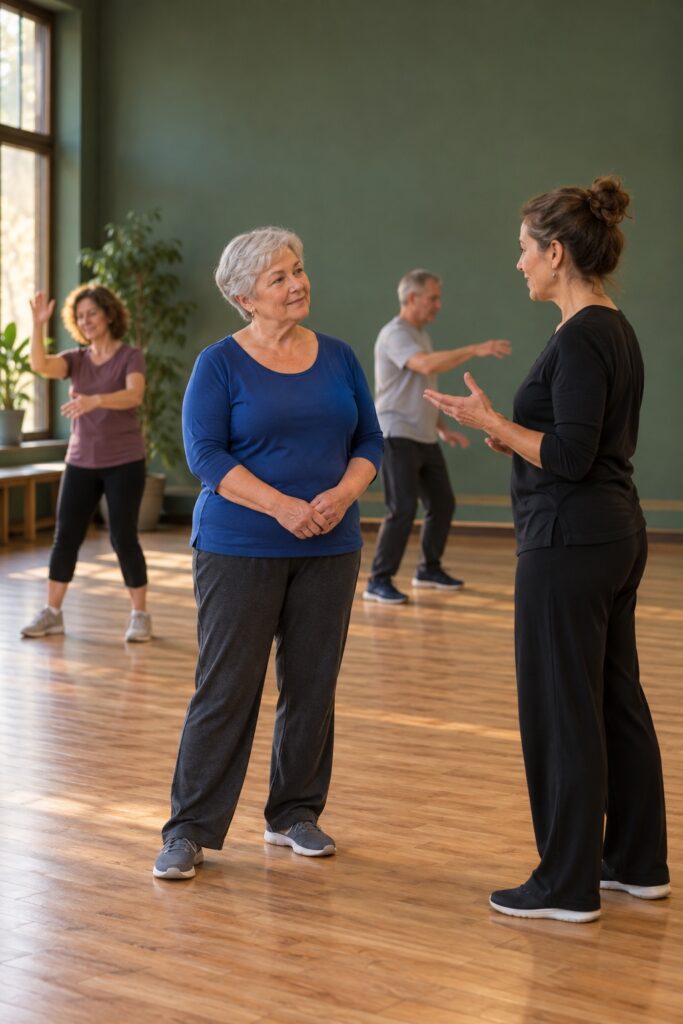
I won’t tell you to “just be confident.” If you want to dance but dread looking confused in front of other people, that phrase leaves all the practical questions unanswered. What will the class expect? Will someone film it? Can you ask for another explanation without becoming the evening’s entertainment?
You can investigate those questions before deciding how brave you feel. Confidence does not have to be an entrance requirement.
Give “awkward” a more useful name
Try finishing this sentence: “The moment I’m most worried about is…” Perhaps it is being singled out, touching an unfamiliar partner, facing the wrong way or discovering that “beginner” means several previous terms.
Then ask for the information that addresses that moment:
- “Does this course start with no dance experience?”
- “How do you give individual feedback?”
- “Please ask before using me in a demonstration.”
- “Can I participate without being filmed?”
- “What should I do when I lose the routine?”
You can make a practical request without sharing your whole personal history. A specific answer tells you more than a promise that everybody will love the class.
You don’t need the promise that nobody is watching
Sometimes people look at one another in a lesson because observation is part of learning. I’d rather help you look for a room where being noticed does not mean being humiliated.
Does the teacher explain corrections respectfully? Can a newcomer ask a question? Are options offered without comments about weight, age or worth? A difficult new step and a dismissive teaching environment are different problems.
You can accept useful correction while refusing ridicule or unwanted touch. “Please explain before touching me” is a clear boundary, not a refusal to learn.
Your age does not tell the teacher your level
You might be completely new, experienced in another form or returning after a long break. Describe that starting point rather than expecting your age to explain it. Familiar vocabulary and present readiness for a movement are not identical either.
There are real routes for older newcomers. The Royal Academy of Dance’s Silver Swans programme welcomes beginners and returners, with teachers trained for adults over 55. That establishes an available type of programme, not the suitability or pace of every local session.
You do not have to choose the hardest class to prove anything about ageing. Nor must you settle for vague teaching because you are learning recreationally. Ask for a level that fits your experience and individual needs.
Make privacy a separate decision
Wanting to dance and wanting your image online are different choices. Ask about filming, promotional posts and the practical opt-out. Standing at the back may not solve the problem if a camera or mirror captures the whole room.
Likewise, ask what the mirror is for during a particular task if it distracts you. A useful sightline should let you receive the teaching without turning the whole lesson into an inspection of your appearance. Do not look away during travelling work or remove support just to avoid seeing yourself.
Choose a manageable first contact
An arranged observation visit, a private introduction and an appropriate group lesson are options, not rungs on a compulsory bravery ladder. You can choose the one that answers your question and fits the provider’s arrangements.
For an invented example, a newcomer who worries about public correction asks how feedback works before booking. The instructor explains a discreet arrangement, and she tries the class. Her useful conclusion is that her question was answered and her boundary respected. She does not have to leave transformed for the visit to count.
If the answer is dismissive, changing the class may be more useful than demanding a new personality from yourself. For practical booking questions, start with choosing a dance class.
When a mistake happens, “I missed the change” is enough description to ask how to rejoin. You do not have to laugh at yourself, apologise for being a beginner or deliver an impressive recovery.
These are participation ideas, not treatment for anxiety. If fear persistently interferes with everyday life, qualified support can help; NIMH explains the distinction from occasional nervousness. You do not have to exhaust every class-planning idea before asking for help.
MarGo! Moments is a non-medical lifestyle publication. This article offers general information, not individual medical advice or an exercise prescription. For health questions, consult an appropriately qualified healthcare professional.
MarGo! editorial feature · AI-assisted, in the MarGo! first-person voice. Not a personal experience or product test unless stated.