
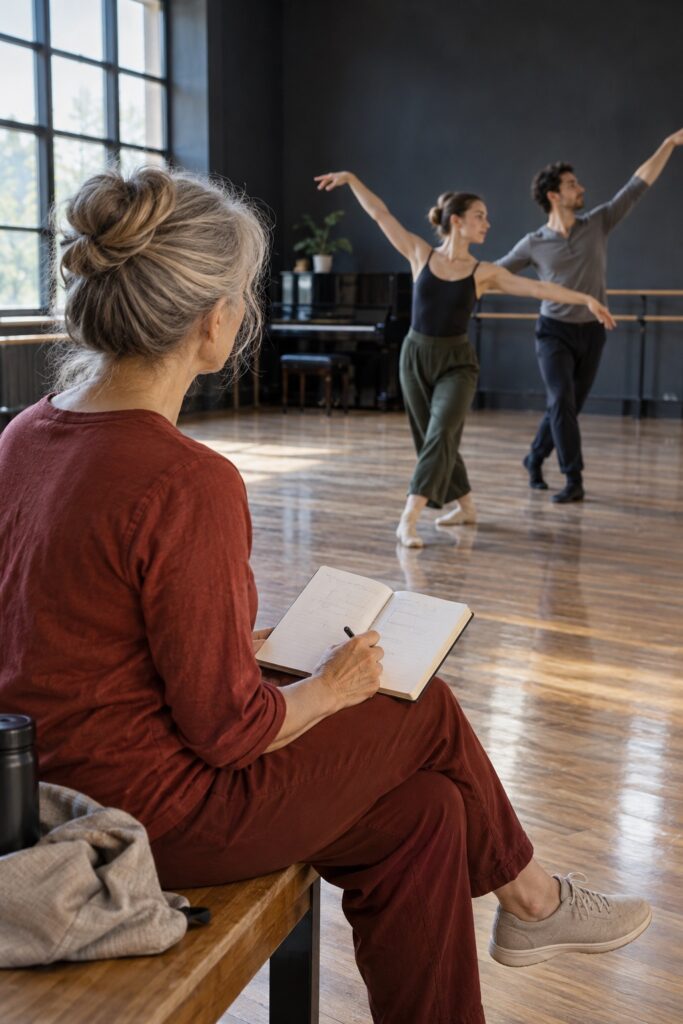
You followed the whole routine with the teacher, then the first movement vanished when the demonstration stopped. I’ll start by separating those two situations: following a visible reference and recalling the order without it are different tasks. Neither makes the other a false achievement.
First ask whether independent recall is even the goal. A follow-along fitness class may welcome watching throughout. A technique course or performance may ask you to remember more. You do not need to invent a secret memory exam for a class that never set one.
Find the first unclear point
“I forget everything” gives a teacher very little to work with. Try one of these descriptions instead:
- I recognize the movements, but lose their order.
- I know each section separately, but cannot connect them.
- The repeated section looks familiar, and I use the wrong ending.
- I know what comes next, but lose the direction when we face another wall.
Those questions need different help. A map can clarify order; it cannot teach a physical transition you have never understood. If direction is the issue, my guide to left, right and mirror images may be the more useful place to start.
A routine map you can actually use
Let me give you an invented example. It contains labels, not choreography to perform: Opening → Middle → Return → Finish.
In this example, Return resembles Opening but ends differently. Calling them both Opening would hide the very choice you need to remember. Give Return its own name and add just enough information to distinguish it.
- Opening: begins after the teacher’s count-in; Middle follows.
- Middle: starting direction needs clarification; Return follows.
- Return: similar beginning to Opening, but its ending leads to Finish.
- Finish: the last section, with no further repeat.
Your real routine may have a different shape. Ask the teacher where its meaningful sections begin rather than forcing it into four boxes. A few useful names are enough; pages of foot instructions can become another thing to memorize.
Give the join its own question
Suppose you can describe Opening and Middle but get stuck between them. Replaying each from a fresh start may leave the missing connection untouched. Ask, “Can you show how the end of Opening sets up Middle?”
Let the teacher explain the actual movement. Then put the confirmed answer beside that join, in language you understand. Keep a question mark where the answer is still uncertain instead of rehearsing a guess until it feels familiar.
I’m offering this map as a simple organisational aid, not a validated memory programme or a substitute for instruction.
A scene writer’s version of the same map
If you also write fiction, the routine map can do a second, separate job: help you inspect the order of actions in a scene. I’m using the same note-taking structure for a different creative task.
Use the same four labels for this invented scene at a rehearsal studio:
- Opening: Nessa arrives to return a borrowed key. She puts it on the desk.
- Middle: Daniel asks her to stay for the next rehearsal. She says she has not decided.
- Return: she approaches the desk again, apparently to leave, but asks when the next rehearsal starts.
- Finish: Daniel answers. Nessa chooses to take the key, with his agreement.
The return to the desk resembles the opening, but the purpose has changed. That is why naming both moments “the key bit” would be unhelpful. In the dance map above, similar beginnings can lead to different endings; in this fictional scene, the same location supports a different choice.
Now inspect the joins. If a draft has Nessa unlocking the studio in the next scene, did she actually take the key before leaving? If she agrees to return, what happened between “I haven’t decided” and that choice? A missing physical action and a missing reason need different revisions. Adding a paragraph of emotion will not put the key in her pocket; adding the key transfer will not explain why she wants to return.
Try this desk-based exercise with a scene of your own: name its sections, track one object and write the character’s immediate purpose beside each section. Check every join once for physical continuity and once for a changed decision. You do not need to perform the actions to examine them.
Keep the two uses separate when you return to class. A fictional scene’s meaning is yours to revise; the actual choreography and its transitions need the teacher’s explanation. In either notebook, a question mark is more useful than a detail you have invented to make the sequence look complete. For the relationship side of the writing exercise, continue with making fictional chemistry specific.
Check the version before blaming your memory
If the teacher changes Return’s ending, remembering the old one accurately can look like forgetting. Confirm which occurrence changed and which parts stayed the same. Date your note and use the current authorised reference.
Ask permission before filming teachers or classmates, and follow the limits on sharing course material. If a new recording has not been supplied, note the classroom correction rather than pretending an older clip now shows it.
A different camera view can also make unchanged choreography look unfamiliar. Check whether the movement changed or only your view of it before reversing the sequence.
Know what to do after a blank
Ask the teacher to identify a suitable return point and how to wait or simplify until it arrives. A useful plan might be, “If I lose Middle, I watch for the agreed cue and rejoin at Return.” The actual option must fit your class and space.
Do not rush through missing material or remove physical support to make recall more impressive. If a teacher suggests reduced rehearsal, sometimes called marking, ask exactly what should remain and what can be left out. Smaller movement is not automatically an appropriate version of every task.
When you review the learning, keep the help visible: “I recognized it when shown,” “I followed with the teacher,” or “I named the next section before the demonstration.” Those are useful observations, not grades of personal worth.
If your map answers the order question but a movement remains unclear, stop rewriting the map and ask about that movement. The notebook has done its job when it helps you return to dancing with a better question.
MarGo! Moments is a non-medical lifestyle publication. This article offers general information, not individual medical advice or an exercise prescription. For health questions, consult an appropriately qualified healthcare professional.
MarGo! editorial feature · AI-assisted, in the MarGo! first-person voice. Not a personal experience or product test unless stated.