
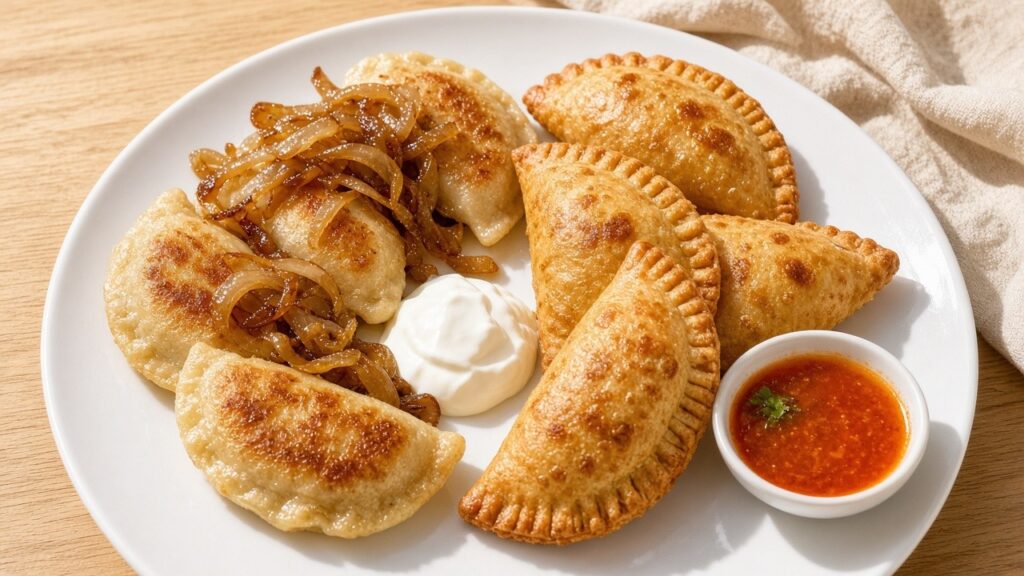
Chicago has one of the largest Polish communities outside Poland, so pierogi are everywhere here: church sales, festivals, delis and grandma’s freezer. My own kitchen runs on empanadas, the Panamanian kind with a crisp corn shell. Put the two side by side and they look like close cousins: a half-moon of dough wrapped around a filling. Bite into them and they’re completely different foods.
Pierogi are Polish dumplings made from a soft, unleavened wheat-flour dough (often with sour cream or egg), filled with potato and cheese, sauerkraut, meat or fruit, then boiled and often pan-fried in butter with onions. Empanadas are Spanish and Latin American turnovers made from a sturdier pastry dough (wheat, or corn masa in Panama, Colombia and Venezuela), filled with seasoned meat, chicken, cheese or vegetables, then baked or deep-fried. The short version: pierogi are boiled dumplings with a tender, pasta-like wrapper; empanadas are fried or baked pastries with a crisp shell.
Below: the short answer, dough, fillings and cooking compared, where each comes from, how they compare with other dumplings and ravioli, whether you can use empanada dough for pierogi, where to try both in Chicago and answers to common questions. My recipes: Panamanian empanadas and keto empanadas.
Pierogi vs empanadas: the short answer
| Pierogi | Empanadas | |
|---|---|---|
| Type | Dumpling | Turnover / hand pie |
| Dough | Soft wheat dough, often with sour cream, egg or both | Pastry dough with fat (wheat), or corn masa |
| Cooking | Boiled, then often pan-fried | Baked or deep-fried |
| Texture | Tender, chewy, pasta-like (crisp edges if fried) | Flaky, crunchy or crisp |
| Classic fillings | Potato and cheese, sauerkraut and mushroom, meat, sweet cheese, fruit | Beef picadillo, chicken, cheese, ham and cheese, vegetables |
| Served with | Butter, fried onions, sour cream, bacon bits | Hot sauce, salsa, chimichurri, ají |
| Origin | Poland and Central/Eastern Europe | Spain (Galicia), then Latin America and the Philippines |
Dough compared (boiled wheat vs corn or wheat, baked or fried)
Pierogi dough
Pierogi dough is a simple, soft, unleavened dough: flour, water or milk, salt and often sour cream, egg or a little butter or oil. It’s rolled thin, cut into circles, filled, folded into half-moons and crimped. Because it’s boiled, it has to be:
- Elastic enough to seal well and not burst in the water.
- Tender, not tough, after boiling.
The result is closer to fresh pasta than to pastry.
Empanada dough
Empanada dough varies by country:
- Wheat pastry (Argentina, Chile, Spain, many others): flour, fat (butter, lard or shortening), salt and water or egg. It’s richer and flakier, designed for baking or frying. Some are puff-pastry-like.
- Corn masa (Panama, Colombia, Venezuela): made from precooked cornmeal or nixtamalized corn dough, sometimes with a little sugar or achiote for color. It’s always fried, giving a crunchy, golden shell. My Panamanian empanadas use corn dough.
- Low-carb doughs: cheese-and-almond-flour “fathead” dough, as in my keto empanadas.
Dough at a glance
| Dough | Fat | Leavening | Best cooking | Texture |
|---|---|---|---|---|
| Pierogi | Little (sour cream, egg) | None | Boil, then fry | Soft, chewy |
| Wheat empanada | More (butter, lard) | Sometimes a pinch of baking powder | Bake or fry | Flaky, crisp |
| Corn empanada | Little to none | None | Deep-fry | Crunchy |
Fillings
Pierogi fillings
- Ruskie: potato and farmer’s cheese (twaróg) with fried onion, the most famous savory pierogi. “Ruskie” refers to the historical region of Red Ruthenia, not Russia.
- Sauerkraut and mushroom (z kapustą i grzybami): a Christmas Eve classic in Poland.
- Meat (z mięsem): ground cooked meat with onion.
- Sweet cheese (z serem na słodko): farmer’s cheese with sugar and vanilla.
- Fruit: blueberries, strawberries, cherries or plums, served with sour cream and sugar.
- Modern fillings: spinach and feta, buffalo chicken, jalapeño and cheddar.
Empanada fillings
- Beef: seasoned ground beef or picadillo, sometimes with olives, raisins, egg or potato (Argentina’s empanadas salteñas, Chile’s empanadas de pino).
- Chicken: stewed and shredded chicken with sofrito.
- Cheese: queso blanco, mozzarella or a cheese-and-onion mix.
- Ham and cheese.
- Corn (humita), spinach, tuna and seafood.
- Sweet: guava and cheese, dulce de leche, pineapple, apple.
In Panama, the classic is a corn empanada filled with seasoned ground beef (and sometimes chicken or cheese), served with a spoonful of hot sauce. See my Panamanian hot sauce recipe.
Cooking methods
| Method | Pierogi | Empanadas |
|---|---|---|
| Boiled | Yes: the standard first step, until they float plus a minute or two | No |
| Pan-fried | Very common after boiling, in butter with onions | Some home cooks shallow-fry |
| Deep-fried | Occasionally | Very common, especially corn dough |
| Baked | Rare; some baked versions exist | Very common for wheat dough |
| Air-fried | Works for boiled or frozen pierogi | Works for many wheat and some corn empanadas |
Where each comes from
Pierogi
Pierogi are Poland’s national dumpling, with close relatives across Central and Eastern Europe: Ukrainian varenyky, Slovak pirohy and others. They’ve been part of Polish cooking for centuries and are tied to holidays, especially Wigilia (Christmas Eve). Polish immigrants brought them to the U.S., and Chicago, Pittsburgh, Buffalo and Cleveland are known pierogi cities.
Empanadas
The word comes from the Spanish empanar, “to wrap or coat in bread.” Empanadas go back to medieval Spain and Portugal; Galicia is famous for its large, pie-like empanada gallega. Spanish colonizers brought the idea to the Americas and the Philippines, and each country made it its own with local dough and fillings.
Pierogi vs empanadas vs dumplings vs ravioli
| Pierogi | Empanadas | Chinese dumplings | Ravioli | |
|---|---|---|---|---|
| Dough | Soft wheat, sour cream/egg | Pastry or corn masa | Thin wheat (sometimes rice) | Egg pasta |
| Shape | Half-moon | Half-moon or round | Pleated crescents, purses | Squares or rounds |
| Cooking | Boil, then fry | Bake or fry | Boil, steam or pan-fry | Boil |
| Sauce | Butter, onions, sour cream | Hot sauce, salsa, chimichurri | Soy, vinegar, chili oil | Tomato, butter, cream |
For dumplings around Chicago, see Chinatown Chicago dumplings.
Can you use empanada dough for pierogi?
Not really. Wheat empanada dough has more fat, so it can split or turn heavy and greasy when boiled. You can bake or fry pierogi fillings in empanada dough, but then you’re making empanadas with pierogi filling, which is delicious (potato-and-cheese empanadas exist in several countries).
The reverse also doesn’t work well: pierogi dough is too soft and lean to give an empanada its crisp shell, though pan-fried pierogi get close.
Where to try both in Chicago
Pierogi
- Polish neighborhoods: the area around Milwaukee Avenue in Avondale (the historic “Polish Village”), Jefferson Park and the Archer Avenue corridor on the Southwest Side have Polish delis, bakeries and restaurants.
- Festivals: Chicago’s Taste of Polonia festival in Jefferson Park, usually over Labor Day weekend, is a pierogi paradise. Just across the Indiana line, Pierogi Fest in Whiting is a summer tradition. Check official sites for current dates.
- Supermarkets: Polish delis sell frozen homemade-style pierogi; big supermarkets carry frozen brands.
Empanadas
- Argentine, Colombian, Venezuelan, Chilean and Puerto Rican restaurants and bakeries across the city sell empanadas, especially on the North and Northwest Sides.
- Food halls and markets often have an empanada stand.
- Panamanian empanadas are harder to find in Chicago, which is why I make my own. See Panamanian food in Chicago.
Hours and menus change, so check before you go.
Making each at home: the basic method
Basic pierogi (makes about 30)
- Dough: mix about 3 cups all-purpose flour with 1 teaspoon salt. Add 1 egg, ½ cup sour cream and about ½ cup warm water, a little at a time, until a soft dough forms. Knead until smooth, cover and rest 30 minutes.
- Filling: mash 2 cups cooked potatoes with 1 cup farmer’s cheese (or a mix of farmer’s cheese and sharp cheddar), plus 1 onion fried in butter. Season well with salt and pepper and let cool.
- Shape: roll the dough thin, about ⅛ inch. Cut 3-inch circles, put a spoonful of filling in the center, fold and pinch the edges firmly to seal.
- Boil: cook in batches in salted, gently boiling water. When they float, cook 1 to 2 minutes more, then lift out with a slotted spoon.
- Fry (optional): pan-fry in butter with sliced onions until golden. Serve with sour cream.
Basic empanadas
For the full, tested method, see Panamanian empanadas. The general steps for any empanada:
- Make the filling first and let it cool completely; hot filling makes the dough tear.
- Make the dough: wheat pastry with cold fat, or corn dough with precooked cornmeal, water and salt.
- Shape: roll or press into circles, add filling, fold and seal with a fork or a decorative twisted edge (repulgue).
- Cook: bake at around 400°F until golden (brush with egg wash for shine), or deep-fry at about 350°F until crisp.
Which is easier for a beginner?
Baked wheat empanadas are usually the easiest: forgiving dough, no boiling and no deep-frying. Pierogi take more practice because the seal has to hold in boiling water, but they freeze beautifully, so a big batch day pays off. Corn empanadas need practice with the dough’s moisture and with frying, but they’re quick once you get the feel.
Sauces and toppings
| For pierogi | For empanadas |
|---|---|
| Melted butter and fried onions | Panamanian ají or other hot sauce |
| Sour cream | Chimichurri (Argentina) |
| Crispy bacon bits | Ají picante (Colombia) |
| Fresh dill or chives | Pebre (Chile) |
| Sugar and sour cream (sweet pierogi) | Guacamole or salsa verde |
Freezing and reheating
Pierogi
- Freeze uncooked: arrange on a floured sheet pan, freeze until solid, then bag. Boil from frozen (a few extra minutes).
- Freeze cooked: boil, cool, toss with a little butter or oil, freeze, then pan-fry from frozen or thawed.
Empanadas
- Freeze uncooked: freeze on a tray, then bag. Bake from frozen (add 5 to 10 minutes) or fry from frozen in moderately hot oil so the inside heats through.
- Reheat cooked empanadas in an oven or air fryer, not the microwave, to keep them crisp.
FAQ
Are pierogi and empanadas made from the same dough?
No. Pierogi use a soft, lean wheat dough meant for boiling. Empanadas use a richer pastry dough (or corn masa) meant for baking or frying.
Are empanadas fried or baked?
Both. Wheat-dough empanadas are often baked; corn-dough empanadas (like Panamanian ones) are fried. Many countries do both.
Can I freeze both?
Yes. Freeze both uncooked on a tray, then bag them. Boil pierogi from frozen; bake or fry empanadas from frozen.
Where can I eat pierogi and empanadas in Chicago?
Pierogi in Polish neighborhoods like Avondale, Jefferson Park and along Archer Avenue, plus Taste of Polonia. Empanadas at Latin American restaurants and bakeries across the city.
Are there sweet versions of each?
Yes. Sweet pierogi are filled with fruit or sweet farmer’s cheese. Sweet empanadas include guava and cheese, dulce de leche, pineapple and apple.
Are pierogi Polish or Ukrainian?
Both cultures have them under different names (pierogi in Poland, varenyky in Ukraine). They share a long history across the region.
What’s the difference between pierogi and potstickers?
Potstickers are Chinese dumplings with a thinner wrapper, usually filled with pork and cabbage, steamed and pan-fried in one pan. Pierogi have a thicker, softer dough and are boiled first.
Why do my pierogi open when I boil them?
Usually the edges weren’t sealed well, there was filling or flour on the seal, or the water was boiling too hard. Press the edges firmly, keep the seal clean and use a gentle boil.