
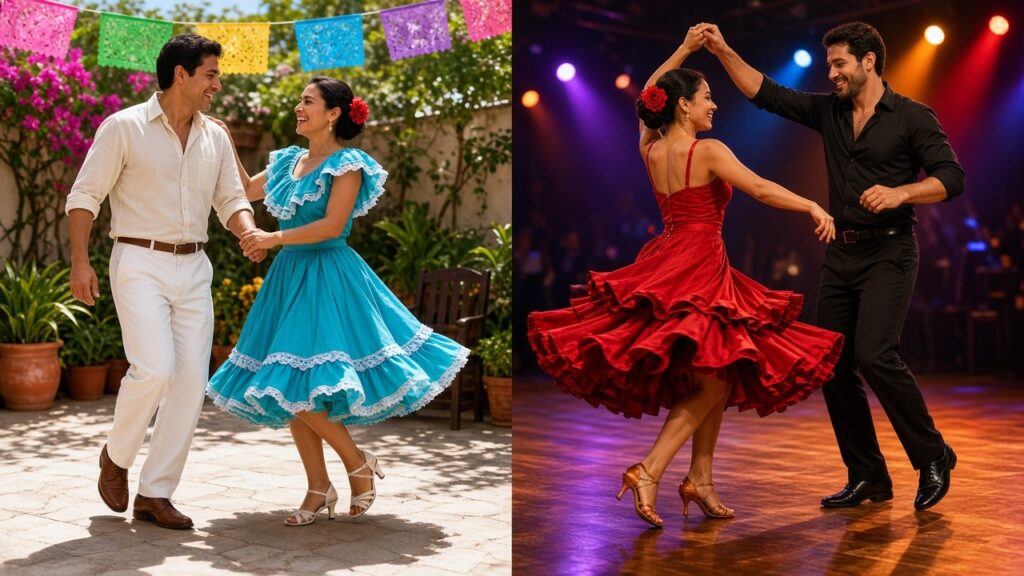
Cumbia and salsa are both Latin dances that fill the floor at parties, but they feel very different once you start dancing. Cumbia is relaxed, steady and easy to join; salsa is faster, busier and full of turns. If you’re deciding which one to learn, or you want to know why your feet get confused when the DJ switches from one to the other, here’s how they compare.
Cumbia comes from Colombia’s Caribbean coast and is danced to a steady 2/4 rhythm with a simple back-rock-together step and a pause, so it’s easier for beginners and feels relaxed and swaying. Salsa developed in New York from Cuban son and other Afro-Caribbean music and is danced to a faster, syncopated 4/4 rhythm built on the clave, with six steps over eight counts (quick-quick-slow) and lots of partner turns. Cumbia is easier to start; salsa takes longer to learn but has more partner patterns. You can’t really dance one step to the other’s music.
Below: origins, music and rhythm, steps and counting, partner work, which is easier, a four-way comparison with bachata and merengue, where to dance each in Chicago and answers to common questions.
Cumbia vs salsa: the short answer
| Cumbia | Salsa | |
|---|---|---|
| Origin | Caribbean coast of Colombia, later spread across Latin America | New York in the 1960s–70s, rooted in Cuban son, mambo and Puerto Rican music |
| Time signature | Usually 2/4 | 4/4 |
| Tempo | Usually moderate and steady | Usually faster |
| Basic step | Back, rock, together, pause | Six steps over eight counts with pauses on 4 and 8 |
| Feel | Relaxed, swaying, grounded | Energetic, sharp, playful |
| Partner work | Simple turns, often open or relaxed closed hold | Many turn patterns, cross-body leads, shines |
| Learning curve | Very easy to start | Easy to start, takes longer to get comfortable |
| Where you’ll dance it | Family parties, weddings, quinceañeras, Mexican and Colombian venues, Zumba | Salsa socials, clubs, congresses, classes |
Origins
Cumbia
Cumbia began on Colombia’s Caribbean coast, where Indigenous flutes, African drums and Spanish song and dress blended over centuries. It became Colombia’s signature dance music and spread through Latin America in the 20th century. Mexico in particular adopted it, and today Mexican cumbia and cumbia sonidera are among the most danced styles in Mexico and in Mexican communities in the US. Peru, Argentina and Central America have their own versions. My how to dance cumbia for beginners guide covers the styles.
Salsa
Salsa took shape in New York in the 1960s and 1970s, when Puerto Rican, Cuban and other Latin musicians combined Cuban son, mambo, guaracha and other Afro-Caribbean styles with big-band brass and New York energy. “Salsa” became the label for this music. As it spread, dancers created styles such as Cuban salsa (casino), LA style, New York style on2 and Colombian Cali style. I compare two of the big ones in Cuban salsa vs LA style and explain the timing debate in salsa On1 vs On2.
Music, rhythm and tempo
Cumbia music
- Rhythm: a steady “chuh-ka, chuh-ka” pulse from a scraper (guacharaca or güiro), with the bass on the downbeat.
- Instruments: traditional cumbia uses drums, gaita flutes and maracas; modern cumbia often adds accordion, keyboards, electric bass and guitars.
- Tempo: usually moderate, though some styles are slower and some modern songs faster.
- Feel: repetitive and hypnotic, easy to follow.
Salsa music
- Rhythm: built on the clave, a repeating two-bar pattern, with layered percussion (congas, timbales, bongos, cowbell) and a syncopated piano montuno and bass.
- Instruments: piano, bass, brass (trumpets and trombones), percussion and vocals with call-and-response.
- Tempo: usually faster than cumbia, ranging from relaxed to very fast.
- Feel: layered, energetic, with breaks and sections that dancers respond to.
How to tell them apart by ear
- Hear a constant scraper and a simple, swaying beat? Probably cumbia.
- Hear brass, piano patterns, cowbell and congas with lots going on? Probably salsa.
- Can you count 1-2-3-4 on a steady pulse with every beat feeling the same? Cumbia.
- Do you hear phrases of eight counts with accents and breaks? Salsa.
More on Latin music by ear in salsa vs bachata music.
Steps and counting
Cumbia basic
| Count | Step |
|---|---|
| 1 | Step back with the right foot |
| 2 | Rock forward onto the left foot |
| 3 | Bring the right foot back next to the left |
| 4 | Pause |
| 5–8 | Repeat with the left foot |
The movement is small and grounded, with soft knees and natural hip movement.
Salsa basic (On1)
| Count | Step |
|---|---|
| 1 | Leader steps forward with the left foot (follower steps back with the right) |
| 2 | Rock back onto the other foot |
| 3 | Bring the feet together |
| 4 | Pause |
| 5 | Leader steps back with the right foot (follower forward with the left) |
| 6 | Rock forward |
| 7 | Bring the feet together |
| 8 | Pause |
On paper they look similar: both have a three-step pattern with a pause. The difference is in the music and the feel. Salsa moves forward and back on a line with faster weight changes and sharper timing; cumbia sways back on alternating sides with a relaxed bounce. Salsa’s pauses also fall within syncopated music, which takes more practice to hear.
Partner work
Cumbia partner dancing
- Open hold (holding hands) or a relaxed closed hold.
- Partners mirror the back step.
- Turns: the follower turns under the leader’s arm; in sonidera style, there are often many turns in a row.
- Lots of room for freestyle and solo moments.
- Often danced in groups at parties, sometimes without a fixed partner.
Salsa partner dancing
- Closed hold or open hold with frequent changes.
- Moves include the cross-body lead, right and left turns, copa, hammerlock and many combinations.
- Clear lead and follow: the leader signals moves through the hands and frame.
- Solo footwork sections called shines.
- Socials usually have a partner change after each song.
If you want to start salsa, my learn salsa dancing for beginners guide is the place to begin, and how to spin in salsa covers turns.
Which is easier?
Cumbia is easier to start. Most people can dance a basic cumbia within one song: the music is steady, the step is small and you can dance alone or with anyone. That’s why cumbia is the dance everyone joins at family parties.
Salsa is easy to start too (the basic is simple), but it takes longer to dance comfortably:
- The music is faster.
- Finding the 1 takes practice.
- Partner patterns take weeks to months to learn.
- Turns require balance and spotting.
See how long does it take to learn salsa for realistic timelines.
Which should you learn first?
- Learn cumbia first if you want to join in at parties quickly, you’re nervous about dancing, or you dance Zumba and want to build on it.
- Learn salsa first if you want to go to salsa socials and clubs, enjoy learning partner patterns, or plan to learn bachata and other social Latin dances.
- Learn both if you go to Latin parties. Cumbia takes an evening to learn, and salsa grows with you over months.
Skills transfer. Rhythm, weight changes, partner connection and turning all carry from one dance to the other.
Cumbia vs salsa vs bachata vs merengue
| Cumbia | Salsa | Bachata | Merengue | |
|---|---|---|---|---|
| Origin | Colombia | New York (Cuban, Puerto Rican roots) | Dominican Republic | Dominican Republic |
| Basic step | Back, rock, together, pause | Six steps over eight counts | Three steps and a tap | March on every beat |
| Tempo | Moderate | Fast | Slow to moderate | Fast |
| Difficulty to start | Very easy | Moderate | Easy | Very easy |
| Hip movement | Natural sway | Natural, from weight changes | Pronounced | Natural from bent knees |
| Partner work | Simple turns | Many patterns | Turns, body waves (sensual style) | Turns and arm patterns |
| Best for | Parties, groups, Zumba | Socials, clubs, complex partner work | Socials, connection | Parties, beginners |
More comparisons in salsa vs bachata vs merengue, plus how-tos for bachata and merengue.
Switching between cumbia and salsa on the same night
At Latin parties and some clubs, the DJ moves from salsa to cumbia to bachata to merengue in one set. Some tips for switching:
- Listen to the first few bars before you start. Identify the rhythm before you step.
- Reset your posture. Salsa is upright and sharp; for cumbia, relax your knees and shoulders.
- Make your steps smaller for cumbia. Salsa’s forward-and-back basic travels more.
- Change your turns. Salsa turns are quick and spotted; cumbia turns are looser and swingier.
- Follow the room. If everyone is in a circle doing a back step, it’s cumbia.
Common mistakes when you know one and try the other
- Salsa dancers doing cumbia: dancing too sharply, stepping too big, trying complex patterns. Relax and keep it simple.
- Cumbia dancers doing salsa: forgetting the pause on 4 and 8, swaying instead of stepping forward and back, and not hearing the 1. Take a beginner class and count.
- Both: looking at your feet instead of your partner.
Where to dance each in Chicago
Cumbia
Cumbia lives in Chicago’s Mexican and Central American communities. You’ll hear it at weddings, quinceañeras, family parties, neighborhood festivals and summer street fests, especially in Pilsen and Little Village, and at Mexican and Latin nightclubs that play cumbia, banda and norteño. Many Zumba classes include cumbia, so a Zumba class in Chicago is an easy way to practice.
Salsa
Salsa has a dedicated scene in Chicago, with classes at dance studios, weekly socials and clubs, and congresses. Start with my guide to salsa dancing in Chicago and learn what to expect at a salsa social. Many socials also play bachata, and some include cumbia and merengue.
Shoes and clothes
| Cumbia | Salsa | |
|---|---|---|
| Shoes | Comfortable shoes that turn; low heels or smooth sneakers | Dance shoes with suede soles, or smooth-soled shoes; low heels for many followers |
| Clothes | Whatever you’d wear to a party; flowing skirts are fun | Comfortable, breathable clothes; dressier at clubs |
| Floor | Patio, backyard or dance floor | Smooth wooden floor |
For salsa specifics, see what to wear salsa dancing.
FAQ
Is cumbia easier than salsa?
Yes, for most beginners. Cumbia’s music is steady and moderate in tempo, and its basic back step is simple. Salsa is faster and has more partner patterns, so it takes longer to dance comfortably.
Can you dance cumbia to salsa music?
Not really. Salsa’s faster, syncopated rhythm doesn’t match cumbia’s back step, and salsa’s eight-count phrasing means you’d drift off the music. A few slower salsa songs can feel close, but it’s better to dance salsa steps to salsa and cumbia steps to cumbia.
Which should I learn first?
If you want to join in at parties fast, learn cumbia first; it takes an evening. If you want to dance at salsa socials, start salsa classes. Many people learn cumbia casually and salsa in classes.
How do I tell cumbia music from salsa music?
Cumbia has a steady, swaying beat with a constant scraper sound (guacharaca or güiro) and often accordion or keyboards. Salsa has a faster, layered rhythm with brass, piano, cowbell and congas, and phrases of eight counts.
Are the shoes and clothes the same?
Similar. Both need shoes that let you turn. Salsa dancers often use dance shoes with suede soles; cumbia is usually danced in everyday party shoes. Wear comfortable clothes for both.
Is cumbia Mexican or Colombian?
Cumbia began in Colombia, and Mexico developed some of its most popular styles. Both countries consider it part of their musical identity.