
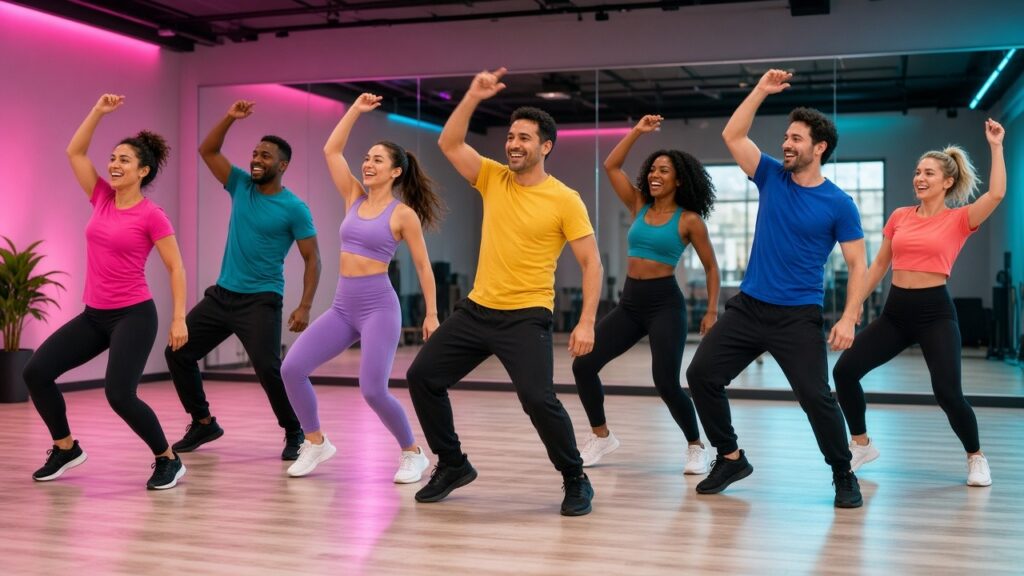
Reggaeton is the music that makes a room move as soon as the beat drops. It’s the soundtrack of Latin parties, clubs and a big part of every Zumba class, and you don’t need a partner or years of training to dance it. You need to find the beat, bend your knees and learn a few moves you can mix and match.
To dance reggaeton, start by finding the dembow beat (a “boom, ch-boom, chick” pattern that repeats every bar), then bounce lightly on every beat with soft knees. Add basic moves one at a time: step-touch side to side, the body roll, hip circles and simple footwork like the kick-step and the cross step. Keep your weight low, move from your hips and chest, and let your arms follow. Put two or three moves together in eight-count combos, and practice to medium-tempo songs before you try fast ones. Most beginners can dance comfortably at a party after a few weeks of short practice sessions.
Below: what reggaeton dance is, how to find the dembow beat, the basic moves step by step, how to build a combo, reggaeton in Zumba, party and club etiquette, how reggaeton compares with hip-hop and dancehall, a practice plan, what to wear and answers to common questions.
What is reggaeton dance?
Reggaeton is a music genre that grew in the late 1980s and 1990s from Jamaican dancehall, reggae en español from Panama, and hip-hop and Latin rhythms in Puerto Rico. Panamanian artists such as El General were among the pioneers of Spanish-language reggae, and Puerto Rico turned it into the reggaeton the world knows today. Since the 2000s, songs like “Gasolina” and later “Despacito” made it global.
Reggaeton dance isn’t one fixed step like salsa. It’s a mostly solo, freestyle street-dance style built on bouncing to the dembow rhythm, hip and chest isolations, body rolls and footwork borrowed from dancehall and hip-hop. At clubs, people also dance it in pairs or groups. In fitness classes, it’s one of the four core rhythms of Zumba.
How to find the dembow beat
The dembow is the rhythm behind almost every reggaeton song. It comes from a dancehall track called “Dem Bow” and repeats on every bar:
- Kick drum on every beat: boom, boom, boom, boom.
- Snare on the off-beats in a syncopated pattern: “ch-boom, chick.”
Together, it sounds like: “boom, ch-boom, chick” over and over.
Practice finding it
- Put on a medium-tempo reggaeton song.
- Nod your head on the kick drum, the heavy low beat.
- Count 1, 2, 3, 4 on each kick, then 5, 6, 7, 8.
- Bounce your knees on each count.
- Notice the snare pattern. Many moves accent the “ch-boom” or the “chick.”
Once you feel the bounce, you’re dancing reggaeton.
Basic reggaeton moves
Practice each move alone for a few songs before you combine them.
The bounce
The bounce is the foundation.
- Stand with your feet hip-width apart, knees soft.
- Bend your knees slightly on every beat, letting your body drop and rise.
- Keep your chest lifted and shoulders relaxed.
- Let your hips follow naturally.
Try a “down” bounce (accenting the drop) and an “up” bounce (accenting the rise) to feel the difference.
Step-touch
- Step to the right on count 1.
- Bring the left foot next to it and tap on count 2.
- Step left on count 3.
- Tap the right foot on count 4.
Add the bounce and let your arms swing.
Body roll
- Start with your chest: push it forward.
- Let the movement roll down: stomach forward, then hips forward, then knees bend.
- Return to standing tall.
- Practice slowly to two counts, then faster.
Body rolls take practice. Use a mirror or a phone video to check the movement flows from top to bottom.
Hip circles
- Stand with your knees bent and your hands on your hips.
- Circle your hips to the right: forward, right, back, left.
- Do four circles, then reverse.
- Make circles smaller and faster to match the music.
Footwork steps
- Kick-step: kick your right foot forward lightly on 1, step it down beside the left on 2, repeat with the left.
- Cross step: cross your right foot in front of your left on 1, step back to center on 2, repeat on the other side.
- Heel-toe: tap the right heel forward, then the right toe back, in rhythm.
- Side step with arm pump: step side to side and pump your arm forward on each step.
Arms
Reggaeton arms are relaxed and follow the body. Try:
- Fists pumping forward or up.
- One arm up with the hand loose.
- Hands on your hips during hip circles.
- Arms swinging naturally with step-touch.
Putting a short combo together
Build an eight-count combination:
| Counts | Move |
|---|---|
| 1–4 | Bounce in place, four counts |
| 5–8 | Step-touch right, step-touch left |
| 1–4 | Two body rolls (two counts each) |
| 5–8 | Hip circle right, hip circle left |
| 1–4 | Kick-step right, kick-step left |
| 5–8 | Cross step right, cross step left |
Repeat it to a whole song. Once it feels easy, change the order, add arms or add a quarter turn. Want to remember longer routines? See how to memorize Zumba choreography.
Reggaeton in Zumba
Reggaeton is one of the four core Zumba rhythms, along with salsa, merengue and cumbia. Zumba reggaeton songs usually use the bounce, the step-touch, body rolls, squats and stomps, with high energy. It’s a great way to learn the moves in a fun, judgment-free setting. My Zumba for beginners guide breaks down the basic reggaeton footwork, and what kind of music is Zumba? explains the rhythms.
Dancing reggaeton at a party or club
Etiquette
- Solo is normal. You don’t need a partner; many people dance alone or in a circle with friends.
- Partner dancing is by invitation. If you dance with someone, ask first and respect their answer. Stop if they step away.
- Keep it comfortable for everyone. Some reggaeton dancing can be close and suggestive. Dance at the level you’re comfortable with, and never assume anyone else wants to dance close.
- Mind your space on a crowded floor; keep arm moves small.
- Have fun. Reggaeton is about the beat and the energy, not perfect technique.
Group dancing
At Latin parties, friends often dance in a circle, taking turns showing a move in the middle. Learn two or three moves you like, and you’ll always have something to do.
Reggaeton vs hip-hop vs dancehall
| Reggaeton | Hip-hop | Dancehall | |
|---|---|---|---|
| Origin | Panama and Puerto Rico, from dancehall and reggae en español | United States (New York) | Jamaica |
| Rhythm | Dembow beat | Varied hip-hop beats | Dancehall riddims |
| Movement | Bounce, hip and chest isolations, body rolls | Grooves (bounce, rock), footwork, popping, locking | Specific named steps, strong isolations, energetic footwork |
| Language | Mostly Spanish | Mostly English | Jamaican Patois and English |
| Partner? | Mostly solo, sometimes pairs | Solo or crew | Solo or crew |
They share a lot. Dancehall gave reggaeton its rhythm and many of its moves, and hip-hop gave it its grooves and attitude. If you like reggaeton, hip-hop dance for beginners is a natural next step.
Adapting moves for your body
Reggaeton should feel good. If something hurts, change it:
- Knees: keep bends shallow and avoid deep squats or drops. Keep your knees in line with your toes.
- Lower back: make body rolls smaller and move from your upper back and chest rather than arching the lower back.
- Low-impact option: replace jumps and stomps with step-touches and marches.
- Balance: keep both feet on the floor for hip circles until you feel steady.
- Warm up first with five minutes of easy movement. See my dance warm-up for beginners.
Adding your own style
Once the basics feel natural, make reggaeton yours:
- Play with levels: dance a phrase low, then come up.
- Hit the accents: freeze or pop your chest on a strong snare or a break in the music.
- Vary the size: small, sharp moves for the verses, big moves for the chorus.
- Add attitude: reggaeton is confident. Lift your chin and smile.
Practice plan
| Week | Focus | Practice |
|---|---|---|
| 1 | The beat and the bounce | 10 minutes a day: find the dembow, bounce to three songs |
| 2 | Step-touch and footwork | Add step-touch, kick-step and cross step |
| 3 | Body rolls and hip circles | Practice slowly with a mirror, then to music |
| 4 | Combos | Put moves together in eight counts; dance full songs |
| 5+ | Style | Add arms, turns and your own variations; take a class |
Short, frequent practice works better than one long session. Film yourself once a week to see your progress. More tips in how to practice dance at home.
Songs to practice to
Start with medium tempo, then speed up:
- “Con Calma” – Daddy Yankee featuring Snow. Steady beat.
- “Despacito” – Luis Fonsi featuring Daddy Yankee. Slower, easy to hear the dembow.
- “Mi Gente” – J Balvin and Willy William. Big, clear beat.
- “Gasolina” – Daddy Yankee. Faster classic.
- “Taki Taki” – DJ Snake with Selena Gomez, Ozuna and Cardi B. Fun and catchy.
Search for “reggaeton workout” or “reggaeton party” playlists for more.
What to wear
- Shoes: sneakers with smooth soles that let you pivot. Avoid very grippy running shoes for turns.
- Clothes: comfortable, breathable clothes you can bend and move in: leggings, joggers, shorts, a tank or T-shirt.
- At a club: whatever you’d normally wear, plus shoes you can dance in for hours.
For fitness classes, see what to wear to Zumba.
Common beginner mistakes
- Locked knees. Every move starts with soft knees.
- Dancing too fast. Match the music, not your nerves.
- Moving only your feet. Reggaeton lives in the hips and chest.
- Holding your breath. Breathe and relax your shoulders.
- Comparing yourself to video dancers. They’ve practiced for years. Have fun with the basics.
If you feel self-conscious, read how to not feel awkward dancing.
FAQ
How long does it take to learn reggaeton?
You can learn the bounce and two or three moves in a week of short practice. Most beginners feel comfortable dancing at a party after three to six weeks. Body rolls and smooth isolations take longer.
Can I learn reggaeton at home?
Yes. Reggaeton is mostly solo, so it’s one of the easiest dances to learn at home with videos, a mirror and a few square feet of space.
What is the difference between reggaeton and dembow?
Dembow is the rhythm that powers reggaeton. In the Dominican Republic, “dembow” is also the name of a faster, more stripped-down music genre related to reggaeton. You can dance similar moves to both.
Is reggaeton a partner dance?
Not necessarily. It’s mostly danced solo or in groups, though people sometimes dance in pairs at parties and clubs. Partner dancing should always be by invitation.
What songs are good for practice?
“Con Calma,” “Despacito,” “Mi Gente,” “Gasolina” and “Taki Taki” are popular choices with clear beats. Start with slower songs.
Is reggaeton good exercise?
Yes. An hour of reggaeton dancing works your legs, core and cardiovascular system, especially in a Zumba class.