
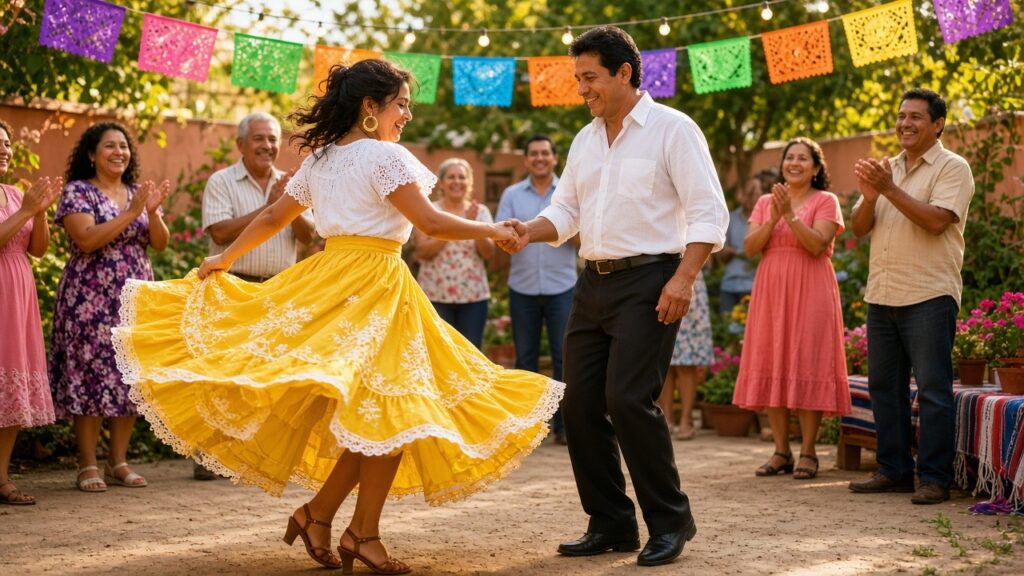
If you’ve been to a Latin wedding, quinceañera or family party, you’ve danced cumbia, or watched everyone else dance it. Cumbia is the song that gets grandparents, kids and shy cousins onto the floor, because the basic step is simple and the rhythm is steady and friendly. It’s one of the easiest Latin dances to learn, and one of the most fun.
To dance cumbia, step back with one foot on the first beat, rock your weight onto the front foot on the second, bring the back foot back to center on the third, and pause on the fourth, then repeat with the other foot. Keep your knees soft, your steps small and let your hips move naturally. With a partner, hold hands or a relaxed closed hold, do the back step facing each other, and add turns: the follower turns under the leader’s raised arm. Most beginners can dance a basic cumbia in one evening.
Below: what cumbia is and where it comes from, how to count it, the basic step, solo and partner cumbia, the main cumbia styles, cumbia in Zumba, songs to practice to, what to wear and answers to common questions. If you’re comparing Latin dances, also see salsa vs bachata vs merengue.
What is cumbia?
Cumbia is a music and dance tradition that began on the Caribbean coast of Colombia, blending Indigenous, African and Spanish roots. Traditional Colombian cumbia uses drums such as the tambor alegre and llamador, gaita flutes, maracas and the guacharaca, a scraped percussion instrument. In the traditional folk dance, women dance with small, gliding steps in long skirts, sometimes holding candles, while men dance around them.
From Colombia, cumbia spread across Latin America in the 20th century and became something different in every country:
- Mexican cumbia became huge, especially from the 1960s onward, and is one of the most danced styles at Mexican and Mexican-American parties. Groups like Los Ángeles Azules made it famous.
- Cumbia sonidera grew from the sonidero sound-system culture in Mexico City, Puebla and Mexican communities in the US, with DJs, shout-outs and lots of turns.
- Peruvian cumbia, including chicha, mixes cumbia with Andean melodies and electric guitars.
- Argentine cumbia villera emerged in the late 1990s with an urban, electronic sound.
- Tejano cumbia, popularized by Selena, mixes cumbia with Texas-Mexican music.
- Panama also has folk cumbia traditions danced with the pollera at festivals, alongside our national dance, the tamborito.
Cumbia is played and danced at family parties all over Latin America and in Latino communities in the US, including in Chicago.
How to count cumbia
Cumbia music is usually in 2/4 time with a steady, swinging beat: a strong “chuh-ka, chuh-ka” from the guacharaca or güiro and a bass on the downbeat. Dancers usually count in groups of four:
- 1: step back
- 2: rock forward (weight back to the front foot)
- 3: bring your feet together
- 4: pause
Some teachers count it “back, front, together, pause,” and others “1, 2, 3, hold.” Either way, it’s a three-step pattern with a pause, then repeated on the other side.
How to find the beat
- Listen for the scraper (guacharaca or güiro). It plays a constant “ch-ch-ch” pattern.
- Find the bass. It hits strongly on the downbeat.
- Clap or tap your foot on each strong beat.
- Count “1, 2, 3, 4” as you clap, then step on 1, 2 and 3 and rest on 4.
Cumbia is forgiving. If you’re a little off, nobody notices as long as you keep moving to the music.
The basic cumbia step (the back step)
Step by step
- Stand with your feet together, knees slightly bent.
- Count 1: step back with your right foot, just a small step, about a foot length.
- Count 2: shift your weight back onto your left foot, in place.
- Count 3: bring your right foot back next to your left.
- Count 4: pause.
- Count 5: step back with your left foot.
- Count 6: shift your weight onto your right foot.
- Count 7: bring your left foot back next to your right.
- Count 8: pause.
That’s it: back-rock-together on one side, then the other.
Making it look like cumbia
- Keep steps small. Big steps make you bounce and lose the beat.
- Bend your knees and let your hips move naturally as you shift weight.
- Step back at a slight angle (on a diagonal) rather than straight back; it feels smoother.
- Relax your upper body. Arms can swing naturally or bend at the elbows.
- Smile. Cumbia is a party dance.
Variations
- Side step: step to the side instead of back, with the same rhythm.
- Forward step: step forward instead of back.
- Circle: do the back step while slowly turning in a circle.
- Traveling step: move forward or sideways with each basic.
Solo cumbia
You don’t need a partner for cumbia. At parties, people often dance it in a group or circle, and it’s common in fitness classes.
Solo ideas:
- Basic back step with arms swinging.
- Side-to-side basic with hip movement.
- Turn in place: do the basic as you rotate a quarter turn every count of four.
- Add arm styling: one arm raised, a hand on your hip, or holding the hem of a skirt like traditional cumbia.
- Shoulder shimmy on the pause.
Practicing alone? See how to practice dance at home.
Cumbia with a partner (hold, turns)
The hold
- Open hold: partners face each other holding one or both hands, arms relaxed and slightly bent.
- Closed hold: the leader’s right hand is on the follower’s upper back, and the follower’s left hand rests on the leader’s shoulder. The other hands are joined.
Keep the connection relaxed. Cumbia is not a tense, tight dance.
The partner basic
The leader steps back with the left foot while the follower steps back with the right, so you mirror each other. Both rock forward and bring feet together, then switch sides.
Basic turns
- Follower’s right turn: the leader raises the joined hands (leader’s left, follower’s right) on count 1 and guides the follower to turn clockwise under the arm over counts 1 to 4. The follower keeps stepping in rhythm while turning.
- Leader’s turn: the leader turns under the joined hands.
- Side-by-side: partners open to face the same direction, holding hands, and do the basic side by side.
- Multiple turns: in cumbia sonidera, dancers do several fast turns in a row. Start with one.
Partner tips
- Leaders: signal turns early by raising your hand a beat before.
- Followers: keep stepping in rhythm during turns; small steps make turning easier.
- Both: keep your arms flexible, not stiff.
Cumbia styles compared
| Style | Where | Feel | Dance |
|---|---|---|---|
| Colombian folk cumbia | Colombia’s Caribbean coast | Drums and flutes, traditional | Gliding steps, long skirts, sometimes candles; performed in folk costume |
| Modern Colombian cumbia | Colombia and beyond | Big band or tropical orchestra | Social partner dance |
| Mexican cumbia | Mexico and US | Keyboards, accordion, steady beat | The back step with partner turns |
| Cumbia sonidera | Mexico City, Puebla, US Mexican communities | DJ-driven, often slower | Lots of turns and fancy arm work |
| Tejano cumbia | Texas | Mixed with Tejano and pop | Partner dance, often bouncy |
| Peruvian cumbia (chicha) | Peru | Electric guitars, Andean melodies | Lively social dancing |
| Cumbia villera | Argentina | Electronic, urban | Freestyle, party style |
If you learn the basic back step, you can dance to almost any of them.
Cumbia in Zumba
Cumbia is one of the core rhythms in Zumba, alongside salsa, merengue and reggaeton. Zumba cumbia songs usually use the basic back step, a “sleepy leg” (dragging the foot behind you) and marching steps. It’s often one of the easiest songs in a class. My Zumba for beginners guide breaks down the basic Zumba cumbia footwork, and types of Zumba classes explains the formats.
Songs to practice to
Start with medium-tempo songs, then try faster ones:
- “La Pollera Colorá” – a classic Colombian cumbia.
- “Cumbia Sampuesana” – a Colombian classic heard at many parties.
- “Cómo Te Voy a Olvidar” – Los Ángeles Azules, Mexican cumbia, medium tempo.
- “Baila Esta Cumbia” – Selena, upbeat Tejano cumbia.
- “Cumbia Sobre el Río” – Celso Piña, Mexican cumbia with accordion.
- “Cariñito” – Los Hijos del Sol, Peruvian cumbia.
Search for “cumbia playlist” on your music app for hours of practice music. Cumbia is usually easy to hear: listen for the scraper.
What to wear
- Shoes: something that turns easily. Smooth-soled shoes or low heels on a wooden floor; sneakers with smooth soles for a fitness class. Avoid very grippy rubber soles on turns.
- Clothes: comfortable clothes you can move in. A flowing skirt is fun for turns.
- For a party: whatever you’re wearing. Cumbia is a come-as-you-are dance.
For more on shoes and clothes for Latin dance, see what to wear salsa dancing.
Common beginner mistakes
- Steps too big. Keep them small and under your body.
- Stiff knees. Bend them slightly.
- Forgetting the pause. The pause on 4 gives cumbia its swing.
- Looking at your feet. Look up and listen to the music.
- Pulling your partner through turns. Lead gently.
Practice plan for your first week
| Day | Practice |
|---|---|
| 1 | Find the beat in three songs; clap and count |
| 2 | Basic back step, 10 minutes, slow songs |
| 3 | Basic with side and forward variations |
| 4 | Basic plus a turn in place |
| 5 | Partner basic and one follower turn, if you have a partner |
| 6 | Dance three full songs without stopping |
| 7 | Dance at a party or class |
FAQ
Is cumbia easy to dance?
Yes. Cumbia is one of the easiest Latin dances. The basic is a simple back-rock-together step, the tempo is usually moderate, and you can dance it alone or with a partner. Turns take a little practice.
Where is cumbia from?
Cumbia began on the Caribbean coast of Colombia, from a mix of Indigenous, African and Spanish traditions. It later spread across Latin America and developed distinct styles in Mexico, Peru, Argentina and elsewhere.
Is cumbia fast or slow?
It varies. Many cumbias are medium tempo, which makes them good for beginners. Some, like cumbia sonidera, can be slower, and some modern cumbias are fast.
How do I dance cumbia with a partner?
Face each other in an open or closed hold and do the back step mirrored: one partner starts with the left foot, the other with the right. Add a follower’s turn by raising the joined hands and guiding the follower under them.
What are good cumbia songs to practice to?
“La Pollera Colorá,” “Cumbia Sampuesana,” “Cómo Te Voy a Olvidar” by Los Ángeles Azules, “Baila Esta Cumbia” by Selena, “Cumbia Sobre el Río” by Celso Piña and “Cariñito” by Los Hijos del Sol are great starting points.
Is cumbia the same as salsa?
No. Cumbia has a simpler three-step back step with a pause and a steady 2/4 rhythm; salsa has a six-step pattern over eight counts and is usually faster. See cumbia vs salsa.