
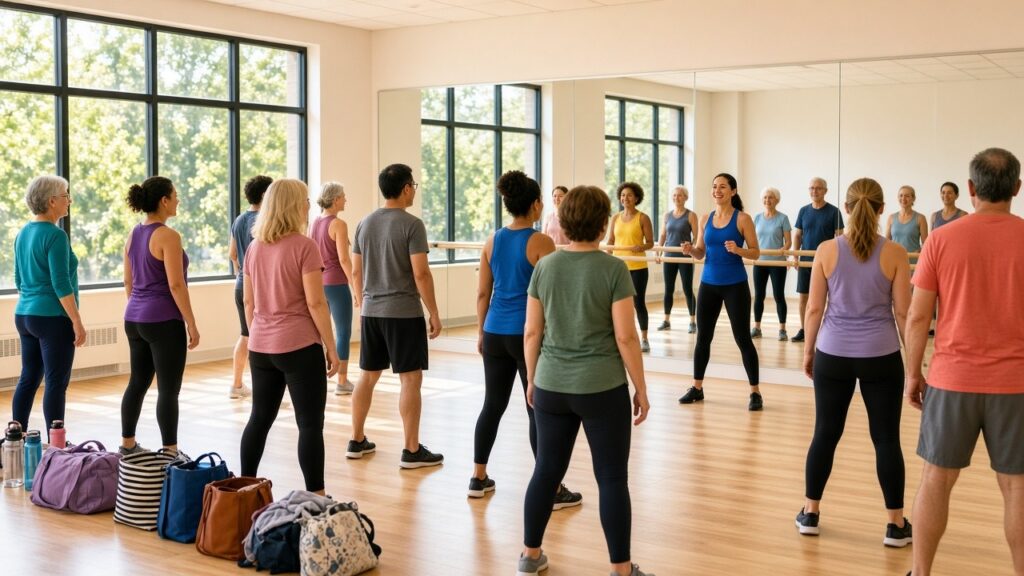
Your first adult dance class can feel like walking into someone else’s family dinner. Everyone seems to know where to stand, when to move to the side, what to do with their water bottle and whether it’s okay to talk to the teacher. Nobody hands you the rules, and most of them are never written on the studio wall. Here they are.
Good dance class etiquette for adult beginners comes down to respect for the teacher, the space and your classmates: arrive 10 to 15 minutes early, wear what the style requires, silence your phone, stand where you can see without blocking regulars, ask before filming, keep your belongings along the wall, rotate partners willingly, take hygiene seriously, give feedback only when asked, and say thank you. A simple, polite “no, thank you” is always acceptable for a partner dance.
I’ve taken almost every style of class as an adult, from Zumba and salsa to ballet and tap. These are the rules I wish someone had told me: before class, where to stand, during class, partner etiquette, style-specific rules, after class and drop-in tips.
Why dance class etiquette matters
Dance classes are shared spaces with mirrors, moving bodies and limited room. Etiquette keeps everyone safe, helps the teacher run the class smoothly and makes newcomers feel welcome. It also protects you: knowing the unwritten rules means one less thing to feel awkward about. If nerves are your biggest obstacle, read how to not feel awkward dancing too.
Before class
Arrive early
Aim for 10 to 15 minutes early, especially for your first class. You’ll have time to sign a waiver, pay, find the restroom, change shoes and introduce yourself to the teacher. Early arrival also lets you warm up; see my 10-minute dance warm-up.
What to wear
| Style | Typical attire | Shoes |
|---|---|---|
| Ballet | Fitted clothing, leotard and tights at many studios; hair in a bun | Ballet slippers |
| Tap | Comfortable clothes that let teachers see your legs | Tap shoes |
| Jazz | Fitted, flexible clothing | Jazz shoes or as instructed |
| Hip-hop | Loose, comfortable streetwear | Clean sneakers |
| Salsa and bachata | Comfortable clothes you can turn in | Dance shoes or smooth-soled shoes |
| Zumba | Breathable workout clothes | Cross-trainers or dance sneakers |
| Belly dance | Fitted top, flowy pants or skirt, hip scarf optional | Barefoot or dance sneakers |
Check the studio’s website for dress codes. For details by style, see what to wear to Zumba and what to wear salsa dancing.
Phones
Silence your phone and put it with your bag. If you’re on call for work or family, tell the teacher and keep it on vibrate near the door.
Introduce yourself
Tell the teacher it’s your first class and mention any injuries or limitations. Teachers want to know so they can suggest modifications.
Street shoes
Many studios don’t allow outdoor shoes on the dance floor, because grit damages sprung floors. Change shoes at the door or in the lobby.
Where to stand
As a beginner, aim for the middle of the room, second or third row. From there you can see the teacher and also follow experienced students in front of you.
- Don’t take the front-center spot in a regular class without asking; regulars often have their “spot.”
- Stagger yourself so you can see the mirror between the people in front of you.
- Leave room for arms and legs. If you can touch someone with an outstretched arm, move.
- Back row is fine in a style like Zumba, but you’ll need to see the instructor; mirrors help.
- In ballet, lines often rotate during exercises, so you won’t stay in the back forever.
During class
Questions
It’s okay to ask questions, usually at natural pauses: between exercises, after a combination is taught or when the teacher asks. Keep questions brief. If yours is personal or complicated, save it for after class.
Filming
Always ask before filming. Many teachers allow a short recording of the final combination at the end of class to help you practice; some don’t allow filming at all to protect their choreography or students’ privacy. Never film other students without permission.
Mirror space
Don’t stand directly in front of someone, blocking their view of the mirror. If you move during a combination, return to a spot where you’re not blocking anyone.
Going across the floor
In classes like ballet, jazz and tap, students cross the room in small groups. Etiquette:
- Wait your turn in the corner, usually in groups of two to four.
- Go when the group in front reaches the middle, or as the teacher instructs.
- Exit to the side at the end and walk back along the wall, not through the middle.
- Don’t stop in the middle if you lose the steps; keep moving or walk off.
Talking
Keep chatting to a minimum while the teacher is talking or demonstrating. A friendly word with a neighbor between exercises is fine.
Water and breaks
Drink between songs or exercises. If you need a break, step to the side or back of the room. In partner classes, tell your partner and step out of the rotation.
Partner-class etiquette
Rotating
Most partner classes rotate every few minutes. Rotate willingly, even if you’d rather stay with a friend; rotating makes everyone a better dancer. Thank each partner as you move on.
Hygiene
- Shower and use deodorant before class.
- Bring mints or gum, and skip garlic-heavy meals right before class.
- Bring a spare shirt and a small towel if you sweat a lot.
- Keep nails trimmed and avoid sharp jewelry.
- Go easy on perfume; close-contact dances amplify it. See perfume for the gym and dance class.
Feedback
Don’t teach your partner unless they ask for help, even if you think you know the step. If a move isn’t working, ask the teacher. Phrases like “Shall we ask the teacher?” or “I think I’m missing something” keep it friendly.
Consent and comfort
- Keep holds appropriate and gentle.
- Respect a partner who wants more space.
- Don’t lead dips, lifts or tricks you weren’t taught in class.
- Speak up or tell the teacher if someone makes you uncomfortable.
How to say no to a partner politely
At socials, “No, thank you” is enough. You don’t need to explain, though “I’m taking a break” or “Maybe later” softens it. In class, if you have a real reason not to dance with someone (they’ve been inappropriate, for example), tell the teacher privately.
Style-specific rules
| Style | Unwritten rules |
|---|---|
| Ballet | Hair in a bun; no talking at the barre; follow barre order; stay in line formations; curtsy or applaud the teacher and pianist at the end (common in many studios) |
| Tap | Don’t tap while the teacher is talking; keep shoes on only in the studio; keep taps tight |
| Jazz and contemporary | Watch your space during floor work and turns; bring knee pads if the class uses floor work |
| Hip-hop | Respect the teacher’s choreography; cyphers at the end are for encouraging, not competing |
| Zumba | Follow even if you’re off; don’t stand directly in front of the instructor if it blocks the mirror for others |
| Salsa and bachata | Rotate partners, mind your arms during turns, don’t teach your partner |
| Belly dance | Hip scarves with coins are fun but check if they’re allowed during instruction |
If you’re curious about trying ballet as an adult, see can adults start ballet; for tap, teach yourself tap dance; for a fun start, Zumba for beginners.
After class
- Thank the teacher. A simple “thank you” goes a long way.
- Clear your space. Take bottles, towels and props with you.
- Return props like toning sticks, mats or chairs to where they belong.
- Ask your questions briefly, if the teacher has time before the next class.
- Don’t linger on the floor if another class is starting; move to the lobby.
Dance studio etiquette for drop-ins
- Check the level. Drop into a beginner or “open level” class, not an advanced one.
- Read the studio’s policies on booking, cancellations, waivers and dress code.
- Arrive extra early to fill out paperwork.
- Don’t compare studios out loud. “At my other studio we do it this way” isn’t welcome.
- Respect the teacher’s style. Each teacher has their own way of counting and cueing.
- Book ahead if the studio requires it; popular classes fill.
For Chicago options, see adult dance classes in Chicago.
Online and livestream class etiquette
- Mute your microphone unless the teacher asks you to speak.
- Turn your camera on if you want feedback, and frame your whole body.
- Keep your space safe: clear furniture and pets.
- Don’t record or share the class unless the teacher allows it.
Etiquette mistakes beginners make (and how to fix them)
| Mistake | Fix |
|---|---|
| Arriving right at the start time | Arrive 10 to 15 minutes early |
| Standing in front of a regular’s spot | Ask, or choose the second row |
| Apologizing every time you miss a step | Smile and keep going; everyone misses steps |
| Filming without asking | Ask the teacher first |
| Teaching your partner | Ask the teacher instead |
| Leaving bags in the dance space | Keep them along the wall or in cubbies |
| Leaving without saying thank you | A quick thank-you to the teacher and partners |
FAQ
Is it rude to arrive late to dance class?
It’s best to arrive on time or early, because warm-ups prevent injuries and late arrivals can disrupt the class. If you’re late, enter quietly, join at the back or side, and warm up gently before joining full-out. Some studios don’t allow late entry after a certain point, especially in ballet.
Can I film the class?
Ask the teacher first. Many allow filming the final combination for practice; some don’t allow filming at all. Never film other students without permission, and don’t post class videos publicly without the teacher’s approval.
Where should I stand as a beginner?
Aim for the middle of the room, in the second or third row, so you can see the teacher and follow experienced students. Avoid blocking others’ view of the mirror.
Is it OK to ask the teacher questions?
Yes. Ask during natural pauses or when the teacher invites questions, and keep them brief. Save longer or personal questions for after class.
How do I say no to a partner politely?
At a social, “No, thank you” is enough; you can add “I’m taking a break” if you like. In class, partners usually rotate, but if you’re uncomfortable with someone, tell the teacher privately.
What should I do if I get lost in class?
Keep moving to the beat, even if it’s just marching or a basic step, and rejoin when the combination repeats. Stopping in the middle of the floor can cause collisions. Ask the teacher about the part you missed at the next pause or after class.
Can I bring a friend to my first class?
Yes, and it’s a great way to feel more comfortable. In partner classes, be ready to rotate away from your friend; it’s part of how everyone learns.