
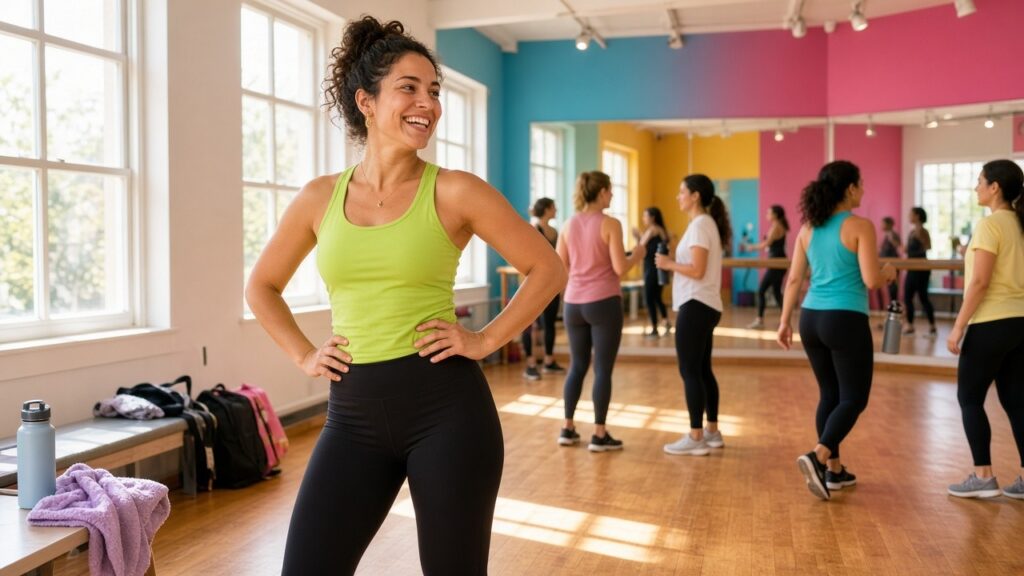
Some dance classes start with a thorough warm-up. Others launch straight into the first song or combination, and you’re expected to arrive ready. Either way, a few minutes of preparation before class help your body move more comfortably and get your head into the room.
A good dance warm-up for beginners takes about 10 minutes and moves from gentle to dynamic: start with light movement to raise your heart rate (marching, stepping side to side), then mobilize your joints (neck, shoulders, spine, hips, knees, ankles), add dynamic stretches like leg swings and lunges with a twist, and finish with a few rehearsal moves from the style you’re about to dance. Save long static stretches for after class.
This is the 10-minute routine I use before Zumba, salsa or ballet. Below: what a warm-up should include, the step-by-step routine, style tweaks, warm-up songs, what not to do, how long to warm up and what to do if class has no warm-up.
Why warm up at all?
Dance asks your body to change direction quickly, balance on one foot, turn, jump and reach. Going from a car, a desk or a cold street straight into that can feel stiff and clumsy. Dance teachers recommend warming up to raise your body temperature gradually, move your joints through their range, and practice coordination before the music speeds up. A warm-up is also a mental transition: you leave the workday at the door and start paying attention to your body and the music.
Signs you’re warmed up
- You feel warmer and may be lightly sweating
- Your breathing is a little faster but you can still talk easily
- Joints feel looser; turning your head and hips feels smooth
- Your balance feels steadier on one foot
- Your mind has switched from your to-do list to the room
What a dance warm-up should include
| Phase | Purpose | Examples |
|---|---|---|
| Pulse raiser | Gradually raises your heart rate and body temperature | Marching, step-touches, gentle bouncing |
| Joint mobility | Moves each joint through a comfortable range | Neck tilts, shoulder rolls, hip circles, ankle circles |
| Dynamic stretches | Moving stretches for the muscles you’ll use | Leg swings, lunges with a twist, arm swings |
| Activation | Wakes up core and supporting muscles | Pliés, calf raises, light core work |
| Rehearsal | Practices the movement patterns of the class | A basic step, a few turns, a short combination |
Warm-ups aren’t about being tired before class starts. You should feel warmer, looser and a little more awake, not exhausted.
A 10-minute warm-up for beginners (step by step)
Do these to music with a moderate beat. Move gently and stop if anything hurts.
Minutes 0 to 2: get moving
- March in place for 30 seconds, swinging your arms naturally.
- Step-touch side to side for 30 seconds, adding arm reaches.
- Gentle knee lifts for 30 seconds.
- Light bounces or heel lifts for 30 seconds. Skip jumping if you prefer low impact.
Minutes 2 to 5: mobilize your joints
- Neck: slowly tilt your ear toward each shoulder, then look left and right. Avoid full head circles if they feel uncomfortable. 30 seconds.
- Shoulders: roll forward 5 times and back 5 times, then shrug and release. 30 seconds.
- Spine: with hands on your hips, gently roll your rib cage in a circle, then do slow cat-cow movements standing. 30 seconds.
- Hips: big, slow hip circles in each direction. 30 seconds.
- Knees: with feet together and hands above your knees, make small circles. 30 seconds.
- Ankles: circle each ankle and point and flex your feet. 30 seconds.
Minutes 5 to 8: dynamic stretches
- Leg swings: hold a wall or barre, swing one leg forward and back 8 times, then side to side 8 times. Switch legs. 1 minute.
- Lunge with a twist: step into a comfortable lunge and rotate your torso toward the front leg. Alternate for 8 reps. 1 minute.
- Arm swings and reaches: big arm circles, then cross-body swings, then reaching overhead side to side. 1 minute.
Minutes 8 to 10: activate and rehearse
- Pliés or squats: 8 slow, controlled bends with feet turned slightly out.
- Calf raises: 8 to 10 slow raises, great for tap, ballet and Zumba.
- Rehearse your style: 1 minute of the basic step you’re about to use, like a salsa basic, a merengue march or a ballet tendu.
You’re ready.
Style tweaks
| Style | Add or emphasize | Why |
|---|---|---|
| Zumba | Extra pulse raiser, hip circles, a merengue march and cumbia step | Class starts fast and uses lots of hip and leg movement |
| Salsa and bachata | Ankle mobility, rib and hip isolations, slow spins with spotting | Turns and weight changes |
| Ballet | Pliés, tendus, ankle work, gentle back mobility | Turnout, pointing and balance |
| Hip-hop | Bounces, grooves, shoulder and chest isolations | Rhythm and upper-body movement |
| Tap | Ankle circles, calf raises, shuffles in place | Ankle and foot work |
| Belly dance | Hip circles, figure eights, shoulder shimmies | Isolations |
| Jazz | Leg swings, pliés, spine rolls | Kicks, turns and floor work |
For Zumba specifics, see Zumba for beginners; for turns, how to spin in salsa; and if you’re starting ballet, can adults start ballet.
Warm-up songs
Choose songs with a steady, moderate tempo, roughly 100 to 125 beats per minute, that feel upbeat but not frantic. Some ideas by style:
- Zumba or Latin classes: a relaxed merengue, cumbia or Latin pop song.
- Salsa and bachata: a mid-tempo bachata or a slower salsa track.
- Ballet: soft piano or classical pieces with a clear pulse.
- Hip-hop: a mid-tempo groove you can bounce to.
- Tap: swing or jazz standards.
Build a 10-minute playlist of three songs: one gentle, one moderate, one a little more energetic.
What not to do
- Don’t do long static stretches cold. Holding deep stretches before your muscles are warm may feel uncomfortable and isn’t the best preparation for dynamic movement. Save static stretching for after class.
- Don’t bounce into stretches. Ballistic bouncing can strain muscles.
- Don’t force flexibility. Splits and deep backbends aren’t warm-ups.
- Don’t skip it because class “has a warm-up.” Some do, some don’t, and a few minutes on your own help either way.
- Don’t wear yourself out. A warm-up should prepare, not exhaust.
- Don’t push through sharp pain. Stop and tell the teacher.
How long to warm up
For most beginner classes, 5 to 10 minutes is plenty. Extend it to 10 to 15 minutes if:
- It’s a cold day or a cold studio (hello, Chicago winters)
- You’ve been sitting all day
- The class is high-intensity or involves jumps, leaps or deep stretches
- You’re preparing for a performance; see how to prepare for a dance performance
What if the class has no warm-up?
Many Zumba classes start with a warm-up song, salsa classes may jump straight into the basic, and some drop-in classes assume you’ll warm up yourself. If yours doesn’t include one:
- Arrive 10 minutes early and do the routine above in a corner.
- If space is tight, do a compact version: marching, joint circles, calf raises and a few slow basics.
- Start the first song or exercise at half intensity and build up.
Warming up in special situations
On a cold day
Cold muscles take longer to feel loose. Wear a layer like a sweatshirt or leg warmers for the first part of the warm-up, extend the pulse raiser to 3 or 4 minutes and peel off layers as you heat up.
After a long day at a desk
Sitting tightens the hips and rounds the shoulders. Add extra hip circles, gentle lunges and chest-opening arm swings, and stand tall through a few slow basic steps before class begins.
Early morning classes
You may feel stiffer first thing in the morning. Give yourself the full 10 minutes, start slowly and drink water before you begin.
Before a salsa or bachata social
You won’t have a formal warm-up at a social. Before your first dance, do a minute of ankle circles, hip circles and a slow basic at the edge of the floor, then start with a slower song if you can. For more, see what is a salsa social.
Cool-down after class
A cool-down helps you transition out of class. Spend 3 to 5 minutes:
- Walking slowly or gently stepping side to side
- Taking a few deep breaths
- Holding gentle static stretches for calves, hamstrings, quadriceps, hips, chest and shoulders for about 20 to 30 seconds each
Warm-up mistakes beginners make
| Mistake | Better approach |
|---|---|
| Static stretching first | Move first, stretch after class |
| Rushing through joint circles | Slow, controlled movement |
| Skipping the warm-up when late | Do a 2-minute version at the side |
| Only warming up legs | Include neck, shoulders and spine |
| Copying advanced dancers’ stretches | Stay in a comfortable range |
Warm-up checklist to save
- Pulse raiser: 2 minutes
- Neck, shoulders, spine, hips, knees, ankles: 3 minutes
- Leg swings, lunges with a twist, arm swings: 3 minutes
- Pliés and calf raises: 1 minute
- Your style’s basic step: 1 minute
Screenshot it and keep it on your phone for the studio lobby.
A pocket version (3 minutes)
When you’re short on time:
- 30 seconds marching
- 30 seconds shoulder and hip circles
- 30 seconds ankle circles and calf raises
- 30 seconds leg swings
- 1 minute of your style’s basic step
FAQ
How long should I warm up before dance class?
About 5 to 10 minutes for most beginner classes, or 10 to 15 minutes if it’s cold, you’ve been sitting all day or the class is high intensity.
Should I stretch before dancing?
Do dynamic stretches, like leg swings and lunges with a twist, before class. Save long static stretches for after class when your muscles are warm.
What songs are good for a warm-up?
Songs with a steady, moderate tempo of about 100 to 125 beats per minute. Choose music related to your class style, like a relaxed merengue for Zumba or soft piano for ballet.
Is a warm-up different for Zumba and ballet?
Yes. Both start with a pulse raiser and joint mobility, but Zumba needs more cardio and hip movement, while ballet focuses on pliés, ankle work, turnout and balance.
What if the class has no warm-up?
Arrive 10 minutes early and do the routine yourself, or a compact version if space is tight. Start the first part of class at half intensity and build up gradually.
Can I use the first Zumba song as my warm-up?
Most Zumba classes start with one or two warm-up songs, and for many people that’s enough. If you arrive cold, stiff or straight from a long commute, a few minutes of joint circles and marching beforehand make the first songs feel easier.
Should I warm up before practicing at home?
Yes. Even a 3-minute version of the routine helps before home practice, especially before turns, jumps or tap.
Do I need equipment to warm up?
No. A wall or a chair for balance during leg swings is helpful, but everything else uses only your body and a little floor space.