
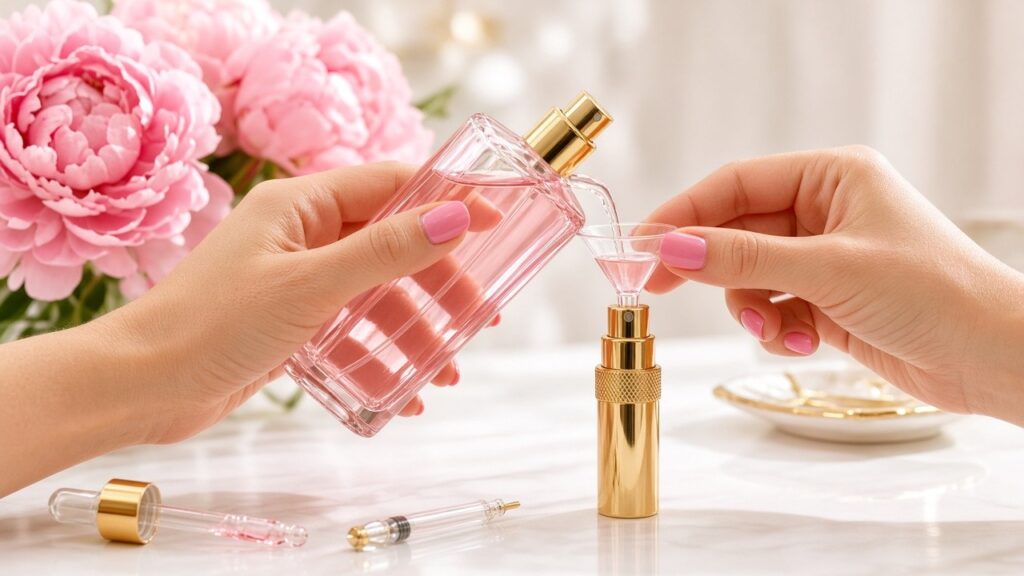
A full bottle of perfume is heavy, fragile and usually bigger than the carry-on liquids rule allows. A decant solves all of that: a few milliliters of your favorite scent in a small atomizer that fits in a gym bag, a clutch or a quart-size travel bag. Decanting is easy once you know which method suits your bottle.
To decant perfume, transfer a small amount from the original bottle into a clean travel atomizer. If your atomizer has a bottom-fill valve, press it repeatedly onto the original bottle’s sprayer nozzle (removed cap, nozzle left on) to pump perfume in. If the sprayer comes off, use a syringe or pipette to draw perfume out of the bottle. Without either, spray into a small funnel set in the atomizer. Label the decant, keep it out of heat and light, and use it within a few months.
I decant my own perfumes for the gym bag, dance class and trips. Here’s everything you need, the three methods, what to do when the nozzle won’t come off, which bottles to use, and how to fly with decants.
What is decanting?
Decanting means moving perfume from its original bottle into a smaller container. People decant to:
- Carry a scent in a purse or gym bag without risking the full bottle
- Travel within carry-on liquids limits
- Share a bit of a fragrance with a friend
- Rotate several scents on a trip without packing several bottles
Professional decant sellers do the same thing at scale, often with sterile tools. At home, all you need is clean equipment and a steady hand.
What you need
| Tool | What it does | Notes |
|---|---|---|
| Refillable travel atomizer | Holds the decant | 5 ml to 10 ml is a good size; choose one with a fine mist sprayer |
| Bottom-fill (pump-fill) atomizer | Refills directly from a spray nozzle | Fastest, least messy method |
| Small funnel | Guides perfume into the atomizer opening | Look for mini perfume funnels; glass or metal is easiest to clean |
| Syringe (no needle needed) or pipette | Draws perfume from an open bottle | Plastic disposable pipettes are inexpensive; use a fresh one for each scent |
| Sticky labels and a fine marker | Name and date the decant | Essential if you decant several scents |
| Paper towel or tray | Catches spills | Perfume can mark varnished wood and some plastics |
Wash reusable tools with warm soapy water, rinse, then rinse with a little rubbing alcohol and let them dry completely so a previous scent doesn’t linger.
Method 1: spray-to-spray refill (bottom-fill atomizers)
Many travel atomizers have a small valve on the bottom. This works with nearly any spray bottle and doesn’t require removing anything.
- Remove the cap from your perfume bottle so the sprayer nozzle (the actuator) is exposed. Some refills need the actuator pulled off to reveal the bare stem; try both.
- Turn the atomizer upside down and place its bottom valve over the bottle’s nozzle or stem.
- Press down firmly in short pumps. Each pump pushes perfume into the atomizer.
- Check the fill window if it has one. Stop below the top so the pump has room.
- Wipe both bottles and spray the atomizer once to prime it.
Pros: clean, fast, almost no waste. Cons: only works with bottom-fill atomizers, and some bottle nozzles are the wrong size.
Method 2: syringe or pipette
Use this when the sprayer can be removed or the bottle has a screw-off top.
- Remove the sprayer (if it unscrews) or open the bottle.
- Draw perfume with a clean syringe or pipette.
- Insert the tip into the atomizer’s opening and release slowly.
- Repeat until filled, leaving a little headspace.
- Close the original bottle tightly and wipe both.
Pros: precise, easy to measure milliliters, works with dab vials. Cons: only possible with removable sprayers; requires a clean syringe or pipette for each fragrance.
Method 3: without a syringe
You can decant without special tools.
Spray through a funnel
- Place a small funnel in the atomizer’s opening.
- Hold the original bottle’s nozzle right against the funnel and spray in slow, short bursts.
- Expect some loss to mist in the air; work in a well-ventilated space.
Spray into the cap, then pour
- Spray several times into a small clean glass or the original cap.
- Pour carefully through a funnel into the atomizer.
These methods waste more perfume and can make the room smell strongly, but they work with any bottle and no special equipment. A rolled cone of clean paper can stand in for a funnel in a pinch.
What if the nozzle won’t come off?
Most designer bottles have crimped sprayers, meaning the pump is permanently sealed to the glass. The actuator (the little button you press) usually lifts off with gentle pressure, but the pump underneath doesn’t. Don’t pry the crimp: you can break the seal, crack the neck or ruin the bottle.
Your options with a crimped bottle:
- Use a bottom-fill atomizer. Pull off the actuator button gently and press the atomizer onto the bare stem.
- Spray through a funnel. Slower, but safe.
- Buy a ready-made travel spray from the brand or a decant seller if you use the scent often.
Glass vs plastic decant bottles
| Glass atomizer | Plastic atomizer | |
|---|---|---|
| Scent stability | Doesn’t react with perfume; best for longer storage | Some plastics can absorb scent or interact with alcohol over time |
| Durability | Can break; many come in metal or silicone sleeves | Very hard to break; good for gym bags |
| Reuse | Easy to clean | May hold onto a previous scent |
| Cost | Higher | Lower |
| Best for | Long trips, favorite scents | Short trips, gym bag, testing |
My choice: glass inside a metal sleeve for perfume I’ll keep for weeks, and inexpensive plastic for a weekend.
Labeling and storing decants
- Label every decant with the fragrance name and the date you filled it.
- Fill most of the way. Less air in the bottle means less oxidation.
- Store like perfume: cool, dark and stable. Don’t leave decants in a hot car or on a sunny windowsill. For more, see storing perfume and knowing when it has changed.
- Keep it upright and closed. Small atomizers can leak in heat or pressure changes.
Flying with decants
US airport rules allow liquids in carry-on bags only in containers of 3.4 ounces (100 milliliters) or less, all fitting in one quart-size clear bag. A 5 ml or 10 ml atomizer easily qualifies. In checked bags, perfume is allowed as a toiletry, with total and per-container limits. Rules change and differ by country, so check the TSA website (or your departure country’s rules) before you fly.
Travel tips:
- Put decants in a zip-top bag in case the change in cabin pressure makes them leak.
- Wrap glass atomizers in a sock or a soft pouch.
- Twist-up atomizers seal better than snap caps.
- Perfume is flammable; never pack large quantities beyond the published limits.
If you travel with little ones, travel coloring books for kids are my favorite small, quiet packing win, too.
Buying decants
You don’t have to make your own. Decant shops sell small amounts of niche and designer perfume for testing. Things to know:
- Price per milliliter is higher than a full bottle but far lower than buying a scent you end up not liking.
- Choose established sellers with clear descriptions, return or problem policies and reviews.
- Decants aren’t official brand products. Brands don’t guarantee repackaged perfume, so quality depends on the seller.
- Discovery sets from the brands themselves are an alternative for trying several scents.
For choosing a fragrance in the first place, see how to choose a perfume and how to pick perfume without smelling it.
How much to decant
Not sure what size atomizer you need? A typical fine-mist sprayer releases roughly 0.1 milliliter per spray, though this varies by sprayer. Use this as a rough guide:
| Decant size | Approx. sprays | If you wear 3 to 4 sprays a day | Good for |
|---|---|---|---|
| 2 ml | About 20 | About 5 to 7 wears | Testing a scent, a weekend |
| 5 ml | About 50 | About 2 weeks | A one- to two-week trip, the gym bag |
| 10 ml | About 100 | About a month | A long trip or daily purse spray |
| 15 to 30 ml | 150 to 300 | Several months | A favorite you carry everywhere |
For a gym or dance bag, 5 ml is plenty for a quick refresh after class. For a long trip, 10 ml of a daily scent plus a 2 ml of something for evenings covers most plans.
Troubleshooting decants
- The atomizer won’t spray: it may need priming. Pump it several times. If it still doesn’t spray, the dip tube may not reach the liquid, so fill a little higher.
- The bottom-fill valve won’t accept perfume: the nozzle on your bottle may be too wide or too short. Gently remove the actuator button to expose the bare stem and try again, or switch to the funnel method.
- It leaks in the bag: tighten the twist mechanism, keep it upright and carry it in a zip-top bag. Very cheap atomizers often leak; a better-quality one is worth it.
- The decant smells different from the bottle: the atomizer may hold a previous scent, or the plastic may be reacting. Clean it with alcohol, let it dry fully, or switch to glass.
- Perfume on the bottle label or furniture: wipe immediately. Alcohol-based perfume can lift printing and damage finishes.
Safety basics
Perfume is mostly alcohol, so it’s flammable. Decant away from candles, the stove and heat sources, and keep decants out of children’s reach; small atomizers can look like toys. Store tools and pipettes away from food, and never reuse a perfume syringe or pipette for anything you’ll eat or drink.
Which method wastes the least?
| Method | Waste | Mess | Speed |
|---|---|---|---|
| Bottom-fill atomizer | Very little | Very low | Fast |
| Syringe or pipette | Very little | Low | Medium |
| Spray through a funnel | Some lost as mist | Medium | Slow |
| Spray into a cap and pour | More | Higher | Slow |
FAQ
Can I take a perfume decant on a plane?
Yes. In US carry-on bags, decants must be 3.4 ounces (100 ml) or less and fit in your quart-size liquids bag, which small atomizers easily do. Check TSA or your local airport authority’s current rules before flying, especially for international trips.
How do I decant perfume without a syringe?
Use a bottom-fill atomizer pressed onto the bottle’s nozzle, or set a small funnel in the atomizer opening and spray slowly into it. You can also spray into a clean cap and pour through a funnel, though you’ll lose a little to mist.
Which method wastes the least perfume?
A bottom-fill atomizer or a syringe wastes almost nothing. Spraying through a funnel or into a cap loses some perfume to the air.
Does decanting change how the perfume smells?
It shouldn’t if the tools are clean and the container is glass or good-quality material. Leftover scent in a reused atomizer, heat or a half-empty bottle exposed to air can change it over time.
How long does decanted perfume last?
Kept cool, dark and well sealed, most decants stay pleasant for several months, often longer. Small, partly filled atomizers have more air relative to perfume, so use them within a few months for the best result.