
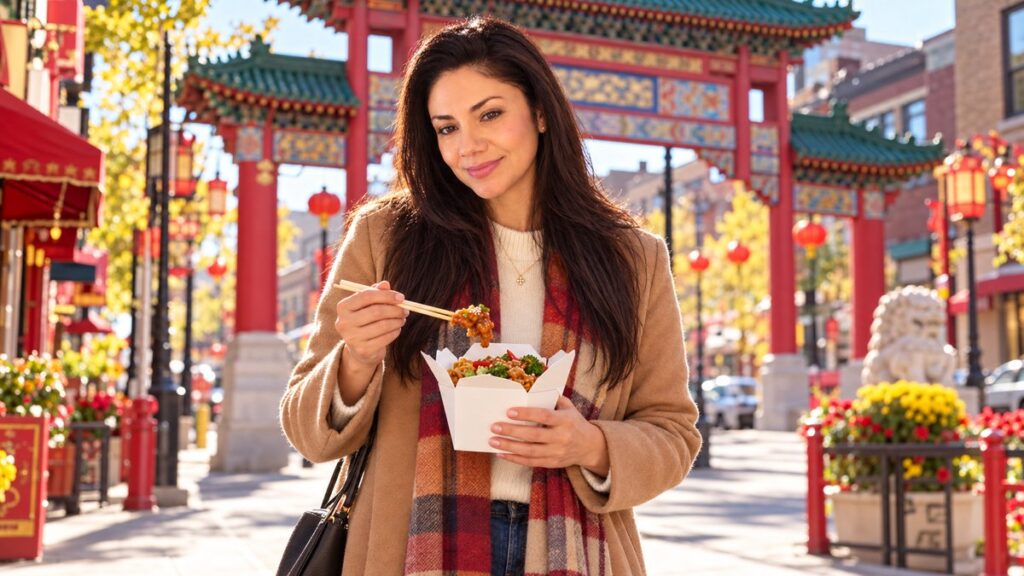
I came to Chicago with a Panamanian palate, and this city taught me the world. In one week you can eat carnitas in Pilsen, dumplings in Chinatown, saganaki in Greektown, nihari on Devon, pho on Argyle and doro wat on Broadway, almost all of it by CTA. This is my map of Chicago’s food neighborhoods: where each one is, how to get there, which places to start with, what to order, when they’re closed, and what I carry home to cook.
Chicago’s best food neighborhoods are Pilsen and Little Village (Mexican), Chinatown (Chinese), Devon Avenue (Indian and Pakistani), Argyle Street (Vietnamese), Greektown (Greek), Little Italy (Italian beef), Broadway in Uptown and Edgewater (Ethiopian), Paseo Boricua (Puerto Rican) and Albany Park (Middle Eastern).
Every restaurant named below was checked as open in fall 2026 on its own website, its listing, or recent local coverage. Hours change, so check before a long trip, especially on the day each place closes (I list those).
Chicago food neighborhoods at a glance
| Neighborhood | Cuisine | Main strip | Getting there | Start with | Order this |
|---|---|---|---|---|---|
| Pilsen | Mexican | W. 18th St. (Ashland to Damen) | Pink Line, 18th | Carnitas Uruapan | Carnitas by the pound |
| Little Village | Mexican | W. 26th St. | Pink Line to Kedzie or California, or #60 bus | Taqueria Los Comales | Steak or al pastor tacos |
| Chinatown | Chinese | Wentworth Ave. and Archer Ave. | Red Line, Cermak-Chinatown | MingHin Cuisine | Dim sum |
| Devon Avenue | Indian, Pakistani | W. Devon (Western to California) | Red Line to Loyola, then #155 bus | Sabri Nihari | Nihari and naan |
| Argyle Street | Vietnamese, Chinese-Vietnamese | W. Argyle St. and N. Broadway | Red Line, Argyle | Hai Yen | Pho or bún |
| Greektown | Greek | S. Halsted St. | Blue Line, UIC-Halsted | Greek Islands | Saganaki, lamb |
| Little Italy | Italian-American | W. Taylor St. | Blue Line, Racine (10-min walk), or #157 bus | Al’s #1 Italian Beef | Italian beef, dipped |
| Uptown / Edgewater | Ethiopian | N. Broadway | Red Line, Lawrence to Thorndale | Demera | Messob platter with injera |
| Paseo Boricua (Humboldt Park) | Puerto Rican | W. Division St. | #70 Division bus | Papa’s Cache Sabroso | Jibarito |
| Albany Park | Persian, Middle Eastern | N. Kedzie Ave. (Wilson to Lawrence) | Brown Line, Kedzie | Noon O Kabab | Kebab plates |
| West Loop | Chef-driven, everything | W. Randolph St. | Green or Pink Line, Morgan | Girl & the Goat | Shared plates |
Pilsen: Mexican Chicago on 18th Street
Pilsen was settled by Czech and other Eastern European immigrants in the late 1800s, which is where the name comes from, and became the heart of Mexican Chicago in the second half of the 1900s. Walk 18th Street west from the Pink Line’s 18th stop and you pass murals, bakeries, taquerías and the free National Museum of Mexican Art in Harrison Park.
- Carnitas Uruapan (1725 W. 18th St.) has sold carnitas on 18th Street since 1975. The Pilsen counter is takeout, by the pound, with tortillas and salsa, and it’s a lunch place: it opens early and closes in the afternoon (4 p.m. weekdays, 5 p.m. weekends in fall 2026). Weekend lines start before opening.
- 5 Rabanitos (1758 W. 18th St.) is the sit-down option, with chef Alfonso Sotelo’s regional dishes: pozole, enchiladas in mole and tortas ahogadas, plus weekend brunch.
Side streets are residential permit parking and 18th Street is metered, so the train is easier. My full Pilsen food guide covers bakeries, markets and what to buy for your own kitchen.
Little Village: 26th Street
Little Village’s 26th Street starts at the big welcome arch at 26th and Albany and runs west for about two miles of Mexican businesses. It’s one of the busiest shopping streets in the city. Take the Pink Line to Kedzie or California and walk south about half a mile, or ride the #60 bus along 26th.
- Taqueria Los Comales (3141 W. 26th St.) has made tacos in Little Village since 1973. Order at the counter; steak and al pastor are the draw.
Come hungry and walk: fruit carts, elote vendors and paleterías fill the gaps between restaurants in warm months.
Chinatown: dim sum, dumplings and bakeries
The Red Line’s Cermak-Chinatown stop drops you at the north end of Wentworth Avenue, the old main street. Chinatown Square, the two-level plaza on Archer, is the newer half and has its own parking lot. In warm months the Chicago Water Taxi runs from downtown to Ping Tom Park; it doesn’t run in winter.
- MingHin Cuisine (2168 S. Archer Ave.) in Chinatown Square serves dim sum all day, from 9 a.m. weekdays and 8 a.m. weekends, and stays open until midnight. Weekday mornings mean no wait; weekend brunch means a line.
- Qing Xiang Yuan Dumplings (2002 S. Wentworth Ave., Suite 103), known as QXY, is the place for northern-style boiled dumplings with dozens of fillings.
- Chiu Quon Bakery (2253 S. Wentworth Ave.) is a long-running Chinese bakery for egg tarts, pineapple buns and baked char siu bao, open from 7 a.m.
While you’re there, the grocery stores on Wentworth and in the square are where I buy dumpling wrappers, fresh ginger, Chinese chives and sesame oil. My Chinatown dumplings guide explains which dumpling is which and how to fold your own.
Devon Avenue: Little India and Pakistani Chicago
Devon Avenue between Western and California, in West Ridge on the Far North Side, has been Chicago’s South Asian main street since Indian merchants opened shops here in the 1970s. Today it’s Indian, Pakistani, Bangladeshi, Nepalese and Afghan restaurants, sari and jewelry shops and spice markets.
Devon has no “L” stop. Take the Red Line to Loyola and the #155 Devon bus west. Most of the Pakistani restaurants are halal, and most of Devon serves no alcohol.
- Sabri Nihari (2500 W. Devon Ave.) is named for its slow-cooked beef nihari, and it’s the reason to come. Add naan and a grilled kebab.
- Khan BBQ (2401 W. Devon Ave.) is a casual Pakistani grill for chicken boti and seekh kebab.
- Udupi Palace (2543 W. Devon Ave.) is all-vegetarian South Indian: dosas, idli and uttapam. Order the masala dosa if it’s your first.
- Sukhadia’s (2559 W. Devon Ave.) is a sweets and snacks shop (closed Tuesdays). Point at the case and buy a mixed box.
- Patel Brothers (2610 W. Devon Ave.) is the big Indian grocery. This is where I buy cumin, coriander seed and cinnamon in bulk for a fraction of supermarket prices.
My Devon Avenue first-timer’s guide has more restaurants, the sweets to try and a walking order.
Argyle Street: Vietnamese Chicago
You’ll know you’ve arrived at Argyle by the pagoda-style roof on the Red Line station. Chinese and Southeast Asian businesses arrived in the 1970s, and after 1975 Vietnamese families made this strip, sometimes called Little Saigon, their own. Pho shops, bánh mì counters and Chinese barbecue sit within two blocks of the station.
- Hai Yen (1055 W. Argyle St.), across from the station, is a Vietnamese standby for pho and bún. Closed Wednesdays.
- Tank Noodle (4953 N. Broadway) is the big, busy pho house at the corner of Argyle and Broadway. Closed Wednesdays; arrive early on weekends.
- Sun Wah BBQ (5039 N. Broadway) is Hong Kong-style barbecue. The Beijing duck dinner, carved at the table and followed by duck soup and fried rice, is what groups come for. Closed Thursdays, with a short afternoon break.
- Ba Le, on Broadway just south of Argyle, has made bánh mì on fresh-baked baguettes since 1982 and is open daily from 8 a.m.
The markets here are one of the places I look for culantro, sold as ngò gai; it’s the herb that makes sancocho taste like home. More on that in where to buy culantro in Chicago.
Greektown: Halsted Street’s tavernas
Greektown is a few blocks of South Halsted Street just west of the Loop, smaller than it once was but still the place for flaming saganaki (“¡Opa!”), grilled octopus, lamb and gyros. The National Hellenic Museum is on the same strip. Take the Blue Line to UIC-Halsted and walk north.
- Greek Islands (200 S. Halsted St.) has served Greek classics since 1971: saganaki, grilled octopus, moussaka, lamb chops. Closed Mondays. Valet parking is available.
My Greektown food guide covers more tavernas, the bakeries and where I buy feta and oregano for my Greek dishes at home.
Little Italy: Taylor Street
Taylor Street, west of the University of Illinois Chicago campus, is the old heart of Italian Chicago and the home of red-sauce restaurants, Italian ice and one of the city’s signature sandwiches.
- Al’s #1 Italian Beef (1079 W. Taylor St.) is where you order the Italian beef: thin-sliced roast beef on French bread. Order it “dipped” (bread dunked in the juices), with sweet peppers or hot giardiniera. Closed Sundays.
- Mario’s Italian Lemonade (1068 W. Taylor St.), across the street, has sold hand-made Italian ice since 1954. It’s seasonal: it opens every May 1 and closes in mid-September.
- Pompei (1531 W. Taylor St.) is a family-run spot for pizza by the slice, pasta and lunch, open daily.
- Conte di Savoia (1438 W. Taylor St.) is the Italian grocery and deli: imported pasta, cheeses and sandwiches.
Ethiopian Chicago on North Broadway
North Broadway between Lawrence and Devon in Uptown and Edgewater has the city’s biggest cluster of Ethiopian restaurants. All of them serve injera, the spongy sourdough flatbread that is both your plate and your spoon, with stews like doro wat (chicken), misir wat (red lentils) and shiro (chickpea).
- Demera (4801 N. Broadway), near the Lawrence Red Line stop, opened in 2007 and is good for groups: order a messob platter to share.
- Tesfa Ethiopian Cuisine (5352 N. Broadway) is a family-run spot with a rooftop patio, busy and fun at night.
- Axum Ethiopian Restaurant (5844 N. Broadway) took over the old Ras Dashen space and builds huge samplers.
- Ethiopian Diamond (6120 N. Broadway) has been open nearly three decades; try the shimbra asa (chickpea dumplings).
- Awash Ethiopian Restaurant (6324 N. Broadway), near Loyola, has a big room for groups.
Never eaten with injera? Read how to eat Ethiopian food with injera first. Vegetarians eat very well here: Ethiopian Orthodox fasting days produced a whole vegan side of the menu.
Paseo Boricua: Puerto Rican Chicago
Two 59-foot steel Puerto Rican flags arch over Division Street in Humboldt Park and mark Paseo Boricua. This is where the jibarito was born: a sandwich that uses two flattened, fried green plantains instead of bread, with steak, lettuce, tomato and garlic mayo. It was created in Humboldt Park in 1996. As a Panamanian who grew up on patacones, I approve.
- Papa’s Cache Sabroso (2517 W. Division St.) is known for its jibarito and its rotisserie “pollo chon.” Closed Sundays.
- Smash Jibarito (2534 W. Division St.) puts smash-burger patties between plantains.
- Borinquen Lounge (4711 N. Western Ave.), in Lincoln Square, is the descendant of the restaurant that created the jibarito.
- Jibaritos y Más (3400 W. Fullerton Ave.), in Logan Square, has around a dozen jibaritos, from steak to morcilla to vegetarian.
Order arroz con gandules on the side. It’s a cousin of our Panamanian arroz con guandú, made without coconut milk.
Albany Park: Chicago’s most mixed food neighborhood
Albany Park, at the end of the Brown Line, is one of the most diverse neighborhoods in the country. Kedzie Avenue between Wilson and Lawrence is a kebab corridor of Persian, Lebanese and other Middle Eastern restaurants, bakeries and groceries, with Korean, Mexican, Guatemalan and Filipino places mixed in along Lawrence.
- Noon O Kabab (4701 N. Kedzie Ave.) is a large Persian restaurant, open daily, built for groups: kebab plates with saffron rice and the stews.
Middle Eastern groceries on Kedzie are where I buy sumac, bulgur and big tins of olive oil.
West Loop, Logan Square and the destination dinners
Not every great Chicago meal belongs to an immigrant neighborhood. These are the chef-driven areas.
- West Loop (Randolph Street, Halsted to Racine). Girl & the Goat (809 W. Randolph St.), Stephanie Izard’s shared-plates restaurant, made the strip famous; book ahead or try the bar. Across the street, Au Cheval (800 W. Randolph St.) is famous for one cheeseburger, mostly walk-in; go right at opening or on a weekday afternoon. Monteverde (1020 W. Madison St.) rolls pasta in view of the dining room; closed Sundays and Mondays.
- Logan Square. Lula Cafe (2537 N. Kedzie Blvd.) is the market-driven neighborhood restaurant on the square; closed Tuesdays.
- Ukrainian Village. Kasama (1001 N. Winchester Ave.) is a Filipino bakery and brunch counter by day (Wednesday to Sunday) and a reservation-only tasting menu at night.
- Hyde Park. Virtue (1462 E. 53rd St.) is Erick Williams’ Southern restaurant; take the Metra Electric to 53rd Street. Closed Mondays.
What food is Chicago known for?
These are the dishes visitors ask about, and where they come from:
| Dish | What it is | Neighborhood roots |
|---|---|---|
| Deep-dish pizza | Tall, buttery crust, cheese under the sauce | River North (1940s) |
| Tavern-style pizza | Thin, crisp, cut in squares | Bars all over the city |
| Italian beef | Thin roast beef in juices on French bread | Little Italy, Bridgeport |
| Chicago-style hot dog | All-beef dog, poppy-seed bun, “dragged through the garden,” no ketchup | Maxwell Street |
| Maxwell Street Polish | Grilled Polish sausage, onions, mustard | Maxwell Street |
| Jibarito | Fried plantains instead of bread | Humboldt Park |
| Garrett-style mix | Caramel and cheese popcorn together | Downtown |
A one-day Chicago food crawl by train
If you have one day and a CTA pass, this route eats across three continents:
- Breakfast, Chinatown (Red Line): egg tarts and buns at Chiu Quon, opens at 7 a.m.
- Late morning, Pilsen (Red to Pink Line): carnitas at Carnitas Uruapan before the afternoon close, then the National Museum of Mexican Art.
- Lunch, Little Italy (#9 Ashland bus north from 18th): a dipped Italian beef at Al’s #1 (not Sunday), and Mario’s ice in summer.
- Afternoon, Argyle (Red Line north): bánh mì or pho, then shop the Vietnamese markets.
- Dinner, Broadway (walk north or Red Line): an Ethiopian platter in Edgewater.
Swap Devon in for Argyle on a weekend if you want nihari and sweets; it’s a bus ride from Loyola.
Tips for eating your way around Chicago
- Use the CTA. Most strips sit on an “L” line; Devon and Division are on buses. Parking is metered on the main streets and permit-only on side streets.
- Check the closed day. Small family places close one weekday: Greek Islands on Monday, Hai Yen and Tank Noodle on Wednesday, Sun Wah on Thursday, Al’s #1 and Papa’s on Sunday.
- Go at weekday lunch for the shortest lines.
- Go with a group and share. Dim sum, Ethiopian platters, Peking duck and Greek family-style meals are built for it.
- Carry some cash. Most places take cards, but small bakeries and street vendors may not.
- Shop while you’re there. Neighborhood groceries have the best prices on spices, herbs, wrappers and flours.
- Food tours are an option if you’d rather have a guide; several companies run walking tours of Chinatown, Pilsen and the West Loop.
Where’s Panama?
Affiliate disclosure: Some links in this section are affiliate links. If you buy through them, I may earn a commission. As an Amazon Associate I earn from qualifying purchases.
Chicago doesn’t have a Panamanian neighborhood, and right now it’s hard to find a Panamanian restaurant at all. I explain what you can find, and how to cook it yourself, in Panamanian food in Chicago. I shop all over this map for my Panamanian cooking: culantro on Argyle, plantains and yuca in Pilsen and Little Village, spices on Devon. If you want the recipes, they’re in my Panamanian food guide, and in my cookbook, Ultimate Cookbook of Panama: Secrets of the Tropical Kitchen by MarGo. As an Amazon Associate I earn from qualifying purchases.
What food is Chicago known for? A useful first-timer’s answer
Chicago is especially associated with deep-dish and tavern-style pizza, Italian beef sandwiches, Chicago-style hot dogs, Maxwell Street Polish sausages, jibaritos, and its many neighborhood food traditions. The city is not one style of pizza plus a checklist: immigrant and community kitchens are a large part of what makes eating here interesting.
Deep dish vs tavern-style pizza
Deep dish is the tall, substantial version many visitors recognize, with a built-up crust and a layered filling. It is not simply thin pizza made thicker, and it usually takes longer to bake. Tavern-style is thin and often cut into squares, making it easy to share around a table. Chicagoans eat both; ordering one does not require announcing that the other is not real Chicago food.
Italian beef and the questions at the counter
Italian beef is thin-sliced roast beef in seasoned juices on a roll. You may be asked about sweet peppers, hot giardiniera and how wet you want the sandwich. “Dipped” generally means more of the roll meets the juices; ask the shop if you want a particular level. Hot giardiniera can bring real heat, so choose deliberately rather than assuming it is just a garnish.
Chicago hot dog vs Maxwell Street Polish
A Chicago-style dog is known for its combination of toppings, commonly including mustard, onion, relish, tomato, pickle, sport peppers and celery salt on a poppy-seed bun. A Maxwell Street Polish centers on a Polish sausage with grilled onions and mustard, often with peppers. They are different sandwiches, not interchangeable names for the same sausage.
The roots column in the quick table above is a simplified neighborhood association, not proof that every component was invented in one place. Food history is often more complicated than a neat origin story.
The jibarito belongs in the conversation too
The jibarito uses flattened fried green plantain in place of bread, commonly with a savory filling and garlic flavor. Its Chicago Puerto Rican context makes it more than a novelty sandwich. Paseo Boricua and Humboldt Park are useful places to understand that wider community food culture, rather than treating one dish as the whole story.
How to taste the city without exhausting yourself
Choose one or two neighborhoods, share portions if it suits your group, and leave time to walk between stops. A deep-dish meal, a beef sandwich, a hot dog and a jibarito in one rushed afternoon is a lot of food and not necessarily a better experience.
Check current opening hours and dietary needs with each business before going. This guide maps neighborhoods and dishes; it does not promise that every cuisine is available on every block or that an old favorite still keeps the same schedule.
Argyle and Paseo Boricua each have their own histories and more than one dish worth learning. Give a neighborhood time rather than treating it as a quick stop for a single famous food.
FAQ
What is the best neighborhood in Chicago for food?
It depends what you crave: Pilsen for Mexican, Chinatown for dim sum and dumplings, Devon for Indian and Pakistani, Argyle for Vietnamese. For the most variety in one stop, Albany Park; for destination dinners, the West Loop.
What is Chicago’s most famous food neighborhood?
For visitors, the West Loop’s Randolph Street and Chinatown. For Chicagoans, Pilsen’s 18th Street and Devon Avenue are the ones people cross the city for.
Is there a food district in Chicago?
The closest is the West Loop’s Fulton Market and Randolph Street, a former meatpacking area that’s now the city’s restaurant row.
Can I get around Chicago’s food neighborhoods without a car?
Yes. Pilsen, Chinatown, Argyle, Greektown, Little Italy, Albany Park and the West Loop are on “L” lines; Devon and Paseo Boricua are a bus ride from a train.
Where can I eat halal food in Chicago?
Devon Avenue has the largest concentration of halal restaurants; Albany Park’s Kedzie corridor has more.
Where should vegetarians eat?
Udupi Palace on Devon (all-vegetarian), any Ethiopian restaurant on Broadway (the vegetarian combo is excellent), and the vegetable dim sum in Chinatown.
What is a jibarito?
A Chicago-born Puerto Rican sandwich with fried, flattened green plantains instead of bread, created in Humboldt Park in 1996.
What should I eat on a short trip to Chicago?
An Italian beef, a deep-dish or tavern-style pizza, a Chicago-style hot dog, and one meal in an immigrant neighborhood: carnitas in Pilsen or dim sum in Chinatown.
¡Buen provecho!