
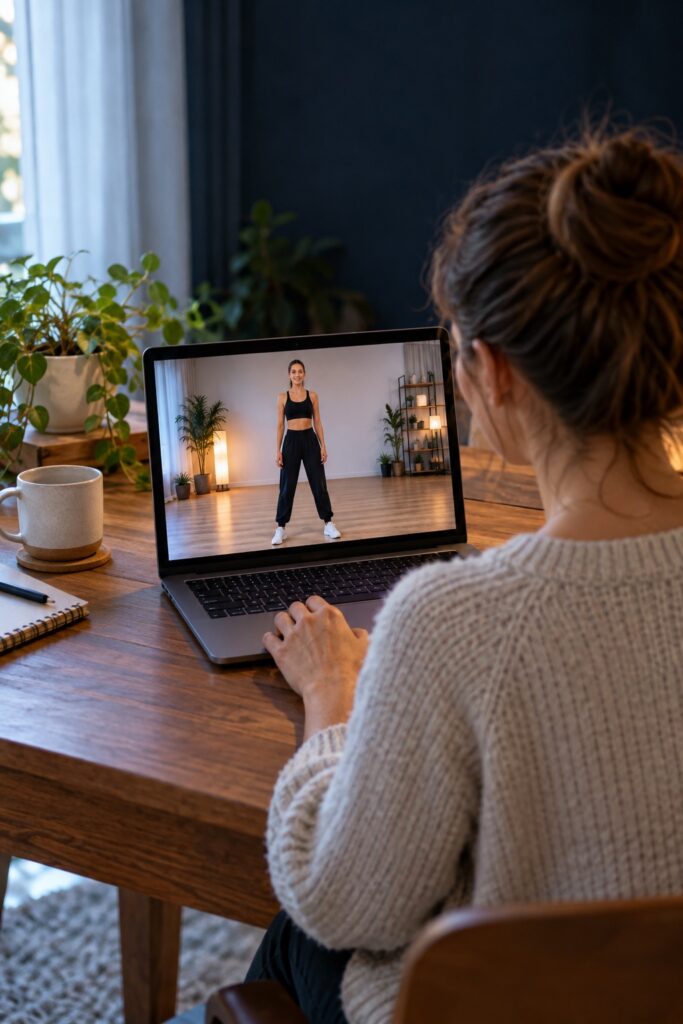
The teacher says “right,” a foot moves toward the left of the screen, and the routine has changed before you decide which way to go. I’ll help you check the demonstration before you turn that moment into a judgment about your coordination.
A video contains both movement and a convention for copying it. Those are separate pieces of information. Start by watching a simple moment while stationary, without trying to dance and decode the filming at once.
Three ways “use your right” can look
For these examples, imagine you are facing the screen directly and the recording has not been digitally flipped.
- Front mirror: the teacher faces you and uses their left hand, which appears on your screen’s right. You use your right. A teacher may deliberately say “your right” while demonstrating with their own left.
- Front anatomical matching: the teacher faces you and uses their right hand, visible on your screen’s left. You also use your right, matching the named body side rather than the picture’s side.
- Back view: the teacher faces away. Their right appears on your right, so the facing direction aligns.
None of those descriptions tells you which convention an unexplained upload uses. “Mirrored” may refer to the teacher’s demonstration, an editing choice or what the viewer is meant to do. Look for an explicit example: “When I say right, use your right foot.”
Flipping the picture does not rewrite the soundtrack
A horizontal flip reverses the image. It does not automatically turn the spoken word “right” into “left.” If speech and movement already work together under one convention, flipping only the picture may make them less clear.
Embedded lettering may reverse, while captions added separately remain readable. A readable title alone cannot prove that the body image is unflipped.
Before changing any mirror control, compare the same simple cue in the original and changed view. Ask whether the image now matches the way you intend to follow. Keep the original available, and do not upload a private class recording or install unfamiliar software merely to experiment. A provider’s alternate view may answer the question more cleanly.
A back view can help without being best for everything
A consistent back view can make direction easier to interpret, but may hide facial cues or the front of a movement. A separate detail view can be useful; rapid unexplained cuts between angles may be confusing.
A 2026 study of instructional perspective found an advantage for the back view in its choreography task. It analysed 31 active dancers aged 18–43 with at least three years of ballet experience. That does not establish a universal rule for older beginners or every dance-fitness class. The researchers’ cognitive-load explanation was an interpretation, not a direct measurement of cognitive load.
I’d use that finding as a reason to consider presentation options, not to reject clear front-facing teaching that works for you.
Name the missing information
“I cannot tell which foot starts after the chorus” is a useful replay target. Check whether the view includes the feet, the teacher explains the side, and the join is visible before any camera cut.
If several demonstrators appear, identify which person shows your intended version. One may demonstrate an adaptation or another role. Their movement and the lead teacher’s spoken cue are not necessarily interchangeable.
Slow playback can help you observe, but following a slowed movement is a separate decision. Stop moving before operating controls, and keep any physical support you need. A different playback speed does not make unsuitable movement suitable.
Take a clear question back to class
Try: “Are you mirroring us, or should I match your named foot?” Or: “The individual steps are clear, but I lose the direction at the camera change.” If direction is clear and the order remains confusing, my choreography guide addresses that different problem.
In a travelling group, avoid a hurried correction into someone else’s path. Use the instructor’s agreed pause or fallback.
A confusing video is not a medical test. Seek medical advice for new, persistent coordination concerns. Sudden symptoms such as loss of coordination, weakness or speech difficulty need emergency help, even if they improve; see the NHS stroke warning signs.
MarGo! Moments is a non-medical lifestyle publication. This article offers general information, not individual medical advice or an exercise prescription. For health questions, consult an appropriately qualified healthcare professional.
MarGo! editorial feature · AI-assisted, in the MarGo! first-person voice. Not a personal experience or product test unless stated.