
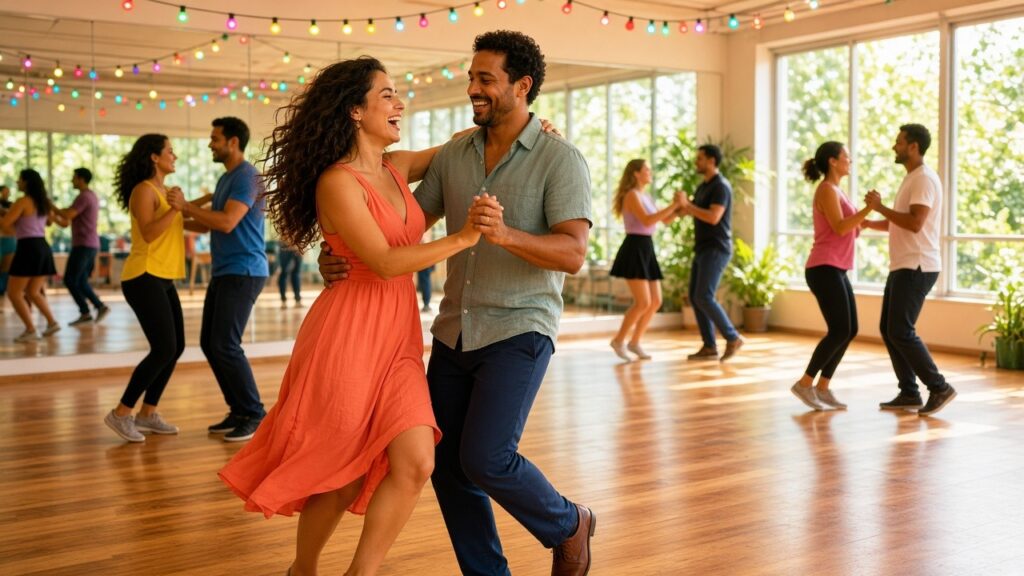
Bachata looks easy from the side of the dance floor: a few steps to the side, a tap, a hip, a smile. Then you’re in a beginner class trying to keep the beat, relax your hips, follow a turn and not step on anyone, and it suddenly feels like a lot. Both impressions are true.
Bachata is one of the easiest Latin partner dances to start, because the basic step is a simple four-count pattern (three steps and a tap) that most people learn in one class. What takes time is everything that makes it look good: relaxed hip motion, connection with a partner, musicality and turns. Most beginners can dance a basic social bachata after about a month of weekly classes, and feel comfortable at socials in about six months.
I learned bachata after salsa and merengue, so I’ve felt its learning curve from both sides. Here’s what’s easy, what’s hard, how bachata compares with salsa and merengue, realistic timelines, which style is harder, and how to learn faster.
Is bachata hard to learn? The short answer
Bachata is easy to start and takes practice to master. The basic step is approachable, the music is usually at a comfortable tempo, and the dance doesn’t require fast spins on day one. Like any partner dance, the real skill is in timing, body movement and connection.
| Stage | What you can usually do | Typical time |
|---|---|---|
| First class | Basic side step with a tap; basic in closed hold; one simple turn | 1 hour |
| After 1 month | Dance a basic with a partner, a few turns, keep time with most songs | 4 to 6 classes |
| After 3 months | Combine patterns, start to hear changes in the music, attend a social | 12 or more classes plus practice |
| After 6 months | Comfortable at socials, smoother body movement, some styling | Weekly classes and regular social dancing |
| 1 year and beyond | Musicality, styling, confident leading or following | Ongoing |
These are typical, not guarantees. Practice frequency, prior dance experience and how often you go social dancing make the biggest difference.
What is easy about bachata
- The basic step. Step, step, step, tap (or step-together-step-tap), side to side, repeated. Most people get it in minutes.
- The count. Bachata music has a clear, steady four-beat rhythm, and the guitar and bongo make the pattern easy to hear.
- The tempo. Many bachata songs are moderate in speed, slower than a lot of salsa.
- Small space. You can practice in a kitchen; you don’t travel across the floor much.
- Closed hold comfort. Many beginners find the closed position steadier than open-hold dances.
- Friendly culture. Bachata socials often welcome beginners, and there’s usually a beginner lesson before the party.
What takes time
Hip motion
Bachata’s hip movement comes from bending and straightening the knees and shifting weight, not from pushing the hips. Beginners often force it, which looks stiff. Relaxed, natural hip motion takes weeks of practice to feel normal.
Connection
Leading and following happen through the frame: hands, arms and upper body. Learning to give and read clear signals, without pushing or pulling, is a skill that develops slowly.
Musicality
The tap isn’t random; it falls on the fourth beat (and eighth). Learning to hear the music’s breaks, accents and changes and dance to them, rather than just counting, is what makes bachata feel expressive.
Turns
Turns in bachata are usually simpler than in salsa, but spinning cleanly, keeping your balance and staying on time still take practice. For spin technique that also works in bachata, see how to spin in salsa without getting dizzy.
Body movement (sensual and modern styles)
Body waves, head rolls and isolations are advanced skills that take months to do comfortably and safely.
Bachata vs salsa vs merengue difficulty
| Merengue | Bachata | Salsa | |
|---|---|---|---|
| Basic step | March in place, two counts | Side to side, four counts with a tap | Forward-back or side, 8 counts with a pause |
| First-class success | Very high | High | Moderate |
| Tempo | Often fast but simple | Moderate | Often fast |
| Turns | Simple, slow | Moderate | Many, faster, more complex |
| Partner connection | Simple | Moderate, close | Higher, more patterns |
| Body movement | Hips via knees | Hips via knees, body waves in some styles | Body styling, shines |
| Overall difficulty | Easiest | Easy to start, moderate to master | Hardest of the three for most beginners |
For a deeper comparison, see salsa vs bachata vs merengue, and if you’re curious how long salsa takes, how long it takes to learn salsa. If merengue sounds like the easiest start, here’s how to dance merengue.
How long does it take to learn bachata?
First class
You’ll learn the basic step, a basic in closed hold, maybe a side basic and one turn. Most beginners leave able to dance the basic to a slow song.
One month
With one class a week and a little home practice, you can usually dance a few minutes with a partner, combine two or three simple patterns and stay on time with moderate songs.
Six months
With weekly classes plus social dancing, most dancers feel comfortable at a social. You’ll know a set of patterns, hear the music’s changes and have smoother hips. Many people start to explore styling or a specific style around this point.
What speeds it up
- Two classes a week instead of one
- Going to socials, even just for an hour after the lesson
- Practicing the basic at home to music for 10 minutes a day
- Dancing with many different partners, not just one
Is sensual or Dominican harder?
Both can be learned by beginners, but they’re hard in different ways.
- Dominican bachata is the traditional style from the Dominican Republic, with faster, playful footwork, open hold and lots of rhythmic variation. The footwork can be the hardest part.
- Bachata moderna is the common studio style in the US, mixing basic footwork with turns from salsa. It’s usually what beginner classes teach.
- Bachata sensual is a Spanish-born style with body waves, head movements and close connection. The body movement and partner control are the hardest parts, and safe technique matters.
Most people find moderna easiest to start, Dominican harder on the feet, and sensual harder on body control and connection. For the details, see bachata sensual vs Dominican bachata.
Can you learn bachata alone or online?
You can learn a lot on your own: the basic step, timing, hip motion, footwork variations and solo styling all improve with home practice and online lessons. My bachata for beginners guide walks you through the basics.
What you can’t fully learn alone is partner connection: leading, following and adjusting to different partners. For that, you need classes and socials. A good plan is online lessons for footwork and timing, plus in-person classes for partnering. For pros and cons, see are online dance classes worth it.
Do you need a partner?
No. Most group bachata classes rotate partners, so you can come alone. Rotating partners also makes you a better dancer, because you learn to dance with different heights, styles and levels.
Tips to learn faster
- Master the basic. A clean, relaxed basic with the tap on time is the foundation of everything.
- Count out loud at first, then switch to listening for the bongo and guitar.
- Bend your knees. Most stiff hips come from locked knees.
- Keep steps small. Big steps make you late.
- Relax your frame. Firm, not tight; responsive, not heavy.
- Take the beginner class before every social. Repetition with new partners helps.
- Watch good social dancers, not just performances.
- Practice to many songs, both slow and fast.
- Film yourself occasionally to see posture and timing.
- Be patient with body movement. Waves and rolls come later; don’t force them.
If you feel self-conscious, my guide on how to not feel awkward dancing is for you. And for more general strategies, see how to get better at dancing.
Common beginner mistakes
- Stomping the tap. The tap is light, a touch of the foot on the floor without weight. If you put weight on it, you’ll start the next count on the wrong foot.
- Looking at your feet. Your posture collapses and your partner loses connection. Look at your partner’s chest or shoulder.
- Forcing the hips. Pushing your hips side to side looks stiff. Let them follow the knees and weight changes.
- Steps too wide. Big steps make you late and throw off balance, especially at faster tempos.
- Gripping hands. A tight grip makes turns uncomfortable. Use light pressure, with fingers hooked rather than squeezed.
- Counting forever. Counting helps at first, but you’ll dance better once you listen for the bongo and the guitar’s rhythm.
- Only dancing with one partner. You learn faster by rotating and adapting to different leads or follows.
A four-week beginner practice plan
| Week | In class | At home (10 to 15 minutes, 3 to 4 times) |
|---|---|---|
| 1 | Basic, side basic, closed hold | Basic to 3 slow songs; find the tap on beat 4 |
| 2 | Forward-back basic, first turn | Basic with relaxed knees; practice the turn’s footwork alone |
| 3 | Turn combinations, open hold | Switch between basics on the music’s changes |
| 4 | First social or practice party | Dance to faster songs; film one minute and watch your posture |
After four weeks, most people are ready to try a beginner-friendly social. Arrive for the lesson, dance a few songs, and leave proud of yourself.
What level class should I start with?
Start with a beginner or level 1 class, even if you’ve danced other styles. Bachata has its own timing and connection, and beginner classes are where you learn them. Move to level 2 when you can dance the basic, side basic and a few turns comfortably with different partners and stay on time without counting.
FAQ
How long does it take to learn bachata?
Most people learn the basic in one class, can dance socially with simple patterns after about a month of weekly classes, and feel comfortable at socials after roughly six months. More practice and social dancing shorten the timeline.
Is bachata easier than salsa?
For most beginners, yes. The basic step is simpler, the tempo is often slower and the turns are less complex. Salsa has more patterns and faster spins. Both take time to master.
Do I need a partner to learn bachata?
No. Most group classes rotate partners, so you can attend alone. You can also practice the basic and footwork solo at home.
Can I learn bachata online?
You can learn steps, timing, footwork and solo styling online. Partner skills like leading, following and connection are best learned in person, so combine online practice with classes or socials.
Common beginner mistakes
- Stomping the tap. The tap is light, a touch of the foot on the floor without weight. If you put weight on it, you’ll start the next count on the wrong foot.
- Looking at your feet. Your posture collapses and your partner loses connection. Look at your partner’s chest or shoulder.
- Forcing the hips. Pushing your hips side to side looks stiff. Let them follow the knees and weight changes.
- Steps too wide. Big steps make you late and throw off balance, especially at faster tempos.
- Gripping hands. A tight grip makes turns uncomfortable. Use light pressure, with fingers hooked rather than squeezed.
- Counting forever. Counting helps at first, but you’ll dance better once you listen for the bongo and the guitar’s rhythm.
- Only dancing with one partner. You learn faster by rotating and adapting to different leads or follows.
A four-week beginner practice plan
| Week | In class | At home (10 to 15 minutes, 3 to 4 times) |
|---|---|---|
| 1 | Basic, side basic, closed hold | Basic to 3 slow songs; find the tap on beat 4 |
| 2 | Forward-back basic, first turn | Basic with relaxed knees; practice the turn’s footwork alone |
| 3 | Turn combinations, open hold | Switch between basics on the music’s changes |
| 4 | First social or practice party | Dance to faster songs; film one minute and watch your posture |
After four weeks, most people are ready to try a beginner-friendly social. Arrive for the lesson, dance a few songs, and leave proud of yourself.
What level class should I start with?
A beginner or level 1 class. Even experienced dancers from other styles benefit from learning bachata’s specific timing, tap and connection from the start.