
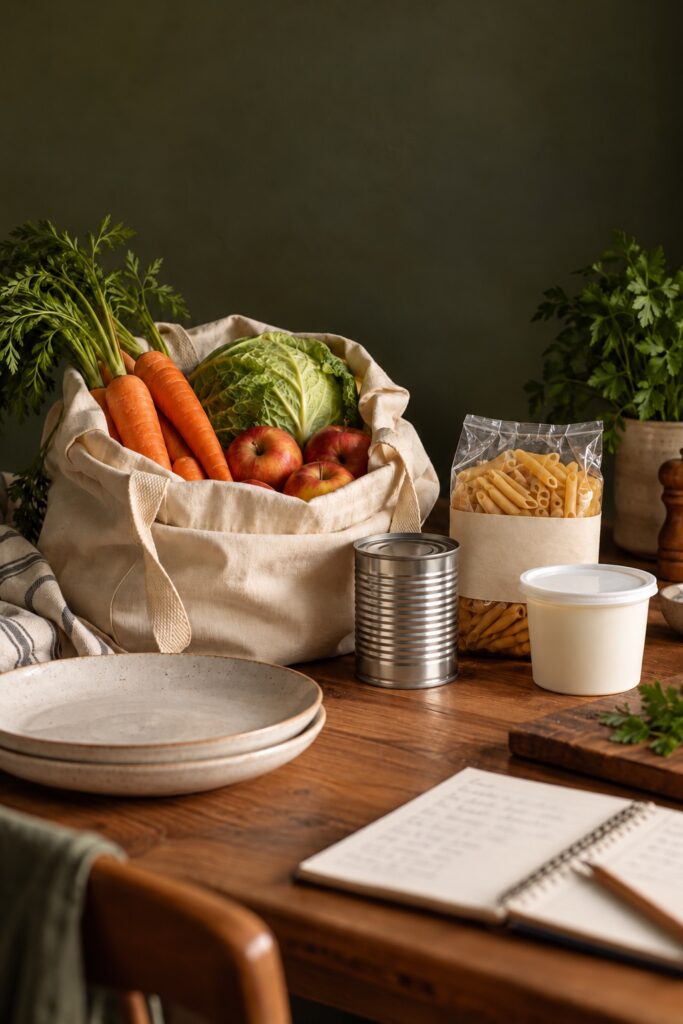
Before I help you fill a shopping basket, I want to know what that food is going to become. Three dinners you can actually make are more useful than seven hopeful recipe ideas and a refrigerator full of ingredients that do not quite meet.
Let me show you a smaller way to plan: count the meals, check what is already there, and buy the missing pieces. There is still room to change your mind.
Count occasions, not calendar squares
Look ahead to your next likely shop. Which meals will you eat at home? Which need to travel? On which evenings do you have time to cook? A dinner at home does not automatically mean an evening available for chopping, roasting and washing up.
Choose a few meals that fit those answers. Give the busiest evening an assembly meal or a familiar quick method. Leave an uncertain evening to ingredients that can wait safely, rather than another bag of delicate leaves.
Then check the cupboard, refrigerator and freezer. Count usable food, not food you vaguely remember buying. Keep reserved lunches out of the dinner calculation. An unlabeled leftover with an unknown history is not an ingredient to build a plan around.
A short list that joins up
Here is an illustrative shop for one person planning three dinners. Adjust quantities to your appetite, product sizes and other meals; this is a planning example, not a tested menu.
- Already available: dry pasta, bread in the freezer, oil, dried herbs and a can of chickpeas.
- Dinner one: pasta with tomato sauce and some chickpeas.
- Dinner two: roasted carrots with the remaining chickpeas, bread and a yogurt topping.
- Dinner three: a jacket potato with a separately packed, properly chilled topping.
- Buy: one suitable small can of tomatoes, enough loose carrots for the planned meal, one baking potato and a small plain yogurt.
The connections matter more than the particular foods. The chickpeas have two named uses; the yogurt can serve the carrot meal and the potato. Follow opening and storage directions, and put those meals close enough together for the ingredients to remain suitable. Add breakfast, lunch and snacks separately so they do not quietly use up the dinner supply.
Read the complete cooking directions before shopping. A recipe that needs an overnight soak, a blender you do not own or an ingredient hidden in the method is not ready to go merely because its title sounds simple.
A larger package needs a second destination
Let me put a fictional bargain on the shelf: 400 grams for 2.40 currency units, or 800 grams for 4.00. The larger pack costs less per 100 grams, but you still spend more today. If half goes unused, the lower unit price has not helped.
Buy the larger pack when you have a wanted second use and appropriate storage. Otherwise, a smaller pack, loose produce or a suitable frozen option may fit better. Health Canada’s budget guidance supports comparing prices and avoiding quantities you do not need.
Finish the shop by getting the food safely home
Collect chilled and frozen products near the end, separate raw animal foods from ready-to-eat food, and go home promptly. Use adequate insulated transport and cold sources when needed. Put perishables away before reorganizing the pantry.
FDA household guidance calls for refrigeration at 40°F/4°C or below and freezing at 0°F/−18°C or below. Refrigerate perishables within two hours, or within one hour above 90°F/32°C. These are limits, not a suggested amount of time to leave groceries in the car.
Before the next shop, notice the one thing that did not work: too much yogurt, not enough bread, a dinner too involved for Tuesday. Change that detail. You can use my use-first guide to bring suitable food into the next plan without turning every week into a new planning project.
Food-safety temperatures and storage limits here follow US household guidance; follow applicable local guidance and product instructions.
MarGo! editorial feature · AI-assisted, in the MarGo! first-person voice. Not a personal experience or product test unless stated.