
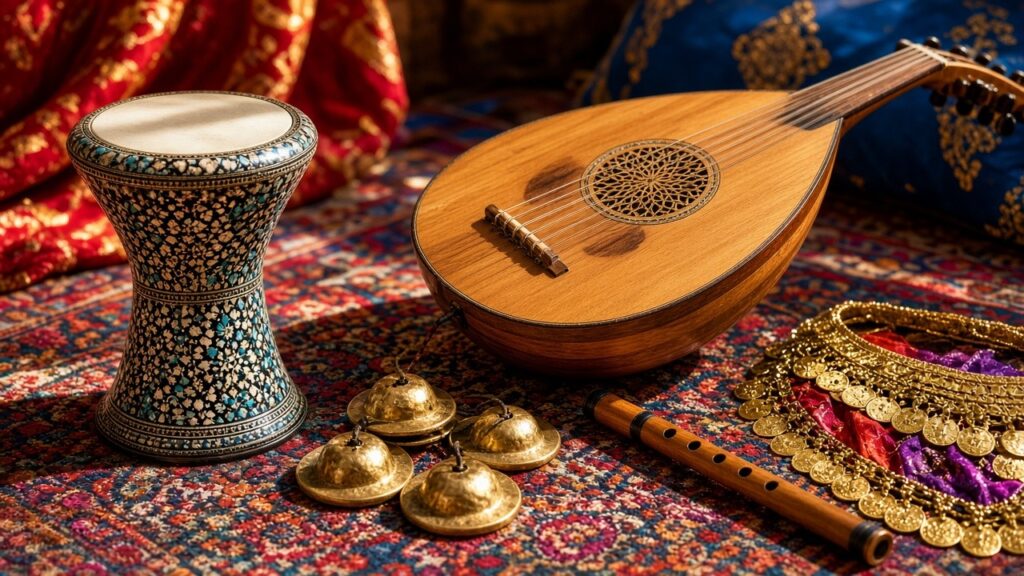
The first time you take a belly dance class, the music can feel mysterious: drums that seem to talk, long flowing melodies, sudden accents and rhythm changes. Once you learn a few names and rhythms, it starts to make sense, and your dancing gets better, because belly dance is all about responding to what you hear.
Belly dance music is usually called Arabic music or Middle Eastern music, and in Egypt the dance itself is raqs sharqi (“oriental dance”). Within it, dancers recognize styles such as classical oriental music, baladi (urban folk), shaabi (popular street music) and Turkish oriental, as well as modern pop and fusion. The music is built on rhythms played on the darbuka drum, the most common being maqsum, baladi, saidi, malfuf and chiftetelli, and melodies played on the oud, qanun, ney, violin and accordion. Dancers often add zills (finger cymbals).
Below: the names for belly dance music, the main rhythms with counts you can clap, the instruments, classic songs and artists, modern and fusion music, how to practice to the music and answers to common questions. New to the dance? Start with belly dance for beginners.
What is belly dance music called?
There isn’t one name, because “belly dance” is an English umbrella term for several dance traditions. Here are the terms you’ll hear:
| Term | What it means |
|---|---|
| Arabic music / Middle Eastern music | The general category most belly dance music falls into |
| Raqs sharqi | Arabic for “oriental dance,” the Egyptian name for the stage form of belly dance; music for it is often called oriental music |
| Baladi | “Of the country.” Earthy urban folk music and dance from Egypt, often starting slow and building up |
| Shaabi | “Of the people.” Popular Egyptian street music, upbeat and fun |
| Mejance or entrance | A multi-part orchestral piece used for a dancer’s entrance, combining rhythms and moods |
| Taqsim | An improvised instrumental solo, usually slow and without a steady rhythm |
| Drum solo | A section or song where only the drums play, and the dancer hits every accent |
| Turkish oriental (oryantal) | Turkish belly dance music, often faster and including 9/8 rhythms |
| Fusion / tribal fusion | Modern styles that mix belly dance with electronic, world, hip-hop and other music |
The main rhythms (with counts)
Middle Eastern rhythms are taught with two main drum sounds:
- Dum (D): a deep bass sound from the center of the drum.
- Tek (T): a sharp, high sound from the edge of the drum.
- Ka (K): a high sound played with the other hand, often used to fill in.
Clap or tap “Dum” with your palm on your thigh and “Tek” with your fingertips. Here are the essential rhythms, written as eight half-beats (four beats) unless noted.
Maqsum (4/4)
D T . T D . T .
“Dum tek – tek Dum – tek -“
The most common rhythm in Egyptian belly dance and pop. Bright, lively and versatile. If you only learn one rhythm, learn this one.
Baladi (4/4)
D D . T D . T .
“Dum Dum – tek Dum – tek -“
Like maqsum, but with two dums at the start, which makes it heavier and earthier. Also called masmoudi saghir. Used in baladi music and many Egyptian songs.
Saidi (4/4)
D T . D D . T .
“Dum tek – Dum Dum – tek -“
From Upper Egypt (the Saʿid). Bouncy and strong, with the two dums in the middle. Used for the cane dance (raqs al assaya) and folk-style dancing.
Malfuf (2/4)
D . . T . . T .
“Dum – – tek – – tek -“
Fast and driving. Used for entrances, exits, spins and fast traveling steps.
Chiftetelli (8/4)
A slow, eight-beat rhythm with a sultry, swaying feel. A common version counts as:
D . . T T . T . D . D . T . . .
Used for slow, sensual sections, veil work and taqsim-style dancing. It’s also common in Greek and Turkish music.
Other rhythms worth knowing
| Rhythm | Feel | Used for |
|---|---|---|
| Masmoudi kabir (8/4) | Slow, heavy, majestic | Dramatic slow sections |
| Ayoub (2/4) | Trance-like, fast | Zar (trance) and drum solos |
| Karsilama (9/8) | Turkish, lively | Turkish and Greek dance |
| Fallahi (2/4) | Fast, light | Folk and entrances |
| Wahda (4/4) | Very simple, slow | Slow songs and taqsim |
You don’t need to know every rhythm to dance. Start by recognizing maqsum, baladi and saidi, and notice when the music shifts between fast and slow.
Instruments
| Instrument | What it is | What it does in the music |
|---|---|---|
| Darbuka (tabla, doumbek) | Goblet-shaped hand drum | Keeps the rhythm and plays accents and solos |
| Riq | Small tambourine with cymbals | Adds texture and shimmer to the rhythm |
| Def (daf) | Large frame drum | Deep, booming support |
| Oud | Pear-shaped, fretless lute | Warm melody and taqsim |
| Qanun | Zither-like plucked string instrument | Shimmering melodies and runs |
| Ney | End-blown reed flute | Breathy, haunting melodies |
| Violin | Western violin played in Arabic style | Lush melodies and slides |
| Accordion | Often in baladi | Ornamented, expressive melody |
| Keyboard and synthesizer | Modern instruments | Pop and shaabi sounds |
| Zills (sagat) | Finger cymbals played by the dancer | Rhythm played by the dancer while she dances |
Arabic melodies use maqamat (singular maqam), a system of musical modes that includes notes between the Western piano keys, which gives the music its distinctive sound.
Classic songs and artists
The golden age of Egyptian music and film (roughly the 1940s to 1970s) produced many songs that belly dancers still perform today. Classic artists include:
- Umm Kulthum: the most famous Arab singer of the 20th century. Instrumental versions of her songs, such as “Enta Omri” and “Alf Leila wa Leila,” are dance classics.
- Mohammed Abdel Wahab: composer of many dance favorites, including the instrumental pieces “Aziza” and “Zeina.”
- Farid al-Atrash: singer, composer and oud player whose songs and film music are danced to often.
- Abdel Halim Hafez: beloved romantic singer whose songs appear in many dance sets.
Many teachers use orchestral arrangements of these songs, which are often long and include several rhythms and moods, perfect for showing range.
Modern and fusion music
- Egyptian pop: artists like Amr Diab, Hakim (shaabi) and many others release upbeat songs with maqsum and baladi rhythms.
- Lebanese pop: artists such as Nancy Ajram and Haifa Wehbe have songs often used in classes.
- Turkish pop and oriental: Turkish oryantal music, faster and often with clarinet and 9/8 rhythms.
- Drum solo albums: recordings of drum solos for practicing accents.
- Tribal and tribal fusion: world, electronic, trip-hop and other music for fusion styles and group improvisation.
- Global pop: some dancers enjoy pop songs that blend Middle Eastern rhythms, though traditional teachers often prefer authentic music for learning.
Do different belly dance styles use different music?
Yes.
| Style | Typical music |
|---|---|
| Egyptian raqs sharqi | Classical oriental orchestral music, Egyptian pop |
| Baladi | Baladi taqsim on accordion or saxophone with drums |
| Shaabi | Egyptian street pop |
| Saidi and cane dance | Saidi rhythm, mizmar (reed horn), drums |
| Turkish oriental | Turkish oriental music with clarinet, 9/8 rhythms |
| Lebanese | Lebanese pop and orchestral music, often powerful drums |
| American Tribal Style / FatChance BellyDance style | Steady rhythms suitable for group improvisation, world music |
| Tribal fusion | Electronic, trip-hop, world fusion |
Moves that match each rhythm
| Rhythm | Moves that fit |
|---|---|
| Maqsum | Hip drops and lifts, basic Egyptian walk, shimmies, traveling steps |
| Baladi | Grounded hip work, heavy hip drops on the double dum, earthy walks |
| Saidi | Bouncy hip lifts, skips, cane twirls and the saidi step |
| Malfuf | Fast traveling steps, turns, entrances with veil |
| Chiftetelli | Slow figure eights, undulations, camels, floor work, veil |
| Drum solo | Sharp hip locks, accents, layered shimmies |
| Taqsim | Slow, flowing isolations; arms and torso expression |
The structure of a classic oriental routine
Many Egyptian-style performances follow a pattern:
- Entrance: a lively, often orchestral section with malfuf or maqsum, sometimes with a veil.
- Melodic section: a song in maqsum or baladi with varied moves.
- Taqsim: a slow improvised solo where the dancer shows emotion and control.
- Drum solo: an energetic section of sharp accents.
- Finale: a short, fast ending, often with turns and a final pose.
Knowing this structure helps you understand what the music asks for, and how to shape your own routines.
How to practice to the music
- Learn to clap the rhythms. Use the Dum and Tek counts above while listening to songs.
- Identify the rhythm in each new song. Is it maqsum, baladi or saidi? Is it fast or slow?
- Match movements to sounds. Accents (hip drops, locks) go with dums and teks; smooth movements (figure eights, undulations, arms) go with melodies and taqsim.
- Practice to drum solos to sharpen your accents.
- Dance to a full song without stopping, even if you repeat simple moves.
- Listen to the melody’s mood. Slow, emotional sections call for slow, expressive movement.
- Play zills along with the rhythm once you’re comfortable: a common beginner pattern is triples (right-left-right).
Short, regular sessions help. See how to practice dance at home for practice tips, and is belly dancing hard? for realistic expectations.
Where to find belly dance music to practice
- Music streaming services: search for “belly dance music,” “raqs sharqi,” “Arabic drum solo” or specific artists.
- Video platforms: many teachers share music lists and choreographies.
- Your teacher: ask for the class playlist and the names of the rhythms you’re working on.
- Belly dance workshops and festivals: often feature live musicians and music vendors.
Listening to live music is the best way to understand how dancers and musicians respond to each other.
FAQ
What rhythms should every belly dancer know?
Maqsum, baladi, saidi, malfuf and chiftetelli are the core rhythms. Masmoudi and ayoub are good next steps.
What is a drum solo in belly dance?
A section or song played only on drums, often the darbuka. The dancer interprets every accent with sharp, precise movements like hip drops, locks and shimmies. Drum solos are often a highlight of a performance.
Do different belly dance styles use different music?
Yes. Egyptian raqs sharqi uses classical oriental music and Egyptian pop, Turkish oriental uses Turkish music with 9/8 rhythms, and tribal fusion uses electronic and world music.
What is a darbuka?
A goblet-shaped hand drum, also called tabla or doumbek, used to play the rhythms of belly dance music. It makes deep “dum” sounds in the center and sharp “tek” sounds at the edge.
Where can I find belly dance music to practice?
Streaming services, video platforms and your teacher’s playlists are the easiest sources. Search for “raqs sharqi,” “Arabic drum solo” or classic artists like Umm Kulthum and Mohammed Abdel Wahab.
Do I need to understand Arabic to belly dance?
No, but learning what a song is about helps you express its mood. Many dancers look up translations of the songs they perform.
How do I count belly dance music?
Most Egyptian songs can be counted in groups of four or eight beats, like Western pop. Clap the dum on beat 1 and count from there. Slow rhythms like chiftetelli and masmoudi kabir are often counted in eight slow beats, and taqsim sections have no steady count at all, so you follow the melody instead.