
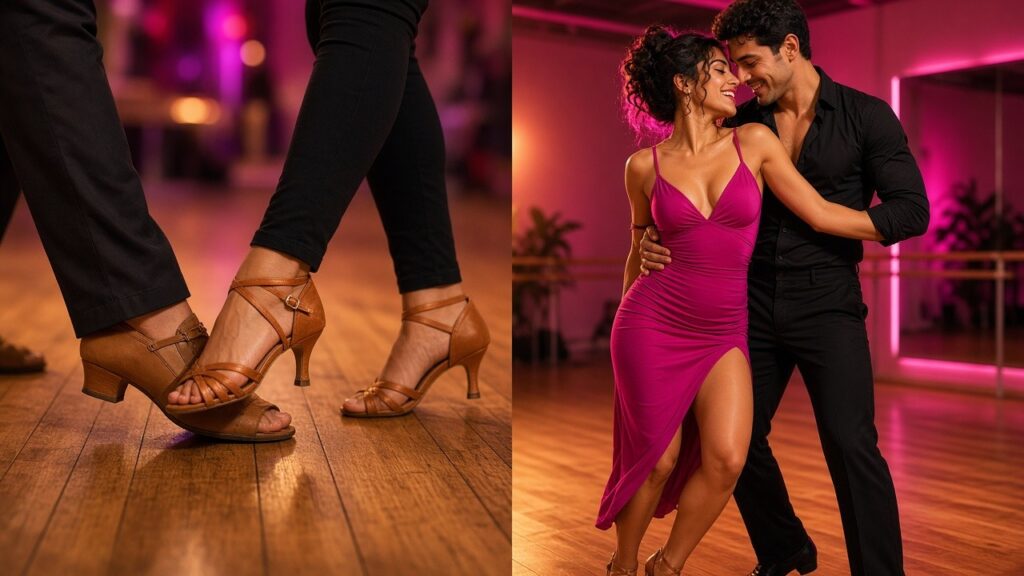
Walk into two bachata socials and you might think you’ve found two different dances. In one corner, couples are trading quick, playful footwork in an open hold, laughing as they syncopate to the guitar. In another, partners move in a close embrace with slow body waves and head rolls. Both are bachata. They’re simply different styles with different roots.
Dominican bachata is the original style from the Dominican Republic: quick, playful footwork, a relaxed open or closed hold, and lots of rhythmic play with the guitar and bongo. Bachata sensual is a newer style developed in Spain in the 2000s, built on body waves, isolations, head movements and smooth turns in close connection. Most US studios teach bachata moderna, a blend in between. Beginners usually find moderna easiest, Dominican footwork the most challenging for the feet, and sensual the most demanding for body control and partner connection.
I dance both on Chicago floors, and here’s how they compare: origins, footwork, hold, music, which is easier, what you’ll see at socials, mixing styles, and the comfort-and-consent etiquette that close-contact styles require.
Bachata sensual vs Dominican: the short answer
| Dominican bachata | Bachata moderna | Bachata sensual | |
|---|---|---|---|
| Origin | Dominican Republic, 1960s onward | International studio style, 2000s | Spain, mid-2000s |
| Hold | Open or relaxed closed; lots of space | Mix of closed and open | Mostly close connection |
| Footwork | Fast, syncopated, playful; a highlight | Simple basics plus turns | Simple basics; feet serve the body movement |
| Body movement | Natural hips, little isolation | Some body rolls | Body waves, isolations, head rolls, dips |
| Turns | Some, often simple | Many, borrowed from salsa | Smooth, flowing, often with body movement |
| Feel | Joyful, rhythmic, conversational | Versatile, social | Smooth, flowing, dramatic |
| Music | Traditional Dominican bachata, often faster | Popular bachata | Often slower, romantic and remixed tracks |
| Beginner friendliness | Moderate; footwork takes practice | High | Moderate; body control takes practice |
Dominican bachata
Origin
Bachata grew up in the Dominican Republic in the 20th century, born in rural areas and working-class neighborhoods. For years it was looked down on as music of heartbreak and bars, then it became a national treasure and spread worldwide. Dominican-style dancing reflects that history: social, rhythmic and close to the music.
Footwork
The footwork is the star. Dancers play with the rhythm, adding syncopations, shuffles, quick steps, kicks and taps that answer the guitar and bongo. The basic is often danced forward and back in a box-like pattern as well as side to side, and the steps are small and quick.
Hold
The hold is relaxed, often open, with arms held loosely and plenty of space between partners. Couples move into closer holds and back out freely.
Feel
Playful, flirty in a lighthearted way, and very musical. It’s common to see partners grinning as they trade footwork. Dominican-style dancers often prefer faster, traditional songs.
Bachata moderna (the US studio default)
Most beginner classes in the United States teach bachata moderna, sometimes just called bachata. It takes the basic side step and tap, adds turns and patterns borrowed from salsa, and sprinkles in some body rolls and styling. It’s flexible: you’ll see dancers at socials blending a little Dominican footwork or some sensual body movement into moderna.
Moderna is the easiest place to start because it gives you a solid basic, clear leads for turns, and a common language you can use with most partners. For the basics, see my bachata for beginners guide.
Bachata sensual
Origin
Bachata sensual was developed in Spain in the mid-2000s and spread through European and then international festivals and studios. It draws on influences from other dance styles, especially in how it uses the body and the connection between partners.
Movement
Sensual focuses on the body rather than the feet: body waves, chest and hip isolations, head movements and rolls, slow dips, and fluid turns. The lead often comes from the torso and connection rather than only the hands.
Hold and connection
Much of the dance happens in a close embrace, with partners connected through the upper body. That closeness requires clear technique for leading, following and protecting each other.
Safety note
Head rolls and dips involve the neck and back. They should be learned in class from experienced teachers, with a gentle, controlled approach, and never forced on a partner who doesn’t know them. Followers can always decline a movement.
How the music differs
All three styles can be danced to the same song, but each style has its favorite sound.
- Dominican dancers often choose traditional Dominican bachata with a prominent lead guitar (the requinto), bongo, and güira, often at a brisk tempo with lots of rhythmic changes.
- Moderna fits popular, commercial bachata that dominates radio and many socials.
- Sensual is frequently danced to slower, romantic bachata, remixes and covers of pop songs, sometimes with long instrumental builds that suit waves and dips.
Learning to hear the instruments helps every style. The bongo and guitar mark the rhythm and the breaks, and the güira (a metal scraper) keeps steady time. For more on how bachata music works, see salsa vs bachata music.
Which is easier for beginners?
Bachata moderna is easiest for most beginners. It’s widely taught, the basic is simple, and leads are clear.
Dominican is joyful but demanding on the feet: the syncopations and quick footwork take practice, especially at fast tempos. People with a background in other footwork-heavy dances may pick it up quickly.
Sensual looks slow, but the body movement, isolations and close lead-follow technique take time to learn safely and smoothly.
A good path for many dancers: start with moderna, add some Dominican footwork to improve rhythm, and take sensual classes once you’re comfortable with the basic and partner connection. If you’re wondering how long any of this takes, see is bachata hard to learn.
Which do Chicago socials dance?
At many Chicago Latin socials, you’ll see a mix. Moderna-style bachata is the most common default, with Dominican footwork and sensual movement both showing up depending on the dancers. Some events and studios specialize in one style, especially sensual, which often has dedicated nights and workshops; others focus on traditional Dominican bachata. Event descriptions usually say if a night leans one way.
If you’re new to the scene, start with a social that offers a beginner lesson. My guides to salsa dancing in Chicago and what a salsa social is explain how socials work, and most of the same etiquette applies to bachata nights.
Can you mix styles?
Yes, and most social dancers do. A typical social bachata might include a moderna basic, a Dominican footwork break and a gentle body wave. The key is to dance to your partner:
- If your partner dances mostly Dominican, keep the hold open and play with footwork.
- If your partner dances sensual, keep movements smooth and only lead body movement they clearly know.
- If you’re not sure, stay in moderna and gradually test what they respond to.
Mixing well is a sign of a versatile dancer, as long as both partners are comfortable.
Comfort and consent on the floor
Close-contact styles need clear etiquette. These guidelines apply to all bachata but matter most in sensual.
- Ask, and accept no. “Would you like to dance?” A no doesn’t need a reason.
- Start with an open or relaxed hold. Let closeness happen gradually and only if your partner moves into it.
- Match your partner’s level. Don’t lead dips, head rolls or intense body movement with someone who hasn’t learned them.
- Followers can adjust. It’s fine to create space, skip a movement or keep your head still.
- No surprise dips. Dips need clear preparation and a partner who’s ready.
- Hands in appropriate places. Back, shoulder blade, side; never anywhere that feels inappropriate.
- Hygiene counts. Fresh breath, deodorant and a spare shirt make close dances pleasant.
- Say thank you and walk your partner off the floor if it’s crowded.
- Speak up or tell an organizer if someone makes you uncomfortable. Good events take this seriously.
Feeling self-conscious is normal at first; my guide on how to not feel awkward dancing can help.
A short timeline of bachata styles
| Period | What happened |
|---|---|
| 1960s to 1980s | Bachata develops in the Dominican Republic, danced socially in a close or relaxed hold with simple steps |
| 1990s | Bachata becomes more popular in the Dominican Republic and abroad; traditional Dominican footwork flourishes |
| 2000s | International studios build bachata moderna with turns and patterns; bachata sensual emerges in Spain |
| 2010s onward | Festivals spread sensual worldwide; urban and fusion styles appear; Dominican style sees a renewed following |
Every style is still evolving, and teachers often blend elements, so you’ll hear different definitions from different studios.
How to practice each style
| Style | Solo practice | With a partner |
|---|---|---|
| Dominican | Footwork drills to fast traditional songs; syncopations and shuffles | Open-hold basics with footwork “conversations” |
| Moderna | Basic, side basic, turns’ footwork | Turn patterns and changes of position |
| Sensual | Body waves, chest and hip isolations, slow head movements with care | Connection drills, waves in hold, prepared dips in class |
Ten minutes of solo practice a few times a week makes classes far easier, whatever style you choose. For a full routine, see how to get better at dancing.
What to wear for each style
Comfortable, breathable clothes and shoes that can pivot work for all three. Dominican footwork is easiest in light shoes with smooth soles; sensual dancers often prefer clothing with some stretch for body movement and avoid bulky jewelry or belts that catch a partner. For outfit ideas, the same principles as what to wear salsa dancing apply.
FAQ
What is bachatango?
Bachatango blends bachata with movements inspired by Argentine tango, such as leg flicks, sharp lines and dramatic pauses. It was popular in the 2000s and still appears in classes and performances, though less often on social floors.
What is urban bachata?
Urban bachata (sometimes called bachata urbana or fusion) mixes bachata with hip-hop, R&B and contemporary dance movement, often danced to remixes and pop covers. It’s common in performances and some workshops, and its styling shows up in social dancing too.
Is Dominican bachata harder than sensual?
They’re hard in different ways. Dominican is harder on the feet because of fast, syncopated footwork. Sensual is harder on body control and lead-follow technique. Most beginners find moderna the easiest first step.
Can I dance sensual bachata with a Dominican-style partner?
Yes, but adapt. Keep the hold more open, follow their rhythm and footwork, and only add body movement if they respond comfortably. Social dancing is about meeting your partner where they are.
Which style should I learn first?
Start with bachata moderna in a beginner class. It gives you the basic, timing and leads you’ll use with almost any partner. Once that feels natural, take a Dominican footwork class to sharpen your rhythm, and a sensual fundamentals class if you’re drawn to body movement.
Is bachata sensual inappropriate for a social dance?
No. It’s a widely danced, respected style. Like any close-contact dance, it depends on respect and consent. Good sensual dancers keep the connection comfortable, adapt to each partner and never force movements, and either partner can keep more space at any time.
Do I need different shoes for Dominican and sensual?
Not necessarily. Any shoe with a smooth sole that lets you pivot works for both. Dominican dancers often like light, flexible shoes for quick footwork; sensual dancers value a stable heel or flat for slow, controlled weight changes and turns.