
Perfume dupes are everywhere now: entire shops, social media channels and drugstore shelves built around “smells like” versions of famous fragrances for a fraction of the price. Some are surprisingly close. Others smell right for ten minutes and then fade into something cheap. The honest answer to whether they’re worth it depends on what you want from a perfume.
A perfume dupe is a legally sold fragrance created to smell similar to a well-known perfume, under its own brand name and bottle. Dupes can be worth it for trying a scent profile, for everyday or gym wear, or when the original is very expensive or discontinued. They often differ in the dry-down and may last a shorter or different amount of time. A dupe is not a fake: counterfeits copy the original brand’s name and packaging and are illegal, with unknown ingredients.
I’ve bought both dupes and originals. Here’s what a dupe is, how it differs from a counterfeit, how to compare one against the original yourself, when to choose each, how to find good dupes and the ethics behind them.
What is a perfume dupe?
“Dupe” is short for duplicate. In fragrance, it means a perfume made by a different company that’s designed to resemble a famous scent. Dupes are sold under their own names, sometimes with a line like “inspired by” or a number that fans associate with a particular original.
Dupes come in several forms:
- Inspired-by brands that build their whole range around popular originals.
- Drugstore and fast-fashion perfumes that closely echo a trending scent.
- Body mists and oils with a familiar scent profile.
- Concentrated perfume oils sold as alcohol-free alternatives.
- “Clone” houses that release scents openly modeled on niche bestsellers.
Perfume formulas can’t usually be protected the way brand names and bottle designs can, and modern analysis makes it easier to approximate a scent. That’s why dupes are legal and so common.
Dupes vs fakes and counterfeits
This is the most important difference to understand.
| Dupe | Counterfeit (fake) | |
|---|---|---|
| Name on the bottle | Its own brand name | The original brand’s name, copied |
| Packaging | Its own design | Imitates the original’s box and bottle |
| Legal status | Legal to sell | Illegal; infringes trademarks |
| Price | Openly low | Often “too good to be true” discounts on the original name |
| Ingredients | Made by a known company, subject to normal regulations | Unknown; may not meet safety standards |
| Honesty | Doesn’t pretend to be the original | Pretends to be the original |
Counterfeits are often sold on unofficial websites, marketplaces and street stalls, sometimes with slightly misspelled names, poor printing, wrong batch codes or cellophane that doesn’t match the brand’s usual wrapping. Because no one knows what’s inside, they may irritate skin. If a famous perfume is advertised far below normal prices from an unofficial seller, be suspicious.
Are dupes worth it?
Weigh the three things people care about most.
Accuracy
The best dupes are very close in the opening, which is the part most people smell first. Differences usually show up later, in the heart and dry-down, where quality and the cost of raw materials matter more. Some dupes smell like “the original, simplified.” Others are close enough that most people around you wouldn’t notice.
Longevity and projection
Some dupes last as long as the original, and a few even project more strongly. Others fade quickly or turn sharp after an hour. Longevity depends on concentration and formula, not on whether a scent is a dupe, so it varies a lot from brand to brand.
Price
Here dupes win easily. They often cost a small fraction of a designer or niche original. That makes them practical for daily wear, the gym bag or trying a scent family before you invest.
| Dupe | Original | |
|---|---|---|
| Price | Low | High, sometimes very high |
| Opening accuracy | Often close | The reference |
| Dry-down | May differ | The reference |
| Longevity | Varies widely | Varies, often well developed |
| Bottle and packaging | Simpler | Designed as part of the experience |
| Availability | Easy online | Sometimes limited or discontinued |
How to run your own side-by-side test
Your skin, your nose and your climate decide whether a dupe works for you. Here’s how I compare a dupe with an original fairly.
- Get both samples. Use a tester or sample of the original rather than memory.
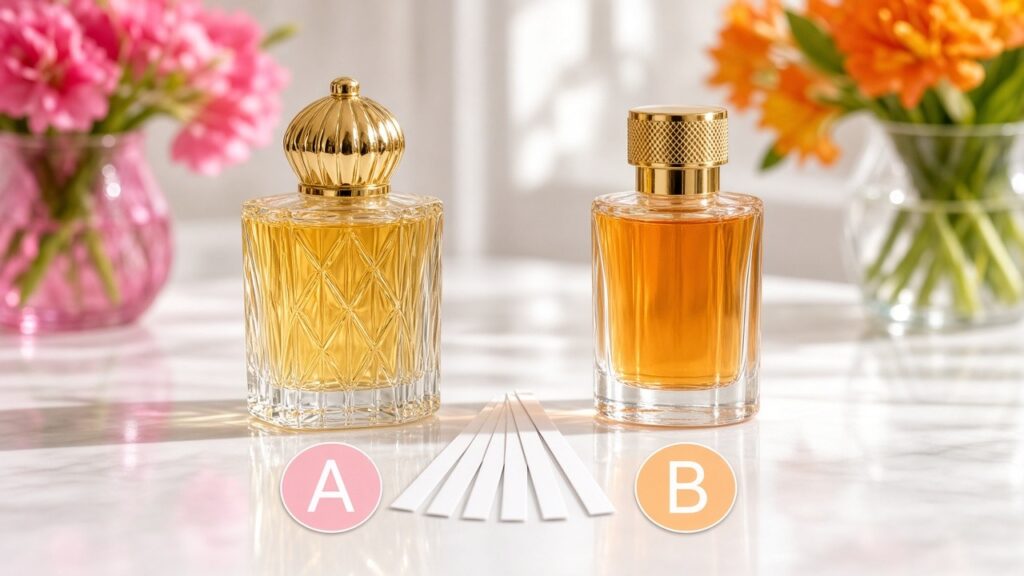
- Label them A and B so you’re not swayed by price or the bottle. Ask a friend to apply them if you want a blind test.
- Spray one on each inner wrist with the same number of sprays.
- Smell at set times: right away, 15 minutes, 1 hour, 3 hours and 6 hours. Write down what you notice.
- Compare projection: hold your wrist a few inches from your nose, then at arm’s length.
- Repeat on another day and swap wrists, since skin and weather vary.
- Ask someone else if they can tell the difference, especially later in the day.
Signs a dupe is good enough for you: you can’t consistently tell A from B after the first hour, it lasts as long as you need, and the dry-down doesn’t turn harsh or flat.
When to buy a dupe vs the original
Buy a dupe when:
- You want to wear a scent family every day without spending much.
- You’re testing whether you even like a trending scent.
- You need a gym, dance or travel perfume you won’t worry about. See perfume for the gym and dance class.
- The original is discontinued or extremely expensive.
- You want to layer and experiment; see perfume layering.
Buy the original when:
- It’s your signature scent and the dry-down matters to you.
- You want the full experience, including the bottle and the brand’s craft.
- The dupe you tried fades fast or smells harsh on your skin.
- It’s a gift where the brand matters.
- You want to support the perfumer who created it.
Many people do both: the original for special occasions and a dupe for everyday or travel.
Dupes for discontinued perfumes
When a beloved perfume is discontinued or reformulated, dupes and “inspired by” scents are sometimes the only way to get close to it again. Search for the original’s name plus “alternative” or “similar to,” compare notes lists, and sample before buying. Some fans find a modern dupe closer to the version they remember than the reformulated original.
How to find good dupes
- Start with the original’s notes. Know the scent profile so you can judge accuracy. My perfume notes vs accords guide helps.
- Buy samples first. Many dupe brands sell small sizes or discovery sets; see what is a perfume discovery set.
- Read reviews from people with similar taste, and look for comments on longevity, not just the opening.
- Check the concentration. An eau de parfum dupe often lasts longer than an eau de toilette dupe.
- Buy from the dupe brand’s official site or reputable retailers to avoid counterfeits of the dupe itself.
- Don’t trust a single video. Scent is personal, and creators may receive free products.
- Learn to judge without a tester. See how to pick perfume without smelling it.
Cost per wear: dupe vs original
Price per bottle can mislead, because a dupe that fades in two hours may need reapplying. Here’s how to compare fairly, using illustrative prices:
| Dupe EDP | Original EDP | |
|---|---|---|
| Example price | $35 for 50 ml | $150 for 50 ml |
| Sprays per wear | 4, plus 2 to reapply | 4 |
| Approx. wears per bottle | About 80 | About 125 |
| Approx. cost per wear | About $0.45 | About $1.20 |
Even if a dupe needs reapplying, it usually stays cheaper per wear. The question is whether the scent experience is close enough for you. Use your own sprays and prices to run the numbers.
A quick dupe-buying checklist
- I know the original’s notes and have smelled it recently.
- I’m buying a sample or small size first.
- The seller is the dupe brand itself or a reputable retailer.
- The product is sold under its own name, not the original brand’s.
- I’ve read reviews that mention longevity and the dry-down.
- I’ll test it on my skin for a full day before buying a big bottle.
Ethics and creators
Dupes raise fair questions.
- Perfumers’ work. A great fragrance takes skilled perfumers months or years. Dupes benefit from that work without paying for it. Some shoppers decide to buy originals from smaller and independent houses for that reason.
- Access. On the other hand, many perfumes are priced far beyond what most people can spend. Dupes let more people enjoy scent.
- Transparency. Dupe brands that say what they are, openly and honestly, are different from sellers who imply a connection to the original brand.
- Influencers. Dupe recommendations are often sponsored or affiliate-driven. Look for disclosures and test for yourself.
- Counterfeits are different. Buying fakes funds illegal operations and can be unsafe; that’s not an ethical gray area.
There’s no single right answer. Many people buy dupes for fun and everyday wear and save their money for originals they truly love.
How to tell if your “original” is actually a fake
- Bought from an unofficial site or marketplace at a deep discount
- Misspellings, blurry printing, crooked labels or a cheap-feeling box
- Batch code missing, or the code on the box doesn’t match the bottle
- Sprayer feels flimsy; liquid color looks wrong
- Scent smells sharp, faint or completely different from a tester
When in doubt, buy directly from the brand or authorized retailers.
FAQ
Do perfume dupes smell exactly like the original?
Rarely exactly. Good dupes are often very close in the opening, but the heart and dry-down may differ because of formula and ingredient choices. Many people around you won’t notice; a fan of the original often will.
Do dupes last as long as the original?
Some do, some last longer, and some fade much faster. Longevity depends on concentration and formula, so test on your own skin and read reviews that mention wear time.
Is a dupe the same as a fake?
No. A dupe is sold under its own name and is legal. A fake (counterfeit) copies the original brand’s name and packaging, is illegal and may contain unknown ingredients.
How do I test a dupe before buying a full bottle?
Buy a sample or small size and wear it beside a sample of the original, labeled A and B. Smell both over several hours, on two different days, and ask someone else if they can tell the difference.
Is it worth paying more for the original?
If it’s your signature scent, the dry-down matters to you, or the dupe doesn’t last on your skin, the original is usually worth it. For everyday, gym or experimental wear, a well-made dupe can be the better value.
Are perfume dupes safe?
Dupes from established companies are generally made under the same cosmetic rules as other perfumes in the country where they’re sold. As with any fragrance, a dupe can irritate sensitive skin, so patch-test first. Counterfeits are the real safety concern, because their ingredients are unknown.