
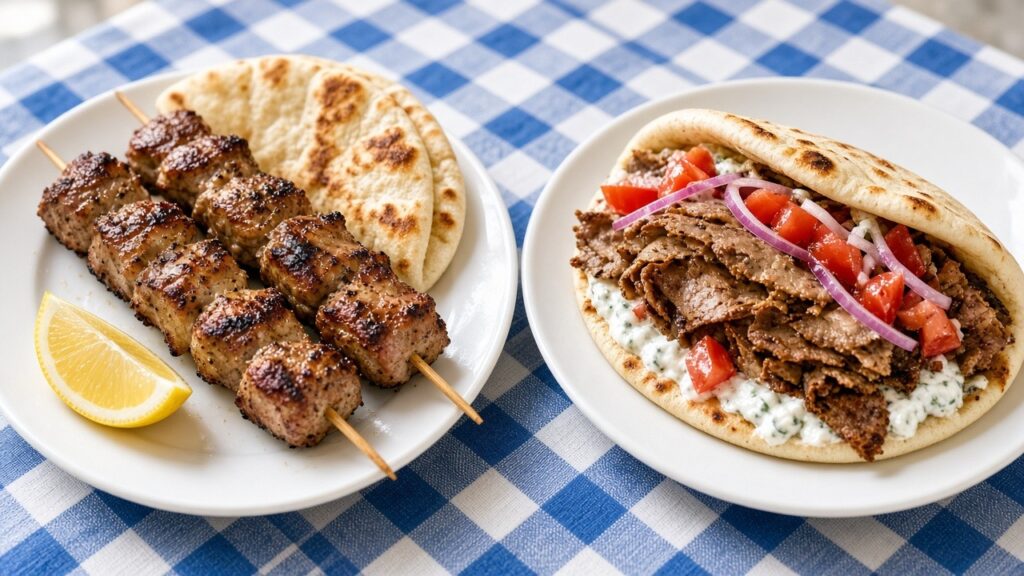
Two warm pitas, the same tomato and onion, perhaps the same spoonful of tzatziki—and two different meat preparations inside. That is why souvlaki and gyro are easy to confuse when you first look at a menu.
Souvlaki is usually pieces of meat cooked on a skewer. Gyro is meat cooked on a rotating vertical spit and shaved off in thin slices. Either can be served in pita or on a plate, so the bread and toppings do not define the difference. In the US, a beef-and-lamb gyro cone is common; in Greece, pork and chicken gyros are common too.
If you remember “skewered chunks versus shaved slices,” most of the menu suddenly makes sense.
Souvlaki vs gyro at a glance
| Feature | Souvlaki | Gyro |
|---|---|---|
| Basic preparation | Small pieces threaded onto skewers and grilled | Meat arranged or formed on a vertical rotating spit, then sliced |
| Typical texture | Distinct chunks with grilled edges | Thin slices with browned edges and tender interiors |
| Meat possibilities | Pork, chicken, lamb or other variations | Pork, chicken, lamb, beef or blends, depending on place and kitchen |
| Served in pita? | Yes, often | Yes, often |
| Served on a plate? | Yes | Yes |
| Typical accompaniments | Pita, tomato, onion, tzatziki, lemon or other sides | Many of the same accompaniments |
| What to ask if unsure | “Is it grilled pieces on a skewer?” | “Which meat is used, and is it shaved from a spit?” |
The Greek tourism board’s guide to cherished Greek dishes describes the distinction between skewered meat, pita-wrapped skewered meat and pita gyro. That is a helpful corrective to the idea that one must be a sandwich and the other must be a plate.
What is souvlaki?
Souvlaki is associated with small skewers of grilled food, most commonly meat. The pieces are cut small enough to cook relatively quickly and develop browned edges. Pork and chicken are familiar choices, though other meats and vegetable versions exist.
A marinade may include olive oil, lemon, garlic and oregano, but no single marinade defines every souvlaki. The cut, seasoning and cooking all affect the result. “Souvlaki” does not mean that every version contains the same meat or sauce.
Does it arrive on the skewer?
Sometimes. You may get skewers on a plate with bread, salad, rice or fries. In a pita wrap, the cooked meat is generally taken off the skewer before wrapping. Removing the wooden stick does not turn it into gyro.
What does kalamaki mean on a Greek menu?
In some Greek usage, especially associated with Athens, kalamaki helps specify the skewer. Food names vary by region, so souvlaki can be used more broadly in conversation or ordering than the neat definitions in an English comparison chart.
If you need to know exactly what is coming, ask whether it is skewered pieces or shaved meat. A specific question works better than correcting a local speaker’s everyday terminology.
What is gyro?
Gyro refers to the rotating-spit preparation and the food made from it. Meat cooks as the spit turns near a heat source. The browned outside is shaved into thin pieces, while the remaining meat continues cooking.
Some spits are built from layers of meat. Some familiar US gyro preparations use a seasoned, formed cone, often with beef and lamb. Those are different constructions, so texture can vary noticeably even when both dishes are called gyro.
Is gyro always lamb?
No. That assumption is especially easy to make if your main reference is a US Greek-American sandwich shop. Pork and chicken gyros are common in Greece, while beef-and-lamb combinations are familiar in the US. A menu’s “gyro meat” may be a blend; ask if the species matters for your diet.
Do not assume “chicken gyro” means grilled chicken breast chunks. It may mean shaved chicken from a spit. Conversely, a shop may use the word loosely for a seasoned chicken wrap. The menu description and the kitchen’s answer matter.
Is homemade gyro exactly the same?
A home recipe can approximate the seasoning and thin-sliced texture using a loaf, skillet or oven method. That can be delicious, but it is an adaptation if you are not using a vertical spit. Calling every seasoned meat strip “authentic spit-roasted gyro” would hide the actual technique.
Why do they come with the same toppings?
Because the accompaniments work with either meat: juicy tomato, sharp onion, creamy tzatziki and soft bread are good partners for grilled or roasted food. Fries may go inside a pita in some styles, or arrive on the side.
The toppings vary between shops, regions and personal preferences. Tzatziki is common but not mandatory in every version. A sauce substitution does not automatically change souvlaki into gyro or the reverse.
If you want to cook the accompaniments, my Greek dishes to make at home includes a starting point for tzatziki and other dishes. Think of the meal as separate components rather than assuming the sandwich name guarantees every topping.
Greece, the US and Chicago’s gyro story
In Greece, pork and chicken are familiar gyro choices, and local vocabulary can influence how a pita order is described. In the US, many people first meet gyro as seasoned beef-and-lamb slices from a formed cone. Neither experience tells the whole story of the other place’s menus.
Chicago played an important role in making the pre-formed gyro cone a widely distributed American food. WTTW’s account of Chicago gyro history describes the development of commercial cones, local manufacturing and competing origin claims. That history is stronger evidence for Chicago’s role in American gyro production than a claim that the city invented the whole rotating-spit tradition.
Gyro, döner, shawarma and kebab
Döner and shawarma also use rotating-spit techniques, but the names belong to distinct food traditions and do not guarantee identical meat, spices, bread or toppings. Gyro is closely connected to that broader history. Kebab is the wider, more flexible term and can include skewered or other meat preparations depending on the cuisine.
Souvlaki’s small grilled pieces make it visually closer to a skewered kebab than to shaved gyro. Shared techniques are useful comparisons, not reasons to treat all these dishes as one recipe.
Which tastes better?
It depends on the experience you want. Choose souvlaki when you like distinct grilled chunks, a little char, and the bite of the original cut. Choose gyro when you like thin slices and a mix of browned edges and softer meat through the pita.
Neither is automatically juicier. Overcooked souvlaki can be dry, and gyro sliced or held poorly can also become dry. A good cook matters more than the name on the board.
For a first comparison, try the same meat species and similar toppings if possible. Comparing chicken souvlaki with a beef-and-lamb gyro changes both the method and the meat, so it tells you less about the method alone.
Is souvlaki healthier than gyro?
There is no dependable answer from the names alone. Meat choice, fat content, portion size, marinade, added oil, pita, fries and sauce can all change the nutritional picture. A large souvlaki plate with fries may be quite different from a smaller gyro portion with salad, or the reverse.
If your priority is more vegetables, add salad. If you want a smaller meal, choose the serving size accordingly. For a specific medical diet, get actual ingredient and nutrition information rather than assuming “grilled” means every version fits your needs.
Are either gluten-free or keto?
The meat itself might fit a particular plan, but the complete dish may not. Pita contains carbohydrate and usually wheat; formed gyro meat or marinades can contain ingredients you do not expect. Cross-contact is relevant for celiac disease.
Ask about the meat mixture, sauces, bread and preparation surface. Ordering “without pita” answers only one part of the question. Do not treat a menu category as a gluten-free certification.
Making the two styles at home
For souvlaki, choose a recipe for your meat, cut even pieces, marinate in the refrigerator, and thread onto suitable skewers. Leave room for heat to reach the pieces instead of packing a dense block. Grill or use an appropriate hot pan, turning for even cooking, and check the meat rather than relying only on browned edges.
For a gyro-style home preparation, use a recipe specifically designed for a baked meat mixture or layered oven method. A firm cooked loaf can be sliced thinly and browned briefly in a skillet, but that is an adaptation rather than a home vertical spit. Do not partly cook a large block and shave raw or undercooked layers to imitate a restaurant machine.
For safety, chicken needs 165°F; ground beef or lamb mixtures need 160°F. Whole cuts of pork, beef or lamb have a USDA minimum of 145°F with a three-minute rest, though a particular recipe may cook them further. Use a thermometer in the thickest relevant piece and follow USDA’s safe-temperature guidance. Keep raw-meat marinade separate from ready-to-eat sauce, and refrigerate leftovers promptly.
What to order if you are unsure
Use the part you care about most:
- “I want grilled pieces, not shaved meat.” Ask for a souvlaki skewer or the kitchen’s equivalent.
- “I want thin sliced gyro meat.” Ask which meat the spit or cone contains.
- “I want a wrap.” Confirm pita rather than assuming the meat name guarantees it.
- “I want a plate without bread.” Ask what sides and sauces are included.
- “I avoid lamb, pork or beef.” Ask about the actual blend, not just the label.
- “I have an allergy.” Give the allergy explicitly and ask about cross-contact; do not rely on a topping description.
These questions work whether you are looking at a Greek menu or a Greek-American one. They also avoid turning ordinary regional vocabulary into an argument.
Souvlaki and gyro FAQ
How do you pronounce gyro?
For the Greek food, an English approximation is YEE-roh; the Greek plural gyros is often approximated YEE-rohs. English usage varies. You do not have to be perfect to order politely.
Is a gyro the same as shawarma?
No, though both belong to a broad family of rotating-spit meat preparations. Seasonings, meat choices, bread and accompaniments differ by tradition and kitchen. Similar equipment does not make the dishes interchangeable.
Is souvlaki the same as kebab?
Kebab is a broad word used for many preparations across different cuisines. Souvlaki is a Greek skewered preparation, but calling all kebabs souvlaki would erase meaningful differences in seasoning, meat and technique.
Can souvlaki be chicken?
Yes. Chicken souvlaki is a familiar option. Look for clearly described grilled pieces rather than assuming all chicken pita fillings are the same preparation.
Does gyro have tzatziki mixed into the meat?
Not as a defining rule. Tzatziki is commonly an accompaniment. The meat’s own seasoning is separate, although a particular kitchen can use its own recipes and sauces.
Which is easier to make at home?
Souvlaki is generally the more direct match for ordinary home equipment: small pieces, skewers and a grill or suitable pan. Gyro-style home recipes are usually adaptations of a technique that uses specialized spit equipment.
The short answer stays simple: choose the meat and serving you want, then remember that souvlaki is about skewered pieces and gyro about shaved spit-cooked meat. Everything else on the plate is a separate, delicious decision.