
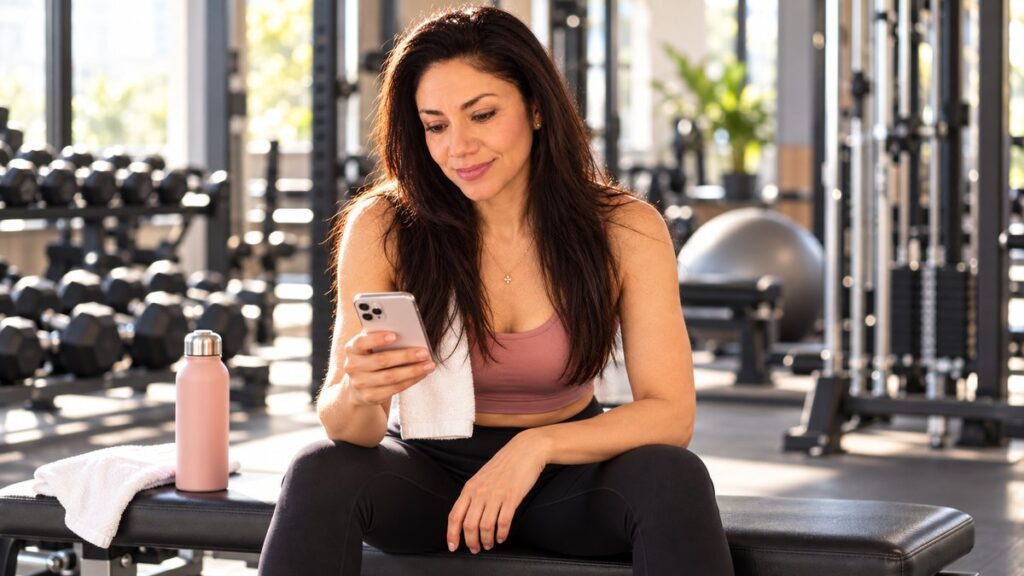
Starting a gym routine is not hard because the exercises are hard. It’s hard because of everything around them: finding time, walking in the first day, not knowing what to do, and keeping going after the excitement of week one fades. I do both Zumba and the gym. Here’s the practical plan I’d give any friend.
To get into a gym routine, choose two or three fixed days, start with short full-body sessions you can repeat, plan each workout before you go, and track it. Pack your bag the night before, start easy, and focus on showing up consistently for a few weeks.
Step 1: Decide why (and make it about how you feel)
A clear reason helps on the days you don’t feel like going. Good reasons are about how you want to feel and what you want to be able to do: more energy, feeling strong carrying groceries up the stairs, dancing longer in Zumba, less stress after work. Write yours down.
Step 2: Pick a realistic schedule
The biggest mistake is planning six days a week when your life has room for two. Start with what you can do even in a busy week.
| Your week | Starter schedule |
|---|---|
| Very busy | 2 days, 30 minutes |
| Average | 3 days, 30–45 minutes |
| More free time | 3 days of gym + 1–2 days of walking or dance |
Schedule it like an appointment. “Monday, Wednesday, Friday at 7 a.m.” works better than “three times a week sometime.”
For reference, the U.S. Physical Activity Guidelines recommend at least 150 minutes of moderate activity a week plus muscle-strengthening on two or more days. A two- or three-day gym routine plus walking gets you there.
Step 3: Choose the right gym
The best gym is the one you’ll go to. Look for:
- Location: close to home or work. Every extra minute of travel is an excuse.
- Hours that match your schedule.
- Atmosphere: do you feel comfortable there? Visit at the time you’d normally go.
- Classes: many gyms include Zumba, toning or cycling, which are great for variety.
- Price: check sign-up fees and cancellation rules.
In Chicago, the Park District’s fitness centers are an affordable option, and some field houses have indoor walking tracks. In warm weather, the city also has free outdoor gym equipment in parks along the lakefront.
Step 4: Follow a simple beginner plan
Don’t invent a new workout every time. Repeat a simple full-body routine for several weeks.
A beginner full-body session (about 40 minutes):
| Part | What to do |
|---|---|
| Warm-up (5–10 min) | Treadmill walk, bike or elliptical at an easy pace |
| Legs | Leg press or bodyweight squats, 2–3 sets of 10–12 |
| Push | Chest press machine or wall/incline push-ups, 2–3 sets of 10–12 |
| Pull | Seated row or lat pulldown, 2–3 sets of 10–12 |
| Hips | Glute bridges, 2–3 sets of 10–12 |
| Core | Plank, 2–3 holds of 20–30 seconds |
| Cool-down (5 min) | Easy walk and gentle stretches |
Tips:
– Machines are beginner-friendly because they guide the movement.
– Choose a weight you could lift a couple more times at the end of each set.
– Increase slowly: a little more weight or a few more reps when it feels easy.
– Ask a trainer or staff member to show you how to use each machine and set it up. Many gyms offer a free orientation.
Step 5: Plan before you go
Walking in without a plan is how people wander, feel lost and leave. Write your workout in your phone or a notebook: exercises, sets, reps and weights. Then you just follow the list.
Step 6: Beat gym nerves
Almost everyone feels nervous at first. Knowing the unwritten rules helps (see gym etiquette for beginners). What helps:
- Go at quieter times (mid-morning, early afternoon) for the first few weeks.
- Take a tour so you know where everything is.
- Bring headphones and a playlist that makes you feel powerful.
- Start with a class. A group class gives you structure and an instructor.
- Remember: most people are focused on their own workout.
Dancers know this feeling: the first class is the hardest. Here’s my guide to not feeling awkward; the same tricks work at the gym.
Step 7: Make it a habit
Habits form from repetition and making things easy.
- Pack your bag the night before and leave it by the door.
- Stack the habit: gym right after work, or right after dropping off the kids.
- Track your workouts: a check on the calendar is motivating.
- Plan for bad days: if you only have 15 minutes, do 15 minutes. It still counts.
- Find a buddy: it’s harder to skip when someone is waiting.
- Reward consistency, not perfection.
Step 8: Add variety you enjoy
Once the routine feels normal, add what you love: a Zumba class, a dance class, swimming, or long walks. I love the mix of gym strength and dance joy. If you’re choosing between them, I compared them here: Is Zumba better than the gym?
A sample first month
| Week | Plan |
|---|---|
| 1 | 2 sessions: learn the machines, light weights, warm-up and cool-down |
| 2 | 2–3 sessions: same routine, write down your weights |
| 3 | 3 sessions: add a set or a little weight where it felt easy |
| 4 | 3 sessions + 1 class or long walk you enjoy |
What to bring to the gym
- Comfortable clothes and supportive shoes.
- Water bottle.
- Small towel.
- Headphones.
- Lock for the locker, if needed.
- Your workout plan.
How to stay motivated when it gets hard
- Remember your why.
- Notice progress that isn’t on a scale: lifting more, climbing stairs easily, more energy, better sleep.
- Change something if you’re bored: a new class, a new playlist, a new time.
- Don’t quit after a missed week. Just go back to your plan. Consistency over months matters more than any single week.
Common beginner mistakes
- Doing too much too soon and feeling exhausted or sore for days.
- Skipping the warm-up.
- Changing the routine every session.
- Comparing yourself with people who have trained for years.
- Waiting for motivation instead of following a schedule.
If you have a health condition or haven’t exercised in a long time, check with your doctor before starting.
Your first gym visit, step by step
The first visit does not need to be a hard workout. Its job is to make the next visit less mysterious. I would rather leave knowing where things are than wander through ten unfamiliar machines and feel defeated.
- Check in and ask for the basics. Confirm how lockers work, whether you need your own lock, where the bathrooms are, and how to request an equipment orientation. A staff demonstration is more useful than copying someone whose machine settings do not fit you.
- Take a short tour. Find the cardio area, beginner-friendly resistance machines, drinking water and an open space for warming up. Check any studio-room rules before assuming an empty room is available.
- Warm up gently. Try several easy minutes of walking or another comfortable movement. You should feel more ready to move, not already exhausted.
- Try a small, familiar plan. If you have an appropriate beginner routine, do that. Otherwise, use the visit to learn a few movements with qualified help instead of improvising heavy lifts. Start with a load you can control and stop if you feel pain, dizziness or unusual symptoms.
- Learn the equipment reset. Ask how to change the seat, adjust the pin or release a safety catch. Write down settings that fit you so you can return confidently.
- Finish before everything feels overwhelming. A manageable first visit is a success. Clean equipment according to the gym’s rules, put items away and check that you have all your belongings.
- Book your own next visit in your plan. Choose a realistic day rather than promising to come back every day immediately. You are building familiarity as well as fitness.
If you have a condition, injury, pregnancy-related consideration or uncertainty about exercise safety, get individual guidance before choosing a routine. A general gym checklist cannot decide which exercises are appropriate for you.
A gym-bag checklist you can actually use
Bring on nearly every visit
- A water bottle, following the facility’s rules.
- Clean workout shoes suitable for your planned activity.
- Clothing that lets you bend and reach without constant adjustment.
- Your membership access, phone or other check-in item.
- A small towel if the gym asks you to bring one.
- A lock if needed; check the locker style first.
- Any prescribed emergency medication you normally carry, handled according to your clinician’s instructions.
- A short written workout or orientation plan so you do not have to remember everything under pressure.
Add only if you will use them
Bring shower sandals and toiletries if you plan to shower, a change of clothes if you are going elsewhere afterward, and a snack if it suits your own meal schedule. Headphones are optional; keep the volume low enough to hear announcements and people around you.
You do not need lifting straps, a belt, chalk, supplements or a new wardrobe to make a legitimate first visit. Specialized equipment should solve an actual training need, not a nervous feeling that everyone else owns more things.
What should stay home?
Leave unnecessary valuables behind. Avoid glass containers if prohibited, strong fragrance in shared spaces, and anything that blocks a walkway. Do not leave your bag beside a machine unless the gym explicitly permits it; lockers keep both your belongings and the floor safer.
Before leaving, check the locker, charging area and bottle holder. A calm exit makes the whole visit feel more manageable—and makes it easier to come back.
FAQ
How many days a week should a beginner go to the gym?
Two or three days is a great start. Guidelines recommend muscle-strengthening activities on at least two days a week.
How long does it take to make the gym a habit?
It varies from person to person. Expect it to take weeks of repetition; keep the routine simple and the schedule fixed so it becomes automatic.
What should I do on my first day at the gym?
Take a tour, ask for an orientation, do a light warm-up and a simple full-body routine with machines, and leave feeling good, not exhausted.
Is it better to go to the gym in the morning or evening?
The best time is the one you can stick to. Mornings avoid end-of-day excuses; evenings may fit better around work.
How do I stop feeling intimidated at the gym?
Go at quiet times, follow a written plan, use headphones, start with machines or classes, and remember everyone started as a beginner.
¡Vamos! Your first workout doesn’t have to be perfect. It just has to happen.