
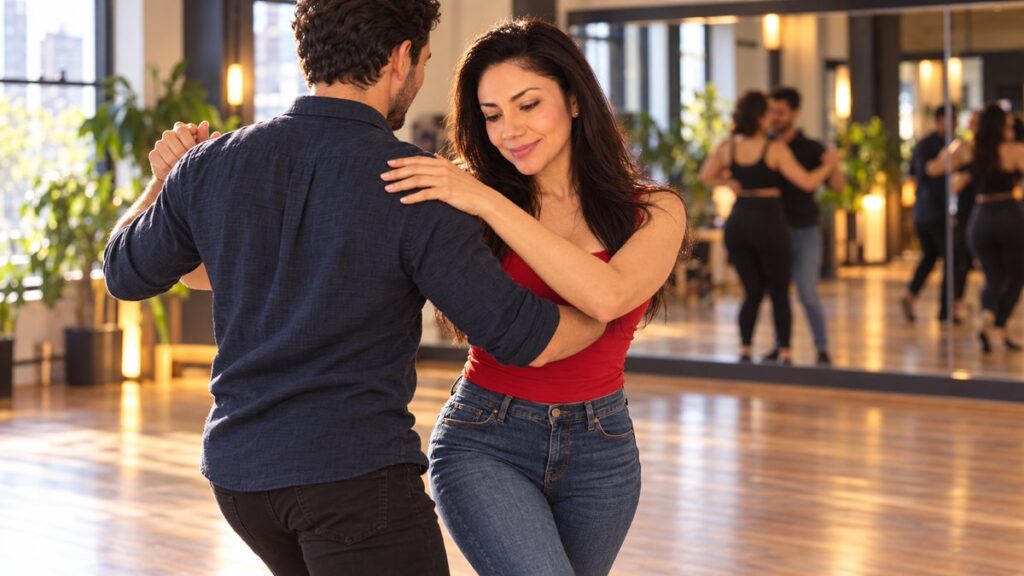
Merengue is happiness you can dance. In every Latin party I’ve ever been to, when the merengue starts, everyone gets up: kids, grandparents, the shy cousin. It’s the easiest Latin dance to learn, and in ten minutes you’ll be dancing. Let’s go!
To dance merengue, march in place on every beat of the music, shifting your weight from one foot to the other. Keep your steps small and bend the knee of the stepping leg so your hips move naturally. Then add side steps, turn slowly with your partner, and keep marching on every beat.
What is merengue?
Merengue is the national dance of the Dominican Republic, and it’s danced all over Latin America and at every Latin party in Chicago. The music is fast and joyful, with instruments like the accordion, the tambora (a two-sided drum) and the güira (a metal scraper). The dance is simple: one step on every beat, and a lot of joy.
A little merengue history
Merengue grew up in the Dominican Republic in the 1800s, with roots in European ballroom dances and African rhythms. In the 20th century it became the national music and dance, and in 2016 UNESCO added the music and dance of merengue in the Dominican Republic to its list of the Intangible Cultural Heritage of Humanity. Today you’ll hear two big families of merengue:
| Style | Sound | When you’ll hear it |
|---|---|---|
| Merengue típico (also called perico ripiao) | Accordion, tambora and güira, fast and earthy | Traditional parties and festivals |
| Orchestral or modern merengue | Horns, piano, bass and big bands | Latin nights, weddings, Zumba classes |
As a Panamanian, the accordion makes me smile: our música típica in Panama loves the accordion too. Different country, same joy.
Step 1: Find the beat
Merengue music has a strong, steady beat, like a march: 1, 2, 3, 4, 5, 6, 7, 8. You step on every single count. No pauses, no tricks. Listen for the drum and clap on every beat before you start moving.
Step 2: The basic merengue step (the march)
- Stand with your feet slightly apart, knees soft.
- Step in place with your left foot on count 1.
- Step in place with your right foot on count 2.
- Keep going: left, right, left, right, one step on every beat.
- Keep your steps small. Merengue isn’t a big walk; it’s a little march close to the floor.
That’s it. You’re dancing merengue!
Step 3: Add the hips (the merengue “swing”)
The hip motion in merengue doesn’t come from pushing your hips. It comes from your knees:
- When you step on your left foot, bend your left knee slightly, then straighten it as you shift your weight.
- Your hip moves naturally to the side as your weight changes.
- Keep your upper body tall and relaxed. Only the legs and hips move.
Practice slowly in front of a mirror. When it feels natural, try it at full speed with music.
Step 4: Move side to side
Now take your march for a walk:
- Side step: step to the left with your left foot, bring your right foot next to it. Repeat. One step per beat.
- Forward and back: march forward four counts, then back four counts.
- Turn in place: march in a small circle, four or eight counts to turn all the way around.
Step 5: Dance merengue with a partner
Merengue is usually danced in a closed position:
- The leader puts their right hand on the follower’s upper back, and holds the follower’s right hand with their left hand at about shoulder height.
- The follower rests their left hand on the leader’s shoulder.
- Stand close but comfortable, facing each other.
- Both march on every beat; the leader starts with the left foot, the follower with the right (like a mirror).
Easy partner moves:
- Side steps together, to the leader’s left.
- Walking turn: both march in a circle while holding the closed position.
- Underarm turn: the leader raises their left hand, and the follower walks under it in a small circle, still marching on every beat (about four counts to turn).
- Hand-in-hand: let go of the closed position, hold both hands, and march around each other.
The beauty of merengue: turns are slow and you never stop marching, so it’s very hard to get lost.
Merengue moves to learn next
Once you can march with a partner, these are the classic next steps. Each one keeps the same march on every beat:
| Move | What happens | Tip |
|---|---|---|
| Follower’s right turn | The leader raises the joined hands and the follower turns to the right under them | Four counts, small steps |
| Leader’s turn | The leader turns under their own arm while the follower keeps marching | Don’t let go of the hand |
| Hammerlock | The follower’s arm wraps softly behind her back as she turns | Soft arms, never pull |
| Cuddle (sweetheart) | The follower turns into the leader’s arm so both face the same direction | Great for walking forward together |
| Window | Both partners look at each other through raised joined hands | Fun for photos! |
Learn them in class, where a teacher can show the hand connections. Merengue is often the first dance at a Latin party, so this little set will carry you through a whole song.
A one-week merengue practice plan
- Day 1: clap the beat for two songs, then march in place for two songs.
- Day 2: add the knee and hip motion, slowly, in front of a mirror.
- Day 3: side steps and forward-and-back, four songs.
- Day 4: turns in place: four counts, then eight.
- Day 5: practice the closed position with a friend or family member.
- Day 6: freestyle: dance two full songs mixing everything, without stopping.
- Day 7: go dancing! A Latin night, a family party or a Zumba class.
Where to learn merengue in Chicago
- Latin Street Music & Dancing (600 W. Roosevelt Rd.) lists merengue among its classes, along with salsa, bachata, cumbia and cha-cha.
- Beginner lessons at Latin nights: many Chicago socials start with a lesson, and the DJs play merengue between salsa and bachata. Here’s where to go salsa dancing in Chicago.
- Chicago SummerDance: free lessons and live bands in Grant Park and neighborhood parks in summer.
- Zumba: merengue is in almost every class. Find one in my guide to Zumba classes in Chicago.
Common beginner mistakes
- Steps too big. Keep them small and close to the floor.
- Pushing the hips. Let the knees create the movement.
- Stopping. Keep marching on every beat, even during turns.
- Looking at your feet. Look at your partner and smile!
- Stiff arms. Keep them soft and connected.
Where can I practice merengue?
- At home: play merengue songs and march for a few songs.
- In a Zumba class: start with my Zumba for beginners guide.
- At Latin nights: here’s what to expect at a salsa social.
Good merengue songs for beginners
Look for classic merengue from artists like Juan Luis Guerra, Wilfrido Vargas, Johnny Ventura and Elvis Crespo (“Suavemente” is a party favorite). Many have a clear, strong beat that’s easy to march to.
How to dance merengue FAQ
Is merengue easy to learn? Yes, it’s the easiest Latin dance. You step on every beat.
What is the basic step of merengue? A march in place, one step on every beat, with the knees creating the hip motion.
What’s the difference between merengue and salsa? Merengue steps on every beat with no pause; salsa uses an eight-count pattern with pauses on 4 and 8 and more turns.
Where is merengue from? The Dominican Republic, where it’s the national music and dance.
What instruments are in merengue? Traditional merengue uses the accordion, the tambora (a two-sided drum) and the güira (a metal scraper). Modern merengue adds horns, piano and bass.
What’s the difference between merengue and bachata? Both come from the Dominican Republic. Merengue is a fast march on every beat; bachata is a four-count step with a tap or hip motion on the 4.
Do you need a partner for merengue? No. You can dance it alone, in a line, or with a partner.
How fast is merengue? Usually fast, but because the step is simple, the speed is easy to follow.
Next steps
When you’re comfortable with merengue, try bachata or salsa. Here’s my guide to salsa vs. bachata vs. merengue, my Dance & Zumba hub and how to learn salsa dancing as a beginner.
¡Que viva el merengue! — MarGo