
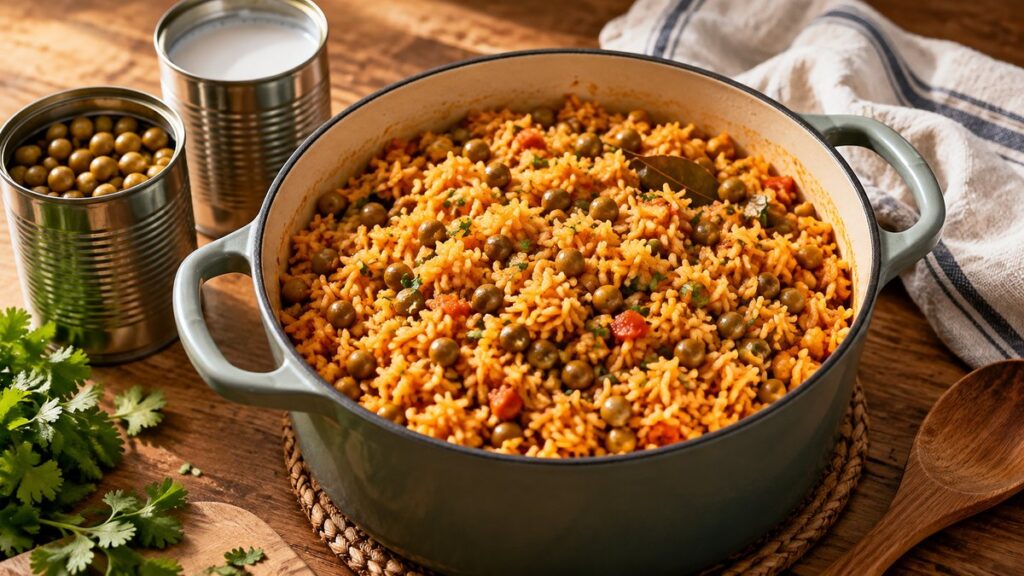
Fresh guandú is a treasure, and frozen guandú is my everyday choice in Chicago. But some nights I get home late, I want arroz con guandú, and the only pigeon peas in the house are in a can. Good news: canned guandú makes a delicious pot of rice, as long as you adjust the liquid. Here’s how, in English and in Spanish.
To make arroz con guandú de lata, drain and rinse a 15-oz can of pigeon peas, cook a sofrito, add 2 cups of rinsed rice, the guandú, a can of coconut milk and about 1⅓ cups of water, boil until the liquid reaches the rice, then cover and steam on low for 20 to 25 minutes.
Is canned guandú as good as fresh?
It’s different, but very good. Canned pigeon peas are already cooked, so they’re softer and a little saltier, and they don’t need any pre-cooking. That saves 20 minutes. The flavor is slightly milder than fresh or frozen green guandú. A good sofrito, coconut milk and culantro make up the difference.
Two kinds of cans to know:
- Green pigeon peas (gandules verdes, guandú verde): the closest to fresh. This is what I buy.
- Dry/mature pigeon peas (brown or beige): firmer and earthier. They work too.
Both are sold in the Latin aisle of most US supermarkets, often by Goya and other Latin brands.
Ingredients
Serves 6 as a side.
- 2 cups (400 g) long-grain white rice, rinsed
- 1 can (15 oz / 425 g) green pigeon peas, drained and rinsed
- 1 can (13.5 oz / 400 ml) coconut milk, shaken
- 1⅓ cups (320 ml) water or chicken broth
- 2 tbsp oil
- 2 oz (55 g) diced ham or bacon (optional)
- 1 onion, finely chopped
- ½ green bell pepper or 3 ají dulce, finely chopped
- 3 garlic cloves, minced
- 2 tbsp tomato sauce
- 4 culantro leaves or 3 tbsp cilantro, chopped
- 1 tsp salt (start here; canned peas are salty)
How to make it
- Rinse the guandú. Drain the can and rinse the peas well. Canned liquid is salty and can make the rice gummy.
- Make the sofrito. Heat the oil in a heavy pot. Cook the ham or bacon 2 to 3 minutes. Add the onion and pepper and cook 4 minutes. Add the garlic, tomato sauce and half the culantro and cook 2 minutes.
- Add rice and peas. Stir in the rice to coat it, then the guandú.
- Add the liquid. Pour in the coconut milk and water, add the salt and taste the liquid. It should be slightly saltier than you want the rice.
- Boil uncovered until the liquid drops to the level of the rice and small holes appear, 6 to 8 minutes. Stir once, gently.
- Cover and steam on the lowest heat for 20 to 25 minutes without lifting the lid.
- Rest 5 minutes, then fluff with the remaining culantro.
Why less water than with fresh guandú?
Fresh or frozen guandú gets cooked first and adds liquid of its own; canned peas don’t need cooking and are already soft. So for 2 cups of rice I use about 3 cups of total liquid (coconut milk plus water) with canned peas, and I don’t add the peas’ canning liquid.
Coconut milk: buy the right can
Use unsweetened coconut milk (13.5 oz / 400 ml), full fat for the classic flavor. Don’t use cream of coconut (like the sweet kind made for piña coladas); it’s sweetened and will turn your rice into dessert. “Lite” coconut milk works, but the rice is less rich. Shake the can hard before opening, because the cream separates.
Scaling: how much liquid for canned guandú
| Rice | Canned guandú (15 oz) | Coconut milk | Water or broth | Salt (to start) | Serves |
|---|---|---|---|---|---|
| 1 cup (200 g) | ½ can | ½ can | ⅔ cup (160 ml) | ½ tsp | 3 |
| 2 cups (400 g) | 1 can | 1 can | 1⅓ cups (320 ml) | 1 tsp | 6 |
| 4 cups (800 g) | 2 cans | 2 cans | 2⅔ cups (640 ml) | 2 tsp | 12 |
For a big batch, use a wide pot so the rice cooks in an even layer, and add 5 minutes to the steaming time.
Rice cooker and Instant Pot methods
- Rice cooker: cook the sofrito in a skillet, then put it in the rice cooker with the rinsed rice, peas, coconut milk, water and salt. Stir once and use the white-rice setting. Let it rest 10 minutes on “warm” before opening.
- Instant Pot: use the sauté function for the sofrito, add the rice and stir, then the peas, coconut milk and only 1 cup (240 ml) water for 2 cups of rice. Scrape the bottom so you don’t get a burn warning. Cook on high pressure 6 minutes, natural release 10 minutes.
Want the concolón?
For the crispy layer at the bottom (concolón), use a heavy pot or caldero, and after the rice is cooked, raise the heat to medium for the last 3 to 5 minutes without stirring. Listen for a gentle crackle and smell for toasty rice, not burnt. Scrape it out in pieces and serve it on top.
Variations
- With pork: brown diced pork shoulder or smoked pork chop in step 2 for a heartier pot.
- With chorizo or sausage: slice and brown it with the sofrito.
- Vegetarian: skip the ham and use vegetable broth; the coconut milk carries the flavor.
- Without coconut: 3 cups of broth instead of coconut milk plus water.
- With dried guandú: soak overnight and simmer 45 to 60 minutes until tender, then use like frozen peas in my from-scratch recipe.
Reheating
Sprinkle the rice with 1 to 2 tablespoons of water, cover and microwave 2 minutes, or reheat in a covered skillet over low heat. Refrigerate leftovers within 2 hours; cooked rice shouldn’t sit out overnight.
Troubleshooting
- Mushy rice: too much liquid, or stirring after covering.
- Too salty: didn’t rinse the peas, or salted before tasting. Next time start with ½ teaspoon of salt.
- Peas fell apart: add them on top of the rice just before covering instead of stirring them in early.
- Hard, undercooked rice on top: the lid wasn’t tight, or the heat was too low. Cover with foil under the lid, sprinkle 2 tablespoons of water and steam 10 more minutes.
- Burnt bottom: the heat was too high while steaming. Use the lowest flame or a heat diffuser.
- Rice tastes flat: add more culantro at the end and a squeeze of lime, and taste the liquid for salt before covering next time.
- Coconut milk separated or oily: the can wasn’t shaken, or it boiled too hard. Stir it in and keep the boil gentle.
En español: arroz con guandú de lata
Ingredientes: 2 tazas de arroz, 1 lata de guandú (escurrido y enjuagado), 1 lata de leche de coco, 1⅓ tazas de agua, 2 cucharadas de aceite, jamón o tocino picado (opcional), 1 cebolla, ½ pimentón verde o 3 ajíes dulces, 3 dientes de ajo, 2 cucharadas de salsa de tomate, culantro picado y sal al gusto.
Preparación:
- Escurre y enjuaga bien el guandú.
- Sofríe el jamón, la cebolla, el pimentón, el ajo, la salsa de tomate y la mitad del culantro.
- Agrega el arroz lavado y el guandú, y mezcla.
- Añade la leche de coco, el agua y la sal. Prueba el líquido.
- Cocina destapado hasta que el líquido baje al nivel del arroz.
- Tapa y cocina a fuego bajo de 20 a 25 minutos, sin destapar.
- Deja reposar 5 minutos y suelta el arroz con un tenedor y el resto del culantro.
Consejo: el guandú de lata ya viene cocido y salado, así que usa menos agua y menos sal que con guandú fresco.
FAQ
Are canned gandules the same as guandú?
Yes. Guandú is the Panamanian name; gandules is the Puerto Rican one.
Which canned pigeon peas should I buy?
Green pigeon peas (gandules verdes) taste closest to fresh. Goya and other Latin brands sell them in 15-oz cans in most US supermarkets.
What’s the difference between canned, frozen and fresh guandú?
Fresh guandú (in Panama’s December harvest) is the most flavorful; frozen is very close and needs about 20 minutes of cooking; canned is already cooked, softer and saltier, and goes straight in.
Can I make it without coconut milk?
Yes. Use 3 cups of broth or water instead.
Should I use the liquid from the can?
No. Drain and rinse.
How long does it keep?
Refrigerate within 2 hours; it keeps 3 to 4 days and freezes for 2 months.
More Panamanian rice
For the from-scratch version with frozen or fresh peas, see my Panamanian arroz con guandú. Serve it with Panamanian tamales at Christmas, or try Panamanian arroz con pollo. Everything is linked in my guide to Panamanian food.
¡Buen provecho!