
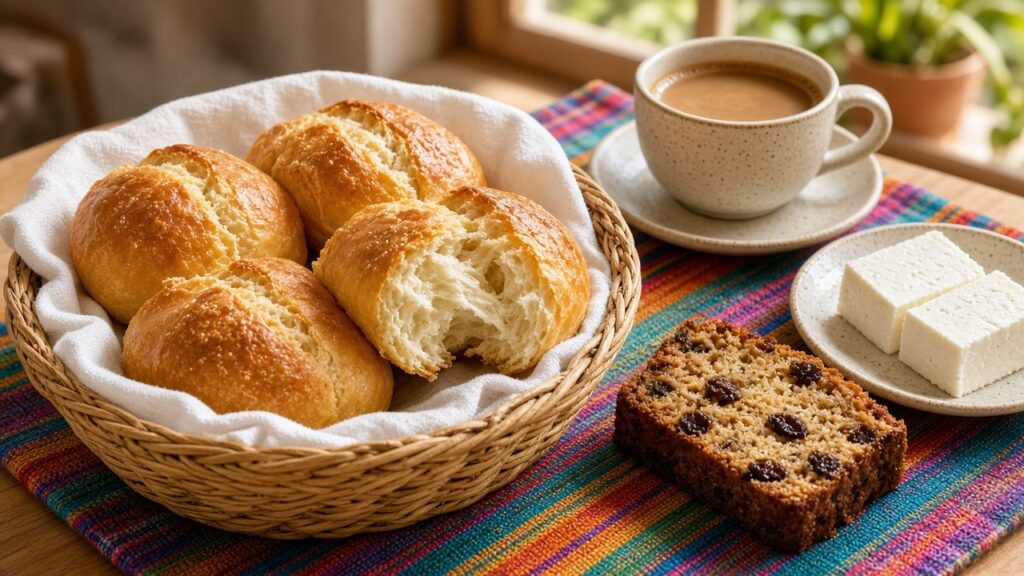
Walk into any Panamanian panadería in the morning and you’ll find the same comforting lineup: soft-crusted pan de micha rolls, dark and spicy pan bon, fluffy pan de leche and sweet rings of pan de rosca. Bread is a big part of the Panamanian breakfast table, served with butter, white cheese, eggs or stewed sausages and a cup of coffee with milk.
Pan de micha is Panama’s everyday white bread roll: a lean yeast dough of flour, water, yeast, salt, a little sugar and fat, shaped into small rolls with a deep crease down the middle and baked until golden, with a light crust and a soft, slightly chewy inside. Pan bon is a dark, sweet, spiced Afro-Caribbean bread with raisins from Colón and Bocas del Toro. Pan de leche is a soft milk bread, and pan de rosca is a sweet ring-shaped bread. To make micha at home, knead the dough for about 10 minutes, let it rise until doubled, shape it into rolls, press a crease into each, proof again and bake at 400°F for about 20 minutes.
Below: what pan de micha is, the other Panamanian bakery classics, ingredients, step-by-step instructions for micha, why bread turns out dense and how to fix it, what to eat with it, storage, a recipe card and answers to common questions. For the full morning spread, see what Panamanians eat for breakfast.
What is pan de micha?
Pan de micha (often just “micha”) is a simple white bread roll sold in bakeries and corner stores all over Panama. It’s usually shaped as a roll with a deep groove running down the middle, so it looks like two joined halves, which makes it easy to tear in two. The crust is thin and golden, and the crumb is soft with a little chew.
It’s an everyday bread: bought warm in the morning, split and buttered, filled with cheese or ham, or used to scoop up the sauce from stewed sausages or eggs.
Micha vs Mexican bolillo vs French bread
| Pan de micha | Mexican bolillo | French baguette | |
|---|---|---|---|
| Shape | Small roll with a deep center groove | Torpedo-shaped roll with a single slash | Long, thin loaf |
| Crust | Thin, light golden | Crusty | Very crisp |
| Crumb | Soft, slightly chewy | Soft and airy | Open and chewy |
| Dough | Lean dough with a little sugar and fat | Lean dough, sometimes a little fat | Flour, water, yeast, salt |
| Use | Breakfast, sandwiches | Tortas, breakfast | Everything |
Micha and bolillo are close cousins, both descended from European-style white bread rolls, but micha tends to be softer and is shaped differently.
Other Panamanian breads
Pan bon
Pan bon is a dark, sweet, spiced bread from Panama’s Afro-Caribbean communities in Colón, Bocas del Toro and Panama City. It’s closely related to Jamaican bun and other West Indian spiced breads. Pan bon is flavored with brown sugar or molasses, spices such as cinnamon, nutmeg and clove, and dotted with raisins, and some versions include grated coconut or a sweet glaze. Many families serve it at Christmas and Easter, often with cheese.
Pan de leche
Pan de leche is soft milk bread enriched with milk, butter, sugar and sometimes egg. It has a tender crumb and a shiny golden top, and it’s loved by kids at breakfast or as a snack.
Pan de rosca
A sweet ring-shaped bread, sometimes braided, sometimes glazed or sprinkled with sugar. It’s a bakery treat for breakfast or afternoon coffee.
Hojaldras
Not a bread from the oven but fried dough, hojaldras are Panama’s favorite breakfast fritter. Here’s my hojaldras recipe.
Other bakery favorites
- Pan de queso and cheese-filled rolls.
- Bollos (corn dough wrapped in husks), at the market rather than the bakery. See bollo de maíz.
- Almojábanos (corn and cheese fritters): almojábanos recipe.
- Pastries such as empanadas and sweet turnovers. See my Panamanian empanadas.
A simple pan bon at home
If you want to try pan bon, here’s a straightforward yeasted version for one loaf:
- Mix 3 cups flour, 2¼ teaspoons instant yeast, ½ cup brown sugar, 1 teaspoon cinnamon, ½ teaspoon nutmeg, ¼ teaspoon ground clove and ½ teaspoon salt.
- Add ¾ cup warm milk, 2 tablespoons molasses, 3 tablespoons melted butter, 1 egg and 1 teaspoon vanilla. Knead for 8 minutes until smooth.
- Knead in ¾ cup raisins (and ¼ cup grated coconut, if you like).
- Rise until doubled, about 1½ hours; the spices and sugar make it slower than micha.
- Shape into a loaf, place in a greased loaf pan and rise again for 45 minutes.
- Bake at 350°F for 35 to 40 minutes, covering loosely with foil if it browns too fast.
- Glaze with a little brown sugar dissolved in hot water while warm.
Let it cool completely before slicing, and serve it with cheese or butter.
Ingredients (8 rolls)
| Ingredient | Amount | Notes |
|---|---|---|
| Bread flour | 4 cups (500 grams) | All-purpose works; bread flour gives more chew |
| Instant yeast | 2¼ teaspoons (1 packet, 7 grams) | Or active dry yeast (see below) |
| Sugar | 1 tablespoon | Feeds the yeast and adds a touch of sweetness |
| Salt | 1½ teaspoons (9 to 10 grams) | |
| Butter or shortening | 2 tablespoons, softened | Softer crumb |
| Warm water | 1¼ cups (about 300 milliliters), about 105°F to 110°F | Add a little more if the dough is dry |
If you use active dry yeast, dissolve it in the warm water with the sugar and wait 5 to 10 minutes until it foams before adding it to the flour.
How to make pan de micha step by step
Kneading
- Mix the dry ingredients: flour, yeast, sugar and salt in a large bowl.
- Add the water and butter. Stir until a shaggy dough forms.
- Knead for 10 minutes by hand on a lightly floured counter, or 6 to 8 minutes in a stand mixer with a dough hook, until the dough is smooth, elastic and slightly tacky.
- Check with the windowpane test: stretch a small piece of dough thin. If it stretches without tearing and you can see light through it, it’s ready.
First rise
- Place the dough in a lightly oiled bowl and cover it.
- Let it rise in a warm place for 1 to 1½ hours, until doubled in size.
Shaping the “michita”
- Punch down the dough gently and divide it into 8 equal pieces (about 100 grams each).
- Shape each piece into a ball, then roll it into a short oval, about 4 inches long.
- Make the groove: dust the top with flour and press a wooden dowel, the handle of a wooden spoon or a chopstick lengthwise down the center, almost all the way through. This deep crease gives micha its two-part shape.
- Place the rolls on a parchment-lined baking sheet, crease side up, about 2 inches apart.
Second rise
Cover loosely and let the rolls rise for 30 to 45 minutes, until puffy. Press gently with a finger; the dent should spring back slowly.
Baking
- Preheat the oven to 400°F with a rack in the middle.
- Create steam (optional): place a metal pan on the bottom rack and pour in a cup of hot water when the bread goes in. Steam helps the crust and the rise.
- Brush or spray the rolls lightly with water.
- Bake for 18 to 22 minutes, until golden brown and hollow-sounding when tapped underneath.
- Cool on a rack for at least 15 minutes before eating.
For a softer crust, brush the hot rolls with melted butter.
Why it turns dense (and fixes)
| Problem | Likely cause | Fix |
|---|---|---|
| Dense, heavy rolls | Not kneaded enough | Knead until the dough passes the windowpane test |
| Didn’t rise | Old or dead yeast; water too hot | Check the yeast date; use warm, not hot, water |
| Flat rolls | Over-proofed | Shorten the second rise; bake when puffy, not huge |
| Dry crumb | Too much flour | Measure by weight or spoon and level flour |
| Pale crust | Oven not hot enough | Use an oven thermometer; bake longer |
| Hard crust | Baked too long or too dry | Brush with butter after baking; store covered |
| Crease disappears | Not pressed deep enough | Press almost to the bottom and dust with flour first |
| Uneven sizes | Pieces not weighed | Weigh each portion |
Cold kitchens slow the rise. Put the dough in an oven with only the light on, or near a warm (not hot) spot.
What to eat with pan de micha
- Butter and white cheese (queso blanco), the simplest breakfast.
- Salchicha guisada: stewed sausages in tomato sauce, perfect for dipping.
- Fried or scrambled eggs.
- Ham and cheese for a quick sandwich.
- Bistec picado or other saucy stews.
- Coffee with milk, the classic morning drink.
- Soup, such as sancocho, to dip.
Storage and freezing
- Room temperature: in a bread bag or covered container for 1 to 2 days.
- Refrigerator: not recommended; bread goes stale faster in the fridge.
- Freezer: cool the rolls completely, wrap them tightly, and freeze for up to 3 months.
- Reheating: warm frozen rolls at 350°F for 8 to 10 minutes, or thaw at room temperature and toast.
Make-ahead tips
- Overnight rise: after kneading, refrigerate the dough covered for up to 12 to 18 hours. Let it warm for an hour, shape and continue.
- Freeze shaped rolls: freeze unbaked shaped rolls on a tray, then bag them. Thaw overnight in the refrigerator, proof until puffy and bake.
Recipe card: pan de micha
Makes: 8 rolls. Prep: 25 minutes. Rise: 1½ to 2¼ hours. Bake: 18 to 22 minutes.
Ingredients
- 4 cups (500 g) bread flour
- 2¼ teaspoons instant yeast
- 1 tablespoon sugar
- 1½ teaspoons salt
- 2 tablespoons softened butter or shortening
- 1¼ cups warm water
Instructions
- Mix flour, yeast, sugar and salt; add water and butter.
- Knead 10 minutes until smooth and elastic.
- Rise 1 to 1½ hours until doubled.
- Divide into 8 pieces, shape into ovals and press a deep crease down each with a dowel.
- Proof 30 to 45 minutes until puffy.
- Bake at 400°F for 18 to 22 minutes, with steam if possible.
- Cool before serving.
FAQ
What is pan de micha?
A Panamanian white bread roll with a thin golden crust, a soft crumb and a deep groove down the middle. It’s the everyday breakfast bread of Panama.
What is pan bon?
A dark, sweet, spiced bread with raisins from Panama’s Afro-Caribbean communities, similar to Jamaican bun. It’s often eaten at Christmas and Easter, sometimes with cheese.
Where can I buy Panamanian bread in Chicago?
Panamanian bakeries are rare in Chicago, but Latin and Caribbean bakeries sell similar rolls, and some Jamaican and Caribbean bakeries sell spiced bun similar to pan bon. See my Panamanian food in Chicago guide. Baking micha at home is easy with this recipe.
Can I freeze homemade micha?
Yes. Freeze cooled rolls tightly wrapped for up to 3 months, and reheat them in the oven.
What is the difference between micha and Mexican bolillo?
Both are lean white bread rolls. Bolillo is torpedo-shaped with a single slash and a crustier exterior; micha has a deep center groove and a softer crust.
Can I use all-purpose flour?
Yes. The rolls will be slightly softer and less chewy. You may need a little less water.