
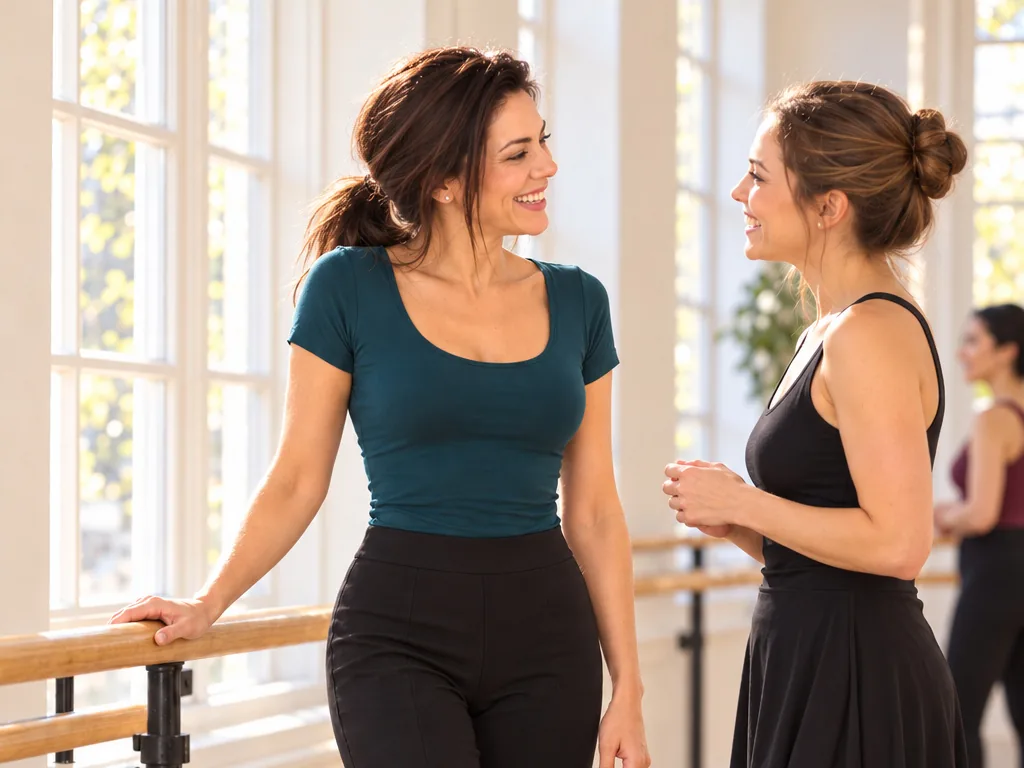
I’ll be honest: I don’t always feel graceful when I walk into a new class or step onto a new dance floor. Nobody does. Awkwardness isn’t a sign that you can’t dance. It’s a sign that you’re paying attention to yourself instead of the music. The good news is that it’s a habit you can change, and the fixes are surprisingly simple.
To stop feeling awkward dancing, give your attention a job: listen for the beat, keep your knees soft and do a simple step-touch or two-step. Relax your shoulders, smile, and remember people notice you far less than you think. In class, choose a true beginner level and keep moving when you get lost.
Why do I feel so awkward when I dance?
A few things happen at the same time:
- You’re learning and performing at once. Steps, rhythm and direction are new, and there are people (and maybe a mirror) around you.
- Your attention turns inward. “Am I doing it right? Is everyone looking?” That self-watching is exactly what awkwardness feels like.
- Your body tenses. Shoulders go up, knees lock, arms stiffen, and stiff movement feels (and looks) awkward.
- You compare. To the regular who’s been coming for five years, or to a dancer on social media.
The fix isn’t “be confident.” It’s to give your attention a better place to go and to loosen the body so the music can move it.
People notice you much less than you think
Psychologists call it the spotlight effect: we overestimate how much other people notice us. In a well-known Cornell study, students who wore an embarrassing T-shirt into a room guessed that about half the people there would notice it. In reality, far fewer did, less than a quarter.
On a dance floor, it’s even more true. Everyone in a beginner class is busy with their own feet. Everyone at a party is busy with their own drink, their own friends and their own moves. That’s freeing, ¿verdad?
Simple moves that always work
If you freeze when the music starts, use one of these. They work for almost any song.
| Move | How | Works for |
|---|---|---|
| Step touch | Step to the side, bring the other foot in, repeat to the other side | Anything: pop, Latin, wedding playlists |
| Two-step with a bounce | Like a step touch, with a little bend in the knees on each beat | Hip hop, R&B, pop |
| Weight shift | Shift your weight from foot to foot without moving your feet | Slow songs, crowded floors |
| Merengue march | March in place on every beat, hips follow the feet | Merengue, cumbia, any Latin song |
| Shoulder shimmy | Small, relaxed shoulder movements on the beat | Fun moments, add it to any step |
Add small arm movements (bend your elbows, let your hands move with the beat), and you’re dancing. Seriously. Simple and on the beat always looks better than complicated and stiff.
Your body: 5 quick tension fixes
- Drop your shoulders. Take a breath and let them fall away from your ears.
- Soften your knees. Locked knees make every move robotic.
- Breathe out. Many people hold their breath when they’re nervous.
- Let your arms move. Don’t glue them to your sides or cross them.
- Smile, or at least soften your face. It relaxes your whole body and tells everyone you’re having fun.
In a dance class
Before class
- Choose a true beginner level. “Open level” can move fast. Look for Beginner, Basic or Level 1, or start with Zumba, which is designed for following along.
- Arrive 10 minutes early so you can find your spot and the room feels yours.
- Tell the teacher it’s your first class. Good teachers will give you a simpler version and an encouraging look.
- Wear clothes you feel good in, and the right shoes for the style.
- Ask your questions in advance: Will there be partner rotation? Is filming allowed? You can say no to being filmed.
During class
- Stand in the middle, two or three rows back, not the back corner. You need to see the teacher. In the back corner, you spend the whole class guessing.
- Follow the feet first, then the arms.
- Keep moving when you get lost. March in place or keep a simple step until the next 8-count, then jump back in. Stopping is what feels awkward. Moving through mistakes is what dancers do.
- Watch the teacher, not yourself in the mirror. The mirror is for later.
- Laugh at mistakes. Everyone turns the wrong way sometimes. I promise.
After class
- Go back next week. The second and third classes are when awkwardness really drops, because the warm-up, the music and the faces are familiar.
- Practice one step at home in the kitchen. Next class, you’ll feel ahead.
I explain how to choose a class you’ll love in my guide to adult dance classes in Chicago.
At a party or wedding
- Get on the floor early, when the dance floor is fuller and less “on display,” or with a group of friends.
- Dance with your people. A circle of friends makes everyone braver.
- Start small: a weight shift and a nod. Build up as the songs go on.
- Join group dances. Line dances like the Cupid Shuffle or the Electric Slide tell you exactly what to do.
- Don’t stand at the edge watching. It’s harder to join after six songs of watching.
At a Latin social (salsa, bachata, merengue)
Social dancing with a partner adds a new layer, but there are rules that make it easier:
- Take a lesson first. Many Chicago socials start with a beginner lesson, a perfect warm-up. Latin Street Dancing’s Wednesday night at La Victoria in Logan Square, for example, includes a lesson before the DJs start.
- Ask for merengue or bachata first. They’re easier than salsa and give you a few comfortable songs.
- Tell your partner you’re a beginner. Good dancers will keep it simple.
- Say “thank you” at the end of the song. One song with someone is normal.
My guide to what a salsa social is and how to enjoy your first one covers the etiquette, and learning salsa without a partner is great for building confidence alone first.
Practice at home to feel braver in public
The fastest way to feel less awkward on a dance floor is to dance more off it:
- Dance to one song a day in your living room. Just one.
- Dance in front of a mirror, then without one.
- Record yourself once a week. You’ll see you look better than you feel.
- Follow a beginner Zumba video. You’ll get comfortable moving to Latin rhythms. My Zumba for beginners guide explains how to start.
Coming back to dance after years away
If you danced as a kid, in high school or in your twenties and stopped, coming back can feel awkward in a different way: your mind remembers more than your body.
- Take a class one level below where you left off. Your technique will come back faster than you expect, and it’s much more fun to feel good in class than to struggle.
- Use your experience, but don’t compare. You’re not competing with the dancer you used to be. You’re meeting the dancer you are now.
- Tell the teacher your background so they understand your starting point.
- Try a new style. Sometimes it feels freer to start fresh than to return to the one you used to know.
FAQ
How do I stop feeling self-conscious when dancing?
Shift your attention outward: to the music, the teacher or your partner. Relax your shoulders, keep your knees soft, and remember the spotlight effect: people notice you much less than you think.
What should I do with my arms when I dance?
Bend your elbows a little and let your hands follow the rhythm, or let your arms swing naturally with your steps. Avoid keeping them glued to your sides or crossed.
Is it normal to feel awkward in a dance class?
Completely normal. Almost everyone does in their first classes. It usually drops a lot by the third or fourth class.
How can I dance if I have no rhythm?
Start by nodding your head to the beat, then step on it. Most people who say they have “no rhythm” just haven’t practiced listening. It improves fast.
What are easy dance moves for beginners?
Step touch, two-step, weight shift, merengue march and a shoulder shimmy. They work with almost any song.
How do I feel less awkward dancing at a wedding?
Go on the floor early or with friends, start with a simple step touch, and join group dances that tell you what to do.
The dance floor has room for everyone, including you. ¡Vamos a bailar!