
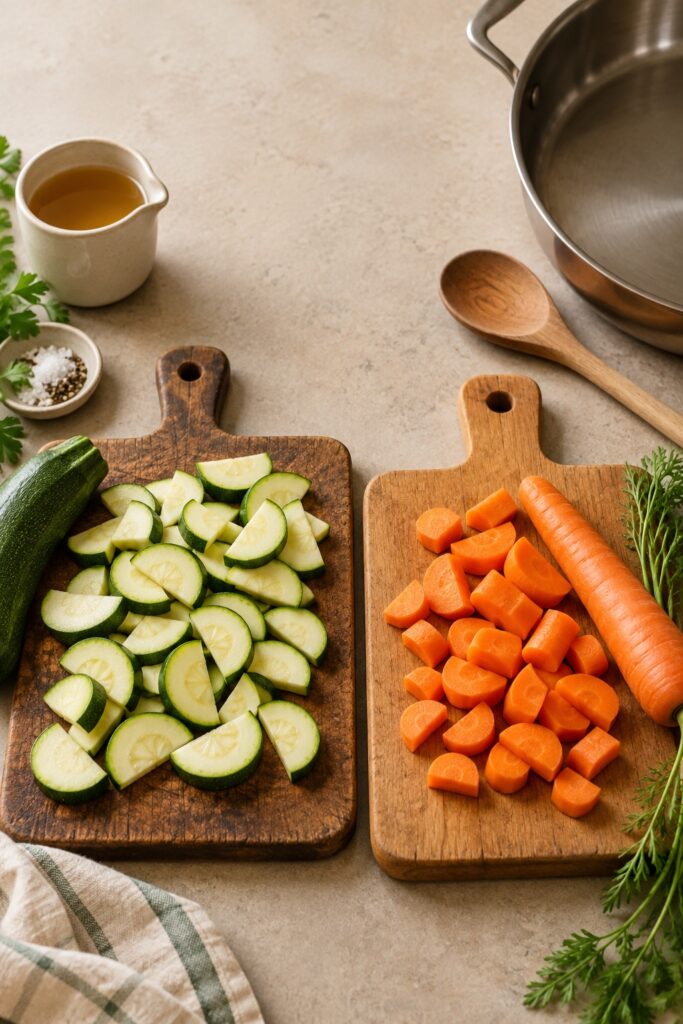
When an ingredient is missing, I want to look at its job before finding its replacement. An egg might bind a mixture, help a cake rise or be the main substance of a custard. One substitute cannot be expected to do all three equally well.
I’ll use ordinary cooking examples to show where you have room to adapt and where a complete tested recipe is the more useful choice.
Read the verb beside the ingredient
Find the point in the method where the ingredient appears. Is it whipped, dissolved, browned, folded in or sprinkled over the finished dish? That verb gives you a clue.
Then name its main function: moisture, bulk, fat, acidity, sweetness, aroma, thickening, binding or lift. Look for a second job, too. Broth provides liquid and seasoning. Cheese adds flavor but also has particular melting behavior. Garlic salt brings salt as well as garlic.
Colorado State University’s substitution guidance treats differences in moisture, flavor, texture and thickening as part of the decision. “Looks similar” is not enough.
Make easy changes at the assembly stage
A bowl made from separately cooked components is forgiving. You can prepare a different grain by its own directions and use it where the recipe calls for a cooked base. A fresh herb garnish can often change to another compatible herb if everyone can eat it.
A one-pot method is less flexible. Replacing dry pasta with a different raw noodle changes hydration, cooking time and the liquid left in the pan. Prepare the replacement separately first when that fits the dish. My pasta and noodle guide explains the difference.
Fresh, frozen, dried and canned describe different starting states. Raw dried beans cannot replace canned beans in a quick assembly. Raw dried kidney beans particularly need an authoritative preparation method, not a slow-cooker shortcut.
Try a thinner-yogurt example
Imagine a vegetable bowl with a thick yogurt-and-herb topping, but the available plain yogurt is thinner. The topping needs to cling and carry flavor; it does not need to set, whip or bake.
I would begin with a spoonful of the available yogurt and the herbs, leaving out the recipe’s added thinning liquid. Try it on a bite of the vegetable. If it coats pleasantly, the simplest adjustment may be less liquid. If it runs off, a different topping may be more useful than chasing the original with extra ingredients.
A bean purée could make a good spread, but it would be a different preparation with its own flavor and method. There is no need to claim the result is identical. This is an illustrative comparison, not a tested substitution ratio.
Account for water, salt and heat
Tomato paste and chopped tomatoes have different concentrations. A sweetened plant beverage and plain milk can behave and taste differently in a savory sauce. A tender vegetable replaced by a dense root needs a different cooking sequence, not merely the same number of spoonfuls.
Check the current label for added salt, sugar and flavorings. Cook a dense replacement earlier or separately when appropriate. If it releases much more water, consider how that affects browning or a filling’s consistency. Change one uncertain component at a time so you can understand the result.
Know when the formula matters
Binding, leavening and thickening are different jobs. A moist purée may replace some moisture without reproducing an egg’s structure. Flour and cornstarch do not automatically thicken equally by the spoonful. A cream substitute useful for baking may not whip.
Illinois Extension’s recipe substitutions make these distinctions. For cakes, custards, yeast doughs and whipped mixtures, choose a tested variation designed for the replacement rather than stacking several unrelated swaps.
Home preservation is a separate safety category. Do not improvise acidity, ingredient proportions or processing in a canning or pickling recipe. Use an authoritative tested method and only its permitted changes. The National Center for Home Food Preservation explains why pickling ratios matter.
A functional substitute is not automatically an allergy-safe one
Check every ingredient and the person’s established requirements, including preparation and cross-contact. Removing a topping does not reliably remove an allergen already introduced. A nut or seed paste used for creaminess changes the ingredient information everyone needs.
Also keep the original cooking requirement: egg-free batter can still contain raw flour and should not be tasted uncooked. Follow the complete suitable method.
Sometimes another meal is the sensible substitute. If preserving the recipe’s identity requires three new purchases and uncertain calculations, use what you have in a simpler format. The aim is a dinner that works, not a perfect imitation at any cost.
Food-safety temperatures and storage limits here follow US household guidance; follow applicable local guidance and product instructions.
MarGo! editorial feature · AI-assisted, in the MarGo! first-person voice. Not a personal experience or product test unless stated.