
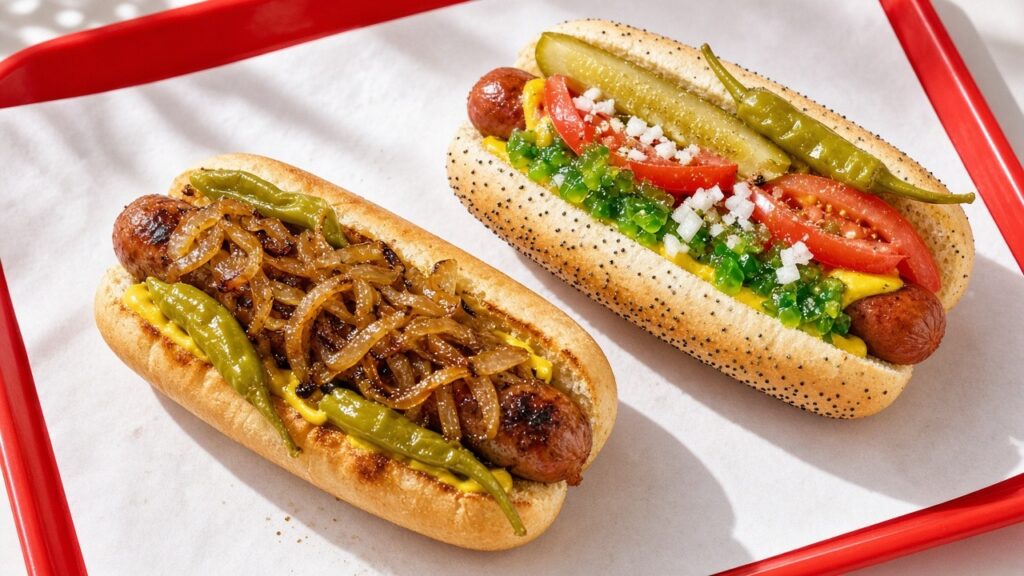
Ask a Chicagoan for the city’s essential street food and you’ll hear two answers before anyone mentions deep-dish: the Chicago-style hot dog and the Maxwell Street Polish. They’re often sold at the same stands, they share a few toppings, and visitors mix them up all the time. They’re not the same sandwich, and Chicagoans have opinions about both.
A Maxwell Street Polish is a grilled or griddled Polish sausage (usually a beef or beef-and-pork kielbasa-style link) on a plain bun, topped with a heap of grilled onions, yellow mustard and usually whole sport peppers. A Chicago-style hot dog is a steamed all-beef frank on a steamed poppy-seed bun, “dragged through the garden” with seven toppings: yellow mustard, bright green sweet relish, chopped white onion, tomato slices or wedges, a dill pickle spear, sport peppers and a dash of celery salt. Neither gets ketchup. The Polish is smoky, garlicky and onion-heavy; the Chicago dog is fresh, tangy and crunchy.
Below: the short answer, what each one is and where it came from, a side-by-side table, where to get each in Chicago, how to make both at home and answers to common questions. Planning a food day? See Chicago food neighborhoods.
Maxwell Street Polish vs Chicago dog: the short answer
| Short version | Maxwell Street Polish | Chicago-style hot dog |
|---|---|---|
| The meat | Polish sausage, grilled | All-beef frank, steamed or simmered |
| The bun | Plain, soft bun | Poppy-seed bun, steamed |
| The signature | Grilled onions and mustard | Seven toppings, “through the garden” |
| The vibe | Late-night, smoky, onion-heavy | Fresh, bright, crunchy |
If you have one stop, get both and split them.
What is a Maxwell Street Polish?
A Maxwell Street Polish is a Polish sausage, typically a coarser, garlicky beef or beef-and-pork link, cooked on a flat-top griddle or grill until the casing blisters and snaps. It goes into a plain bun with:
- Grilled onions: lots of them, cooked soft and golden on the same griddle.
- Yellow mustard.
- Sport peppers: small, pickled green chiles, usually whole.
That’s it. No relish, tomato or pickle.
Many stands also sell a pork chop sandwich made the same way: a bone-in pork chop on a bun with grilled onions, mustard and peppers. (Watch for the bone.)
History of Maxwell Street
Maxwell Street, on Chicago’s Near West Side, was home to a huge open-air market from the late 1800s through much of the 20th century. Immigrants from Eastern Europe, Jewish merchants, Black families arriving during the Great Migration and Mexican families all sold, shopped and ate there. The market was also a birthplace of Chicago electric blues, with musicians playing on the street for tips.
The Maxwell Street Polish is usually credited to Jimmy Stefanovic, a Macedonian immigrant who took over a hot dog stand at the corner of Maxwell and Halsted streets in the late 1930s and started selling grilled Polish sausages with onions. His stand became known as Jim’s Original, which still operates nearby after moving from the original corner when the area was redeveloped.
The original market was relocated in the 1990s. Today’s Maxwell Street Market runs on Sundays in a different location nearby, with food stalls famous for Mexican street food. Check the City of Chicago’s official market page for current dates and location.
What is a Chicago-style hot dog?
A Chicago dog is an all-beef hot dog, traditionally with a natural casing for snap, steamed or simmered (some places char-grill it), served in a steamed poppy-seed bun.
The seven toppings
In the classic order of assembly:
- Yellow mustard
- Sweet pickle relish, in a famously bright neon green
- Chopped white onion
- Tomato slices or wedges (often two)
- A dill pickle spear
- Sport peppers (two or so)
- A dash of celery salt
This is what Chicagoans mean by “dragged through the garden.” The combination of salty, sweet, sour, hot and fresh is the whole point.
Vienna Beef, the Chicago company most associated with the Chicago dog, traces its roots to the 1893 World’s Columbian Exposition. Depression-era stands, including several on Maxwell Street, piled cheap vegetables on a hot dog to make it a full meal, which is one popular explanation for the “garden” toppings.
Why no ketchup?
Chicago hot dog purists say ketchup’s sweetness overpowers the balance of the other toppings and the beef. It’s become a point of local pride: many stands simply don’t offer it, and asking for ketchup marks you as a visitor. (You won’t get arrested. You might get a look.)
Side-by-side table (meat, bun, toppings, cooking)
| Maxwell Street Polish | Chicago-style hot dog | |
|---|---|---|
| Meat | Polish sausage: beef or beef-and-pork, garlicky, coarser | All-beef frank, finer texture |
| Size | Usually larger and thicker | Standard hot dog size |
| Cooking | Griddled or grilled until blistered | Steamed or simmered; “char dog” is grilled |
| Bun | Plain, soft bun | Steamed poppy-seed bun |
| Toppings | Grilled onions, yellow mustard, sport peppers | Mustard, green relish, onion, tomato, pickle spear, sport peppers, celery salt |
| Ketchup? | No | No |
| Flavor | Smoky, garlicky, savory, sweet onions | Bright, tangy, fresh, crunchy |
| Often served with | Fries (sometimes piled on top) | Fries |
| Origin story | Maxwell Street, 1930s | Chicago stands from the 1920s–30s; Vienna Beef from 1893 |
Is a Polish a kind of hot dog?
They’re cousins. Both are cooked sausages served in a bun, so in casual talk people call a Polish “a hot dog.” Technically a Polish sausage is a different sausage (seasoned differently, often coarser and with pork), so Chicagoans order them by name.
Where to get each in Chicago
Many classic stands sell both. A few well-known names to start with (hours and locations change, so check each place’s official site or listing before you go):
- Jim’s Original (near the old Maxwell Street area): the name most tied to the Maxwell Street Polish; also known for pork chop sandwiches.
- Maxwell Street Express and other stands nearby: same style, often open late.
- Portillo’s: a Chicago chain with Chicago dogs and Polish sausages, easy for visitors.
- Superdawg Drive-In (Northwest Side): a 1948 drive-in famous for its own “Superdawg,” served with a pickled green tomato instead of tomato slices.
- Gene & Jude’s (River Grove, just outside the city): a stripped-down “depression dog” with mustard, relish, onion and sport peppers, fries piled on top, no tomato.
- The Wieners Circle (Lincoln Park): char dogs and late-night attitude.
Hot dog stands are everywhere in Chicago, from tiny neighborhood shacks to airport counters. Look for the Vienna Beef sign if you want a classic. If you’re also exploring Greek food, see Greektown Chicago food, which is close to the old Maxwell Street area.
How to make each at home
Maxwell Street Polish at home
- Caramelize onions: slice 2 large onions. Cook in a little oil on a griddle or skillet over medium heat, stirring, until soft and golden, 15 to 20 minutes. Salt lightly.
- Cook the sausages: score the Polish sausages lightly and cook on the same griddle or a grill over medium heat, turning, until browned and blistered and hot all the way through, 8 to 12 minutes (follow the package directions).
- Warm the buns on the griddle for a few seconds.
- Assemble: sausage, a heap of onions, yellow mustard and a couple of sport peppers.
Chicago dog at home
- Simmer the franks in water just below a boil for 5 to 7 minutes (or steam them).
- Steam the poppy-seed buns for 30 to 60 seconds in a steamer basket over the pot.
- Assemble in order: mustard, relish, onion, tomatoes along one side, pickle spear along the other, sport peppers, then celery salt.
Full ingredients, shopping tips and a party bar plan are in how to make a Chicago-style hot dog at home.
Where to find the ingredients
Chicago supermarkets usually stock all-beef franks, poppy-seed buns, Polish sausages, sport peppers and neon green relish. Outside Chicago, look online for Vienna Beef products or Chicago dog kits, or use the closest substitutes (regular sweet relish plus a drop of blue food coloring, pepperoncini for sport peppers).
How to order at a Chicago hot dog stand
Chicago stands move fast, especially at lunch and late at night. A few tips:
- “A dog with everything” gets you the full Chicago treatment (at most places). Some stands have their own house version, so look at the menu board.
- Order a Polish by name: “a Polish with everything” usually means onions, mustard and peppers.
- Say “no peppers” if you don’t like heat; sport peppers are medium-hot.
- Fries often come with it, sometimes piled right on top of the sandwich in the wrapper.
- Bring a card and some cash. Most places take cards now, but some small stands are still cash-friendly.
- Eat it right away. Steamed buns and grilled onions don’t travel well.
Chicago dog vs Maxwell Street Polish: which should you try first?
If you want the classic Chicago food experience in one bite, start with the Chicago dog: it’s the one on souvenirs and in guidebooks. If you love grilled sausages, onions and late-night street food, the Polish may become your favorite. If you’re visiting with a group, order one of each and share.
Other Chicago sandwiches you’ll see at the same stands
- Italian beef: thin-sliced roast beef soaked in juice on a French roll, with sweet peppers or hot giardiniera.
- Combo: Italian beef with an Italian sausage in the same roll.
- Pork chop sandwich: the Maxwell Street classic with onions and mustard.
- Tamales: Chicago stands often sell corn-roll tamales, a local tradition.
FAQ
Why is there no ketchup on a Chicago hot dog?
Tradition and taste: Chicagoans feel ketchup’s sweetness overwhelms the mustard, relish, pickle and beef. Many stands don’t offer it.
What are the seven toppings on a Chicago dog?
Yellow mustard, bright green sweet relish, chopped white onion, tomato slices or wedges, a dill pickle spear, sport peppers and celery salt, on a poppy-seed bun.
Where did the Maxwell Street Polish come from?
The Maxwell Street market area on Chicago’s Near West Side. It’s usually credited to Jimmy Stefanovic, whose stand at Maxwell and Halsted (later Jim’s Original) began selling grilled Polish sausages with onions in the late 1930s.
Is a Polish a kind of hot dog?
Casually, yes; both are sausages on a bun. But a Polish is a different, usually coarser and garlickier sausage, so in Chicago you order it by name.
Where can I get both in Chicago?
Most classic hot dog stands sell both, including Jim’s Original, Maxwell Street Express and Portillo’s. Check current hours before you go.
What’s a “char dog”?
A Chicago dog with the frank char-grilled instead of steamed, often with the same toppings.
What are sport peppers?
Small, medium-hot pickled green chile peppers, sold in jars. They’re on both the Chicago dog and many Maxwell Street Polishes.
Can I get a vegetarian Chicago dog?
Yes. Many stands and home cooks use a plant-based frank with the same seven toppings, which are all vegetarian. Some Chicago stands list veggie dogs on the menu; ask before you order.