
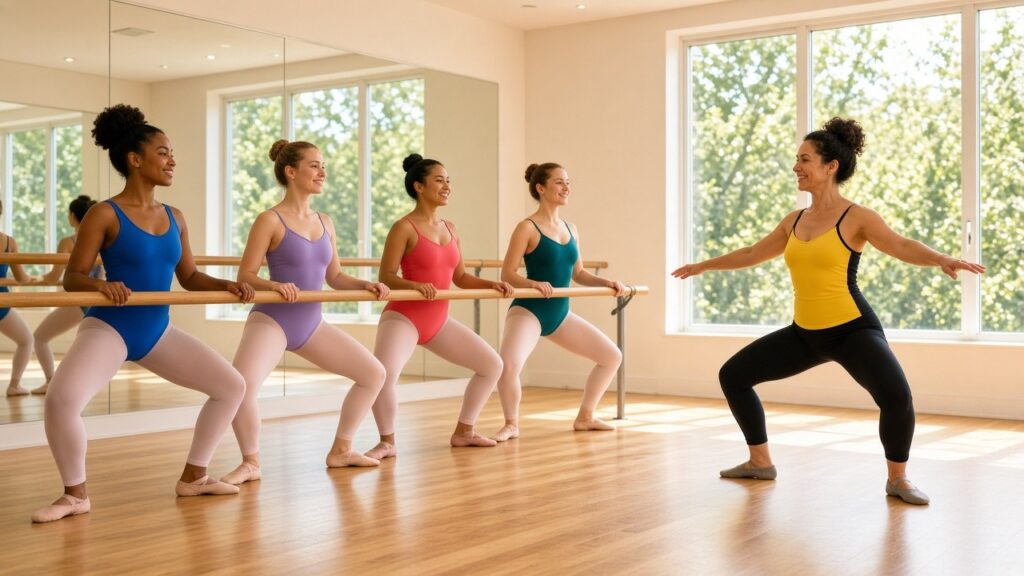
Your first ballet class can feel like it’s taught in a foreign language, because it is. “Plié, tendu, dégagé, rond de jambe” rolls off the teacher’s tongue, and you’re still figuring out which foot goes in front. The good news: you only need about 20 words to follow a beginner class, and the rest come naturally with time.
Ballet terms are French because ballet was formalized at the French royal court in the 17th century, and the vocabulary stuck everywhere. The first terms you’ll hear are plié (bend), relevé (rise), tendu (stretched), dégagé (disengaged), rond de jambe (circle of the leg), frappé (struck), fondu (melted), grand battement (big kick), port de bras (carriage of the arms), sauté (jump), chassé (chase), pas de bourrée, balancé, pirouette, arabesque, attitude, passé (or retiré), barre, center and révérence. Learn the meaning of each word, and the movement usually makes sense.
Below: why the terms are French, the first 20 terms you’ll hear, an A–Z glossary with pronunciation and meaning, terms grouped by barre, center and jumps, turns and directions, tips for learning the vocabulary fast and answers to common questions. For the positions every term builds on, see ballet positions for beginners.
Why ballet terms are in French
Ballet grew out of Italian Renaissance court dances, but it was in 17th-century France, under King Louis XIV, that it became a codified art form. In 1661, Louis XIV founded the Académie Royale de Danse, and French ballet masters named and organized the steps. As ballet spread across Europe, Russia and the world, the French vocabulary went with it. That’s why a class in Chicago, Moscow or Tokyo uses the same words.
Pronunciation varies a little between teachers and countries, and some methods (like Vaganova or Cecchetti) use slightly different terms, but the core words are universal.
The first 20 terms you’ll hear in class
| Term | Pronunciation | Meaning | What you do |
|---|---|---|---|
| Barre | bar | The handrail | The first part of class, holding the rail |
| Plié | plee-AY | Bent | Bend the knees with legs turned out |
| Demi-plié | duh-MEE plee-AY | Half bend | Small knee bend, heels on the floor |
| Grand plié | grahn plee-AY | Big bend | Deep knee bend, heels lift (except in second) |
| Relevé | ruhl-uh-VAY | Raised | Rise onto the balls of the feet |
| Tendu | tahn-DOO | Stretched | Slide the foot out along the floor to a point |
| Dégagé | day-gah-ZHAY | Disengaged | Like a tendu, but the foot lifts slightly off the floor |
| Rond de jambe | rawn duh ZHAHMB | Circle of the leg | Draw a half circle with the foot |
| Frappé | frah-PAY | Struck | Strike the foot out from the ankle |
| Fondu | fawn-DOO | Melted | Bend the supporting leg smoothly as the other extends |
| Développé | dayv-law-PAY | Developed | Unfold the leg into the air |
| Grand battement | grahn bat-MAHN | Big beating | A big, controlled kick |
| Port de bras | por duh BRAH | Carriage of the arms | Arm movements |
| Passé / Retiré | pah-SAY / ruh-tee-RAY | Passed / withdrawn | Toe at the knee, leg bent and turned out |
| Arabesque | ah-rah-BESK | Arabesque | Standing on one leg, the other extended straight behind |
| Attitude | ah-tee-TOOD | Attitude | Like an arabesque, but the lifted leg is bent |
| Sauté | soh-TAY | Jumped | A jump from two feet to two feet |
| Chassé | shah-SAY | Chased | A gliding step where one foot “chases” the other |
| Pirouette | peer-oo-ET | Spin | A turn on one leg |
| Révérence | ray-vay-RAHNS | Bow | The bow or curtsy at the end of class |
Ballet terms A–Z
| Term | Pronunciation | Meaning |
|---|---|---|
| À la seconde | ah lah suh-GAWND | To the second (side) position |
| Adagio | ah-DAH-zhee-oh | Slow, controlled movements |
| Allegro | ah-LAY-groh | Fast, lively movements, especially jumps |
| Arabesque | ah-rah-BESK | Pose on one leg with the other extended behind |
| Assemblé | ah-sahm-BLAY | Jump that brings both legs together in the air |
| Attitude | ah-tee-TOOD | Pose with the lifted leg bent |
| Balancé | bah-lahn-SAY | Rocking waltz step |
| Battement | bat-MAHN | Beating action of the leg |
| Battement glissé | bat-MAHN glee-SAY | Gliding battement; same as dégagé in some methods |
| Bourrée (pas de bourrée) | boo-RAY | Small linking steps on the balls of the feet |
| Brisé | bree-ZAY | Broken: a small beaten jump |
| Cambré | kahm-BRAY | Arched: bending the upper body forward, side or back |
| Changement | shahnzh-MAHN | Jump in fifth, changing which foot is in front |
| Chaînés | sheh-NAY | Chains: fast traveling turns on both feet |
| Chassé | shah-SAY | Gliding step where one foot chases the other |
| Coupé | koo-PAY | Cut: foot placed at the ankle |
| Croisé | krwah-ZAY | Crossed body position |
| Cou-de-pied | koo-duh-PYAY | Neck of the foot: foot wrapped at the ankle |
| Développé | dayv-law-PAY | Unfolding the leg into the air |
| Échappé | ay-shah-PAY | Escaped: feet move from closed to open position |
| Effacé | eh-fah-SAY | Open, shaded body position |
| En croix | ahn KRWAH | In the shape of a cross: front, side, back, side |
| En dedans | ahn duh-DAHN | Inward (turning toward the supporting leg) |
| En dehors | ahn duh-OR | Outward (turning away from the supporting leg) |
| Enchaînement | ahn-shen-MAHN | A combination of steps |
| Entrechat | ahn-truh-SHAH | Jump where the legs cross and beat in the air |
| Épaulement | ay-pohl-MAHN | Use of the shoulders and head |
| Fondu | fawn-DOO | Melting: bending the supporting leg |
| Fouetté | fweh-TAY | Whipped: a turn with a whipping leg |
| Frappé | frah-PAY | Struck: striking action of the foot |
| Glissade | glee-SAHD | Gliding traveling step |
| Grand jeté | grahn zhuh-TAY | Big leap |
| Jeté | zhuh-TAY | Thrown: a jump from one foot to the other |
| Pas de chat | pah duh SHAH | Step of the cat: a sideways jump with knees lifted |
| Pas de deux | pah duh DUH | Dance for two |
| Petit allegro | puh-TEE ah-LAY-groh | Small, quick jumps |
| Piqué | pee-KAY | Pricked: stepping directly onto a straight leg in relevé |
| Pirouette | peer-oo-ET | A turn on one leg |
| Plié | plee-AY | Bending the knees |
| Port de bras | por duh BRAH | Carriage of the arms |
| Relevé | ruhl-uh-VAY | Rising onto the balls of the feet |
| Révérence | ray-vay-RAHNS | Bow or curtsy |
| Rond de jambe | rawn duh ZHAHMB | Circular movement of the leg |
| Sauté | soh-TAY | Jumped |
| Sissonne | see-SAWN | Jump from two feet onto one |
| Soutenu | soot-NOO | Sustained: a turn in fifth on relevé |
| Temps levé | tahn luh-VAY | Hop on one foot |
| Tendu | tahn-DOO | Stretched: foot extended along the floor |
Barre terms
These make up the first part of most classes, in roughly this order:
- Pliés – bends in first, second, fourth and fifth.
- Tendus – foot stretches along the floor.
- Dégagés – quick brushes slightly off the floor.
- Rond de jambe à terre – half circles of the leg on the floor.
- Fondus – melting bends on one leg.
- Frappés – striking foot actions.
- Adagio or développés – slow leg extensions.
- Grand battements – big kicks.
- Stretches – often at the end of barre.
Barre exercises are often done en croix: front, side, back, side.
Center and jump terms
After the barre, you move to the center of the room for balance work and jumps.
- Center adagio: slow movements and balances without the barre.
- Tendus and port de bras in center.
- Petit allegro: small jumps such as sautés, changements, échappés, glissades and assemblés.
- Grand allegro: big jumps such as grand jetés.
- Traveling steps: chassés, pas de bourrée and balancés across the floor.
Turn terms
| Term | What it is |
|---|---|
| Pirouette | A turn on one leg, usually in passé |
| En dehors | Turning outward, away from the supporting leg |
| En dedans | Turning inward, toward the supporting leg |
| Chaînés | Fast linked turns traveling in a line |
| Piqué turn | Stepping onto a straight leg and turning |
| Soutenu | A turn in fifth on relevé |
| Fouetté | A whipping turn, often done in series |
| Spotting | Keeping your eyes on a fixed point to avoid dizziness |
Spotting isn’t French, but you’ll hear it in every class.
Terms for directions and body positions
| Term | Meaning |
|---|---|
| Devant | In front |
| À la seconde | To the side |
| Derrière | Behind |
| En avant | Forward |
| En arrière | Backward |
| De côté | Sideways |
| En face | Facing the audience |
| Croisé | Crossed |
| Effacé | Open |
| Écarté | Separated, wide |
| En l’air | In the air |
| À terre | On the ground |
Terms that beginners often mix up
| These two | The difference |
|---|---|
| Tendu vs dégagé | Tendu stays on the floor; dégagé lifts just off it |
| Passé vs retiré | Passé is the action of passing the foot by the knee; retiré is the position. Many teachers use them interchangeably |
| Arabesque vs attitude | Arabesque leg is straight; attitude leg is bent |
| En dehors vs en dedans | Outward turns away from the supporting leg; inward turns toward it |
| Jeté vs sauté | Jeté goes from one foot to the other; sauté lands on the same feet it took off from |
| Coupé vs cou-de-pied | Coupé is the cutting action; cou-de-pied is the position at the ankle |
| Demi-plié vs grand plié | Small bend with heels down vs deep bend |
What a beginner combination sounds like
A teacher might say: “Facing the barre, first position. Two demi-pliés, one grand plié, rise in relevé, then tendu front, side, back, side, en croix. Close in first. Port de bras forward and back. Then second.”
Translated: two small knee bends and one deep bend, rise onto the balls of your feet, then stretch the foot to the front, side, back and side, closing to first each time, then bend the upper body forward and back with the arms, and repeat the whole thing in second position.
Once you know about 20 words, combinations like this become easy to follow. Beginner adult classes usually explain new terms, so don’t be afraid to ask.
How to learn the vocabulary fast
- Learn the meaning, not just the sound. “Tendu” means stretched, so you stretch your foot.
- Group words by family. Battement tendu, battement dégagé and grand battement are all “beatings” of the leg.
- Say the words as you do the steps at home.
- Make flashcards with the term on one side and the meaning and movement on the other.
- Watch beginner ballet videos that name each step.
- Ask your teacher to repeat or demonstrate any word.
- Learn the order of barre, so you can predict what’s coming next.
FAQ
How do you pronounce ballet terms?
Most are pronounced roughly as in French, with the stress at the end: plié is “plee-AY,” tendu is “tahn-DOO,” relevé is “ruhl-uh-VAY.” Teachers’ accents vary, so follow your teacher.
Why are ballet terms in French?
Because ballet was formalized at the French royal court in the 17th century, when the Académie Royale de Danse named the steps. The French terms spread with ballet around the world.
What is the difference between tendu and dégagé?
In a tendu, the foot slides out along the floor until only the tips of the toes touch. In a dégagé, the foot brushes out the same way but lifts slightly off the floor, a little faster.
What is a plié?
A plié is a bend of the knees with the legs turned out. A demi-plié is a small bend with the heels down; a grand plié is a deep bend.
What terms will I hear in my first class?
Barre, plié, relevé, tendu, dégagé, rond de jambe, port de bras, passé, sauté, chassé and révérence are almost always part of a beginner class.
Do all ballet methods use the same terms?
Mostly. RAD, Cecchetti, Vaganova and other methods use the same French core vocabulary, with a few differences in names and arm positions.