
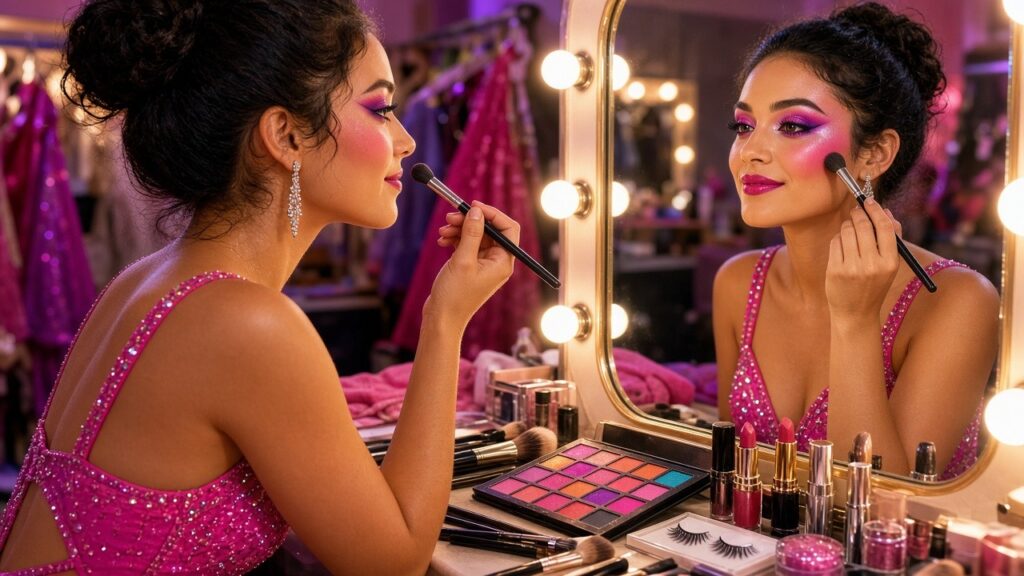
Makeup that looks beautiful in your bathroom mirror can disappear completely under stage lights. Bright lights flatten your features, and from the audience your face is small and far away. Stage makeup exists to fix that: it puts your features back so people can see your expressions from the back row.
Stage makeup is bolder, more defined and longer-lasting than regular makeup. Under bright stage lights, regular makeup washes out, so performers use foundation with good coverage, stronger contour and blush, defined brows, dramatic eyeshadow and eyeliner, false lashes, and a bold lip color, all set with powder and a long-wear setting spray to survive heat and sweat. You don’t need special theatrical brands; many drugstore and regular products work, as long as they’re long-wearing and applied with more intensity. The bigger the venue, the bolder the makeup.
Below: why stage lights change everything, how to adjust foundation, contour, eyes, brows, lashes and lips, how to set makeup for sweat, a step-by-step dance recital look, how to remove heavy makeup, a kit list and answers to common questions. If you have a show coming up, also read how to prepare for a dance performance.
Stage makeup vs regular makeup: the short answer
| Regular makeup | Stage makeup | |
|---|---|---|
| Goal | Enhance your face up close | Make features visible from a distance under lights |
| Foundation | Light to medium coverage | Medium to full coverage, long-wear |
| Contour and blush | Soft, subtle | Stronger, placed to sculpt the face |
| Eyes | Neutral or soft color | Deeper shadow, strong liner, false lashes |
| Brows | Natural | Fuller and more defined |
| Lips | Any shade | Defined with liner, bold color |
| Setting | Optional | Essential: powder and long-wear spray |
| Up close | Looks natural | Looks heavy, and that’s fine |
Why stage lights change everything
- Bright lights wash out color. Rosy cheeks, soft brown shadow and nude lips can disappear completely.
- Lights flatten the face. Front lighting removes the shadows that normally show your cheekbones, jaw and eye shape. Contour adds them back.
- Distance shrinks features. Your eyes and mouth carry your expression, so they need the most definition.
- Colored gels change how makeup looks. Red and pink tints can make blush vanish; blue light can make skin look gray.
- Heat and sweat. Lights are hot, dancing raises your temperature, and makeup has to survive both.
The bigger the stage and the farther the audience, the bolder you go. A small studio recital needs less than a large theater.
Foundation and contour for stage
Foundation
- Choose medium to full coverage in a long-wear or transfer-resistant formula.
- Match your skin or go no more than one shade warmer. Lights wash you out, but a foundation much darker than your skin looks like a mask, especially on the neck and chest.
- Blend down the neck and onto the chest and shoulders if your costume shows them, so your face matches your body.
- Use a primer to help foundation grip, mattifying if you’re oily.
Contour, highlight and blush
- Contour under the cheekbones, along the jaw, at the temples and down the sides of the nose, a little stronger than you’d wear day to day.
- Highlight the tops of the cheekbones, the bridge of the nose and the brow bone. Avoid very glittery highlight on large areas; it can look shiny under lights.
- Blush: use more than usual, in a bright shade like coral, rose or berry. Blend from the apples of the cheeks toward the temples.
Eyes, brows and lashes
Eyes carry expression, so they need the most attention.
Eyeshadow
- Prime your lids so shadow doesn’t crease.
- Apply a medium shade over the lid and into the crease.
- Add a deeper shade in the outer corner and crease to make the eye look bigger and more defined.
- Highlight the brow bone and the inner corner.
- Follow your studio’s look if you’re in a group number. Many recitals use a specific shadow color.
Eyeliner
- Line the upper lash line with a strong black or dark brown liner. A wing makes the eye look bigger and more lifted.
- Line the lower lash line from the outer corner, about a third to halfway in, with a soft dark liner or shadow.
- Waterproof formulas survive sweat and tears.
Brows
Brows frame the face and show expression. Fill them in a little fuller and darker than everyday, matching or slightly deeper than your hair color, and set them with brow gel.
Lashes
False lashes are standard for most performances because mascara alone won’t show from far away. See best false lashes for dancers for types, glue and how to keep them on.
Lips
- Line your lips with a liner matching your lipstick.
- Choose a bold shade that reads under lights: a classic red, a bright pink or a deep berry. Follow your teacher’s choice for group numbers.
- Use long-wear or matte lipstick, blot, and apply a second layer.
- Avoid heavy gloss that smears during the show. If you want shine, dab a little in the center of the lips.
- Bring the lipstick with you for touch-ups between numbers.
Setting for sweat
Stage makeup has to survive hot lights and heavy movement:
- Set liquid and cream products with a thin layer of powder.
- Bake under the eyes lightly if you crease.
- Finish with a long-wear setting spray.
- Use the sandwich method, spraying before and after powder, for long shows.
Read setting spray vs powder for the details and sweat-proof makeup for dance for a full routine.
Stage makeup for dance recitals step by step
- Start with clean, moisturized skin. Let moisturizer absorb.
- Do your hair first so you don’t smudge makeup while pinning. See how to do a dance bun.
- Primer.
- Eyeshadow and eyeliner before foundation if you use dark colors. Fallout is easy to clean off bare skin.
- Foundation and concealer, blended onto the neck.
- Set with powder.
- Contour, blush and highlight.
- Brows.
- False lashes and mascara.
- Lip liner and lipstick.
- Setting spray.
- Check from a distance. Step back from the mirror, or take a photo from across the room. If you can’t see your features, add more.
Plan for 30 to 60 minutes the first time, and do a full trial at a dress rehearsal.
Stage makeup by performance type
| Performance | Makeup level | Notes |
|---|---|---|
| Small studio recital | Moderate | Bolder than everyday, but the audience is close |
| Large theater | Full stage makeup | The back row is far away |
| Dance competition | Bold, polished | Judges sit close, so blending matters; strong eyes and lips |
| Outdoor performance | Lighter, long-wear | Daylight shows heavy makeup more; SPF matters |
| Ballet | Classic: defined eyes, lashes, rosy cheeks, red or rose lips | Elegant, often uniform across the company |
| Latin and ballroom | Very bold: dramatic eyes, lashes, contour, strong lips | Glamorous to match costumes and tans |
| Video or livestream | Medium | Cameras are closer than audiences, so blend carefully |
Stage makeup for different skin tones
- Avoid ashy powders. Some translucent powders look white under lights or flash. Choose powders made for your skin tone.
- Pick blush that shows: deeper and brighter shades like berry, brick or warm red show up best on medium and deep skin.
- Match foundation under good light and check it on your neck.
- Use warm, rich eyeshadow shades that read on your skin rather than pale shades that disappear.
My Latina makeup step-by-step has more tips for warm and olive skin.
Does stage makeup look different on camera?
Yes. Cameras are closer than an audience and pick up texture, so heavy stage makeup can look harsh in close-up photos, while it looks right from the seats. For recital photos and videos, blend edges carefully, avoid heavy flash-reflecting powders, and keep contour soft enough to look natural up close.
Touch-ups between numbers
- Blot, don’t wipe. Press blotting paper on shiny areas.
- Powder lightly on the T-zone.
- Reapply lipstick, which fades fastest.
- Check your lashes and add a dot of glue to any lifting corner.
- Fix smudged liner with a cotton swab and a little remover, then reline.
- Mist setting spray before you go back on.
Keep a small touch-up bag backstage with these items so you don’t have to dig through your full kit.
Common stage makeup mistakes
- Foundation too dark or too orange. It looks like a mask and doesn’t match your neck.
- No contour. The face looks flat and round under lights.
- Too little blush. It disappears under lights.
- Skipping lashes. The eyes vanish from the audience.
- Glittery or very shiny products on large areas. They reflect light and look sweaty.
- No trial run. Makeup on show day should never be a surprise.
- Not checking from a distance. What looks too heavy in the mirror often looks right from the seats.
Removing stage makeup
Heavy makeup needs a careful removal routine:
- Remove false lashes gently after softening the glue with remover.
- Use an oil-based cleanser or cleansing balm on dry skin to break down long-wear products, then rinse.
- Follow with a gentle water-based cleanser (a double cleanse).
- Use eye makeup remover for waterproof mascara and liner, holding a pad on the eye before wiping.
- Moisturize.
- Never sleep in stage makeup. It can clog pores and irritate your eyes.
Stage makeup kit list
- Primer
- Long-wear foundation and concealer
- Setting powder and brush or puff
- Contour, blush and highlight
- Eyeshadow palette with medium and deep shades
- Black waterproof eyeliner
- Brow pencil or powder and brow gel
- False lashes and glue
- Mascara
- Lip liner and long-wear lipstick
- Long-wear setting spray
- Makeup remover, cotton pads and cotton swabs
- Blotting papers
- Brushes and sponges
- A small mirror
FAQ
Do I need special stage makeup or can I use my regular makeup?
You can usually use your regular makeup, applied more boldly and in long-wear formulas. Theatrical brands exist and work well, but they aren’t required for most recitals.
How heavy should stage makeup be?
Heavy enough that your features are clear from the back of the audience. It will look too much up close, which is normal. Smaller venues need less.
How do I remove heavy stage makeup?
Remove lashes first, use an oil cleanser or balm, follow with a gentle face wash, and use eye makeup remover for waterproof products. Moisturize afterward.
Does stage makeup look different on camera?
Yes. Cameras are close, so they show texture and harsh lines. Blend carefully and soften contour for photos and video.
How early should I do my makeup before a show?
Usually one to two hours before call time or before you perform, after hair is done. Leave time for setting and fixing mistakes.
Do men wear stage makeup?
Often, yes. Male dancers usually wear foundation, contour, defined brows and sometimes eyeliner so their features show from the audience. Follow the production’s guidelines.
What colors should I use for a dance recital?
Follow your studio’s instructions first. If you choose yourself, medium brown and deep brown or plum shadows, black liner, a bright rose or coral blush and a classic red or berry lip read well under most stage lights and suit most skin tones.
Is stage makeup bad for your skin?
Not if you remove it thoroughly the same night and moisturize. If you’re acne-prone, choose non-comedogenic products and patch test anything new before a show.