
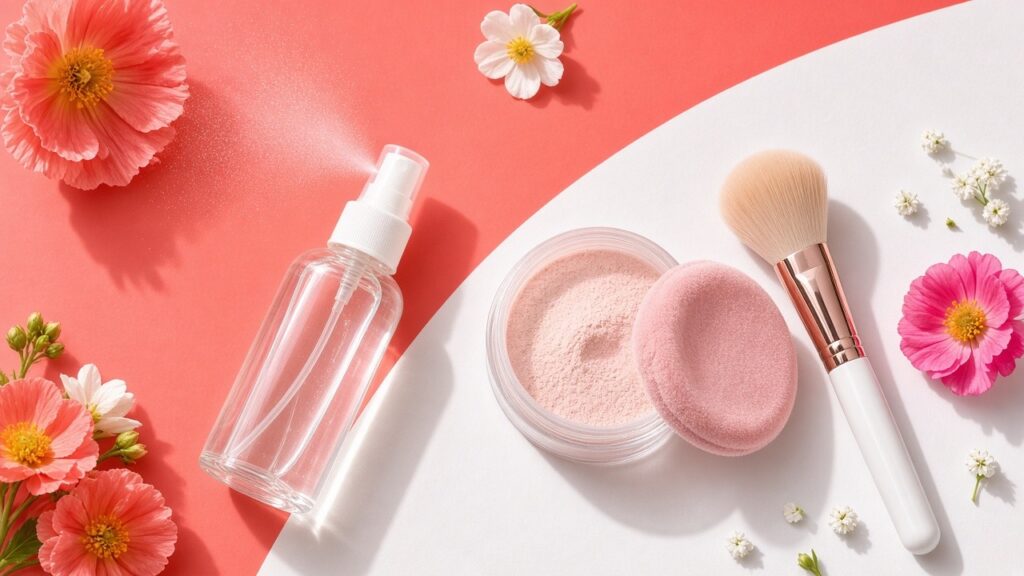
If your makeup slides off by the second song in Zumba or melts under stage lights, you’ve probably wondered whether setting spray or setting powder is the fix. They both “set” makeup, but they work in different ways, and for sweat, the best answer is usually not one or the other.
Setting powder absorbs oil and moisture and locks creamy products in place, so it’s best at controlling shine and stopping creases. Setting spray uses film-forming ingredients to bind your layers together and keep them from moving or rubbing off, and it melts away the powdery look. For sweat, most people get the best results with both: a thin layer of powder where you get shiny or crease, then a long-wear setting spray over everything. Oily skin leans on powder; dry skin leans on spray.
Below: what each product does, which one holds up better when you sweat, how to choose for oily, dry and combination skin, the order to use them, translucent versus tinted powder, and answers to the common questions. For a full routine, see my sweat-proof makeup for dance guide.
Setting spray vs powder: the short answer
| Setting powder | Setting spray | |
|---|---|---|
| What it does | Absorbs oil and moisture; sets cream and liquid products | Forms a light film that binds makeup layers |
| Best for | Shine control, creasing under eyes, oily skin | Long wear, transfer resistance, dry skin, removing a powdery look |
| Finish | Matte to soft-focus | Depends on formula: matte, natural or dewy |
| Sweat | Helps with oil but can get patchy if overloaded | Long-wear formulas help makeup stay through sweat |
| When to use | After liquid and cream products | Final step (sometimes also between layers) |
| Risk | Cakey or dry-looking if you use too much | Can feel tacky; some formulas add shine |
What setting powder does
Setting powder is a finely milled powder pressed into a compact or sold loose. Its main jobs:
- Absorbing oil: ingredients such as silica, talc, cornstarch or rice powder soak up sebum so skin looks less shiny.
- Setting creams and liquids: a light layer on top of foundation and concealer makes them less tacky, so they move less and don’t crease as easily.
- Blurring: soft-focus powders scatter light and make pores and texture look smoother.
- Making a base for powder products: blush, bronzer and eyeshadow blend more smoothly over a set base.
Ways to apply powder
- Brush: a fluffy brush gives the lightest layer. Best for most of the face.
- Puff: press, don’t swipe. Gives more coverage and stronger oil control, especially on the T-zone and under the eyes.
- Damp sponge: presses powder into skin for a more skin-like finish.
- Baking: a thick layer of loose powder left on for a few minutes, then dusted off. Baking is popular for stage and photos, but it can look heavy in daylight and dry on mature or dry skin.
What setting spray does
Setting spray is a fine mist that goes on as the last step. There are two general types:
- Long-wear or “setting” sprays contain film-forming polymers that help hold makeup in place and resist transfer and sweat. These are the ones to pick for workouts and performances.
- Hydrating or “finishing” sprays are mostly water, glycerin and botanical ingredients. They refresh the skin and melt powders into the face but don’t add much staying power.
Many sprays are labeled by finish: matte sprays often include oil-absorbing ingredients, and dewy sprays add glow. Read the label for words like “long-wear,” “transfer-resistant” or “sweat-resistant.”
How to apply setting spray
- Shake the bottle.
- Hold it about 8 to 10 inches from your face.
- Close your eyes and mist in an X, then a T, so the face is evenly covered.
- Let it dry completely without touching your face, about a minute.
- For extra hold, some people mist a makeup sponge and press it over the face, or mist between layers.
Which keeps makeup on when you sweat?
Sweat and oil break down makeup in different ways:
- Oil dissolves foundation from underneath, causing slipping and shine, often on the T-zone.
- Sweat is mostly water. It beads on top and can streak or wipe off makeup when you touch your face or towel off.
Powder helps most with oil. Long-wear setting spray helps most with sweat and rubbing. That’s why the combination works so well for dancers, gym classes and hot, humid days.
On its own:
- If you only use powder, your makeup will stay matte longer, but heavy sweating can make powder clump or slide, and towel contact can wipe it away.
- If you only use spray, your makeup will hold together better through sweat, but oily skin may still get shiny and slip.
For a hot Zumba class, a dance performance or a summer day in Chicago, I’d choose both. Pair them with a sweat-friendly base, explained in the sweat-proof makeup guide, and blot instead of wiping.
Skin type: oily vs dry
| Skin type | Powder | Spray |
|---|---|---|
| Oily | Essential; use on the T-zone and wherever you shine | Matte, long-wear formula |
| Combination | Only on the oily areas | Long-wear, natural finish |
| Dry | Very light, only where you crease | Hydrating or long-wear with a natural or dewy finish |
| Mature | Fine, light powder; skip baking | Hydrating or natural finish |
| Sensitive | Fragrance-free | Alcohol-free and fragrance-free if alcohol stings |
Patch test new products on a small area of skin before using them for a show or a long day, especially if you have sensitive or acne-prone skin.
Using both: the order
There are a few ways to layer them. The most common:
- Skin prep: moisturizer and sunscreen; let them absorb.
- Primer: mattifying for oily skin, gripping or hydrating for dry skin.
- Liquid and cream products: foundation, concealer, cream blush or contour.
- Setting powder: a thin layer, concentrated where you get shiny or crease.
- Powder products: blush, bronzer, eyeshadow.
- Setting spray: the final mist.
The sandwich method
For maximum staying power, some people use spray twice:
- Mist setting spray after primer or after foundation.
- Powder once it’s dry.
- Finish with setting spray.
This is useful for performances, long events and heavy sweating, but it’s more product than you need for an ordinary day.
Translucent vs tinted powder
| Translucent powder | Tinted powder | |
|---|---|---|
| Color | Sheer, made to be invisible | Has skin-tone pigment |
| Coverage | None | Light coverage that evens out skin |
| Best for | Setting without changing your foundation’s color | Touch-ups, light coverage, matching your skin |
| Watch out for | White cast (flashback) in flash photos on some formulas, especially on medium and deep skin | Choosing the right shade |
“Translucent” doesn’t always mean truly invisible. Some powders look white or gray on medium and deeper skin tones, especially in flash photography. If you have tan, brown or deep skin, try a tinted setting powder, or a translucent formula designed for deeper skin tones. My Latina makeup step-by-step has more on avoiding ashy finishes.
Which to use for each situation
| Situation | What to use | Why |
|---|---|---|
| Everyday office or errands | Light powder on the T-zone, or spray alone if you’re dry | Enough hold without heaviness |
| Zumba or gym class | Thin powder plus long-wear matte spray, minimal base | Sweat and rubbing |
| Dance performance on stage | Powder (or a light bake under the eyes) plus long-wear spray, using the sandwich method if you sweat a lot | Heat from lights and long wear |
| Wedding or long event | Powder plus long-wear spray | Hours of wear, hugs, photos |
| Hot, humid summer day | Oil-absorbing powder on shiny areas plus matte spray | Oil and humidity |
| Flash photography | Tinted or flashback-free powder, plus spray | Avoid white cast |
| Dry winter day | Very light powder only where needed, hydrating or long-wear spray | Avoid dry patches |
Setting under the eyes
The under-eye area creases more than anywhere else because the skin moves every time you smile and blink.
- Use a thin layer of eye cream and let it absorb.
- Apply concealer sparingly. Too much product is what creases.
- Smooth out lines with your fingertip before setting.
- Press a small amount of powder in with a small puff or damp sponge.
- Brush off any excess and finish with spray.
If baking makes your under-eyes look dry or crepey, skip it and use a light press of powder instead.
How to choose a good setting spray or powder
- Read the claims: “long-wear,” “transfer-resistant” or “sweat-resistant” for staying power; “hydrating” or “refreshing” for comfort.
- Pick the finish: matte for oily skin, natural for most people, dewy for dry skin.
- Check the ingredients if you’re sensitive: alcohol and fragrance can sting some skin.
- For powder, test the shade on your skin in daylight and, if possible, with a phone flash, to check for white cast.
- Try travel sizes before you commit to a full size.
Reapplying during the day or a performance
- Blot first. Press blotting paper on shiny areas to lift oil and sweat without moving makeup.
- Powder lightly. A small amount with a puff, only where needed.
- Mist again to remove any powdery look.
- Never rub with a towel. Press gently.
For a dance class, keep blotting papers, a pressed powder and a small setting spray in your bag. For performances, see how to prepare for a dance performance.
Common mistakes
- Too much powder. It looks cakey and can clump when you sweat. Start with less and add only where you need it.
- Powdering over wet foundation. Wait a minute for foundation to settle first.
- Holding the spray too close. It can leave droplets and spots.
- Touching your face before the spray dries.
- Using a hydrating mist and expecting long wear. Choose a long-wear formula.
- Skipping skin prep. Dry, flaky skin makes powder look worse; very oily skin breaks through any product. Moisturize and prime.
FAQ
Can I use setting spray and powder together?
Yes, and for sweat and long wear, that’s usually best. Powder controls oil and sets creams, and spray binds everything and removes the powdery look.
Which goes first, powder or spray?
Usually powder first, then spray as the last step. For extra hold, spray once before powder as well.
Can setting spray replace powder?
For dry or normal skin, often yes. If you have oily skin or crease under the eyes, spray alone usually won’t control shine as well as powder does.
Will powder look cakey when I sweat?
It can if you use too much or bake heavily. Use a thin layer, press it in, finish with setting spray, and blot instead of wiping when you sweat.
Can I reapply setting spray during the day?
Yes. Blot first, add a little powder if you need it, then mist again. Long-wear sprays can be reapplied over makeup.
Does setting spray work without primer?
Yes, but primer and spray work together. Primer helps makeup grip the skin from below, and spray holds it from above.
Is setting powder bad for your skin?
Not for most people. If you have acne-prone skin, look for non-comedogenic products and remove makeup thoroughly after you sweat.