
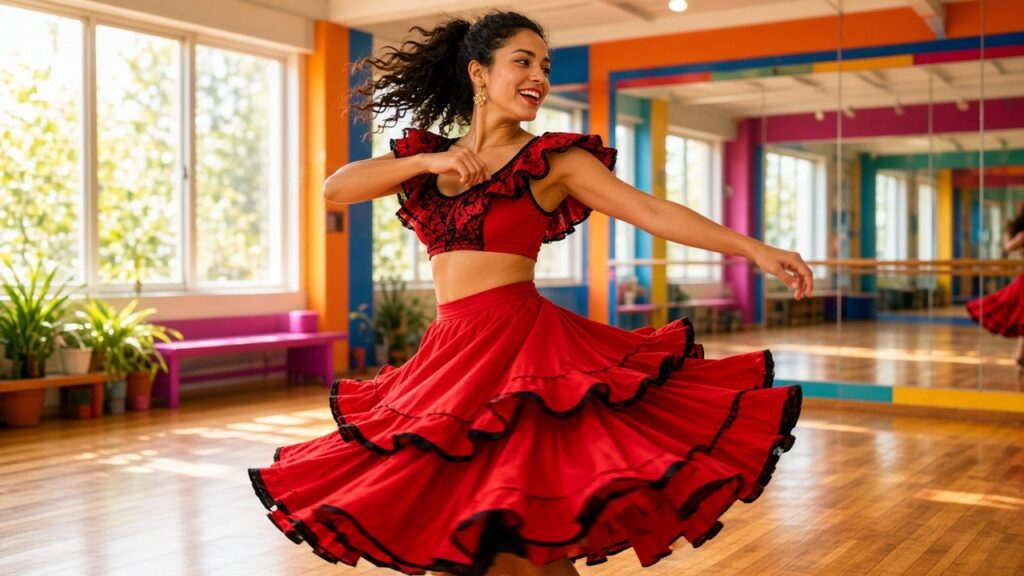
Turns are the moment salsa starts to feel like flying, and also the moment many beginners feel dizzy, off-balance or late on the next step. The good news is that clean spins are mostly technique, not talent. Spotting, posture, a small pivot and the right arms turn a wobbly spin into a controlled one.
To spin in salsa without getting dizzy, spot: fix your eyes on one point, keep them there as your body starts to turn, then whip your head around and find the same point again. Stand tall with your weight over the ball of your supporting foot, keep your core engaged, and pivot on the balls of your feet rather than the heels. Keep your arms in a compact frame, turn on the counts the pattern calls for, and practice slowly before adding speed or doubles.
These are the spotting and pivot drills I use in class and at home. Below: spotting, axis and posture, pivots, arm positions, single to triple spins, partner turns with lead and follow cues, shoes and floors, home drills, common mistakes and an FAQ.
How to spin in salsa: the short answer
| Element | What to do | Why it helps |
|---|---|---|
| Spotting | Fix your eyes on a point, turn your head last and find the point first | Reduces dizziness and keeps you facing the right way |
| Axis | Stand tall, stack head over shoulders over hips over the supporting foot | A straight axis spins; a bent one wobbles |
| Pivot | Turn on the balls of your feet, heels slightly lifted | Less friction, smoother rotation |
| Arms | Compact frame, elbows slightly bent, close to the body | Smaller shape turns faster and steadier |
| Core | Engaged but not rigid | Holds the axis together |
| Timing | Prepare on the right count, finish on time | Keeps you on the music and with your partner |
Spotting: how to not get dizzy
Dizziness during spins comes largely from your eyes and inner ear trying to process continuous movement. Spotting breaks the movement into a quick head snap and a steady gaze, which is why dancers in every style use it.
- Choose a spot at eye level straight ahead: a light, a sign, your partner’s face.
- Begin the turn with your body while your eyes stay on the spot as long as possible.
- When your head can’t stay any longer, whip it around quickly, faster than your body.
- Find the same spot again right away.
- Keep your chin level. Tilting your head up or down makes balance harder.
Practice spotting standing still first: turn your head quickly from one side to the other while your eyes jump to a fixed point. Then practice slow quarter turns, half turns and full turns while spotting.
Why spotting feels strange at first
Your head moves separately from your body, which can feel awkward. It also takes practice to get the timing: if you turn your head too early, you lose the spot; too late, and you’ll feel pulled around. Start slow. Most dancers find spotting becomes automatic with a few weeks of regular practice.
What if I still feel dizzy?
Some people are more sensitive to spinning. Spin less often, practice slowly, take breaks, and stop if you feel unwell. Dizziness after several turns is common; spotting helps, but it may not eliminate it entirely. If dizziness is severe or persistent, talk to a healthcare provider.
Your axis and posture
A spinning top works because it has a straight, centered axis. So do you.
- Stand tall. Imagine a string pulling you up from the crown of your head.
- Stack your body. Head over shoulders, shoulders over hips, hips over your supporting foot.
- Engage your core. Gently draw your navel in and keep your ribs from flaring.
- Shoulders down, not hunched around your ears.
- Don’t lean back. Leaning back is the most common reason spins travel and wobble.
- Soft knees before the turn, then grow tall as you rotate.
Pivoting on the ball of the foot
Salsa turns are usually done on the balls of the feet, not flat-footed and not on the heels.
- Shift your weight onto the ball of the supporting foot.
- Lift the heel slightly so you’re rotating on a small point.
- Keep the free foot close, often near the supporting ankle or in a small step.
- Rotate, using the step’s momentum and your core rather than pushing with the arms.
Most beginner salsa turns are “step turns”: you step and pivot through a pattern of three steps (for example, during counts 5, 6, 7 in many On1 patterns), rather than doing a ballet-style pirouette on one leg. Learning a clean step turn is the base for everything else.
Arms: frame vs free spin
Partner turns (in frame)
When you’re being turned, your arm stays connected to your partner’s hand with gentle tension. The hand above your head is relaxed, fingers lightly closed around your partner’s fingers or making a loose “halo” so their hand can circle. Your free arm stays close, often near your waist or chest.
Free spins
In a free spin (without holding hands), bring your arms into a compact shape: elbows slightly bent and in front of your body, hands near your chest or in a soft circle. Pulling the arms in makes you spin faster; opening them slows you down. That’s useful to finish a spin on time.
Arms not to do
Flailing arms, straight arms swinging wide, or gripping your partner’s hand tightly all throw off the turn and can hurt your partner’s shoulder.
Single, double and triple spins
| Spin | What it is | When to learn it | Key focus |
|---|---|---|---|
| Single | One full rotation | Your first weeks | Spotting, clean step turn, finishing on time |
| Double | Two rotations in the same time | After singles feel effortless and on time | Faster spot, stronger axis, compact arms |
| Triple | Three rotations | Advanced | Excellent balance and spot; not needed for social dancing |
How to do a double spin
- Master a balanced single that finishes on time.
- Prepare: soft knees, a strong axis and a slight preparation in the opposite direction.
- Pull in your arms to speed up.
- Spot twice, fast.
- Finish with your weight on the right foot, ready for the next count.
Never sacrifice timing for extra rotations. A clean single on the music beats a messy double.
Spinning with a partner (follow and lead cues)
For followers
- Wait for the lead. Don’t anticipate; turn when you feel the signal.
- Keep your frame. Gentle tension in the arm, not limp, not stiff.
- Spot your partner as your focus point.
- Stay on your axis. Let the lead’s hand guide, but turn yourself.
- Finish facing your partner, ready for the next step.
For leads
- Prepare clearly, usually on the count before the turn, with a gentle signal through the hand.
- Lift your hand above the follower’s head in a small circle (a halo), not a big swing.
- Don’t pull or push. The lead initiates; the follower turns.
- Keep your own basic going on time.
- Make space. Check the floor before you lead a turn on a crowded social.
- Lead doubles only to followers who can clearly do them.
How do I turn my partner in salsa?
A basic right turn for the follower: from the basic, lead the follower’s right hand (or the joined hands) up and gently to the left on the preparation count, circle your hand above their head as they step through, and lower it as they finish facing you. Take this in a class first; a teacher can correct small details of timing and hand position.
Shoes and floors that help or hurt
| Help | Hurt |
|---|---|
| Dance shoes with suede soles | Rubber-soled sneakers that grip |
| Smooth wooden or dance floors | Carpet, sticky floors, concrete |
| A secure strap or lacing | Loose sandals or slip-on shoes |
| Heel height you can balance on | Very high heels for beginners |
| Clean soles | Dust or spills on the floor |
For full details, see what to wear salsa dancing. If your shoes stick, a little cornstarch on the soles can help on a sticky floor at home; don’t use powder on floors where other people dance.
Drills to practice at home
You don’t need a partner or a studio. A smooth floor and a few minutes are enough. These drills pair well with my salsa without a partner practice routine.
- Spotting drill (2 minutes). Stand still, snap your head side to side between two points.
- Quarter turns (2 minutes). Turn 90 degrees at a time, spotting each wall.
- Half turns (2 minutes). Turn 180 degrees, spotting front and back.
- Slow single step turns (3 minutes). Three steps, one rotation, spotting. Do them in both directions.
- Balance hold (1 minute). Finish a turn and hold your position on one foot for 2 seconds.
- Turns to music (3 minutes). Do a turn every 8 counts in your basic.
- Doubles (optional, 2 minutes). Only once singles are clean.
Practice both directions. Most people have a “good side”; your weaker side needs extra time.
Common mistakes
- No spot, or spotting with the eyes only, not the head
- Leaning back or looking down
- Heels on the floor, causing friction
- Big arm swings that pull you off axis
- Rushing the turn and arriving early
- Stepping too wide during step turns
- Turning on sticky shoes
- Followers anticipating instead of waiting for the lead
- Leads pushing the follower around
When you’ll feel the difference
With 10 minutes of home drills three or four times a week, most beginners feel noticeably steadier in a few weeks. Spins in class stop feeling like a gamble, and you’ll arrive on time for the next step more often. If you’re still at the start of your salsa journey, see learn salsa dancing for beginners and how long it takes to learn salsa.
FAQ
How do I spot when I turn?
Pick a point at eye level. Keep your eyes on it as long as possible as your body turns, then quickly whip your head around and find the same point again. Keep your chin level. Practice slowly with quarter and half turns first.
How do I turn my partner in salsa?
Prepare on the count before the turn, raise your joined hands in a small circle above your partner’s head, and guide gently without pushing or pulling. Keep your own basic on time and lower your hand as they finish. Learn the timing in a class first.
How do I do a double spin?
First make your single clean and on time. Then prepare with soft knees, pull your arms in to speed up, spot twice quickly, and finish on the right foot. Don’t add rotations at the cost of timing.
What shoes make turning easier?
Dance shoes with suede soles turn best because they slide smoothly. Avoid grippy rubber soles. A secure fit and a heel height you can balance on help you stay on your axis.
How do I practice turns at home?
Use a smooth floor and practice spotting drills, quarter turns, half turns and slow single turns in both directions, then add turns into your basic to music. Ten minutes a few times a week makes a real difference.