
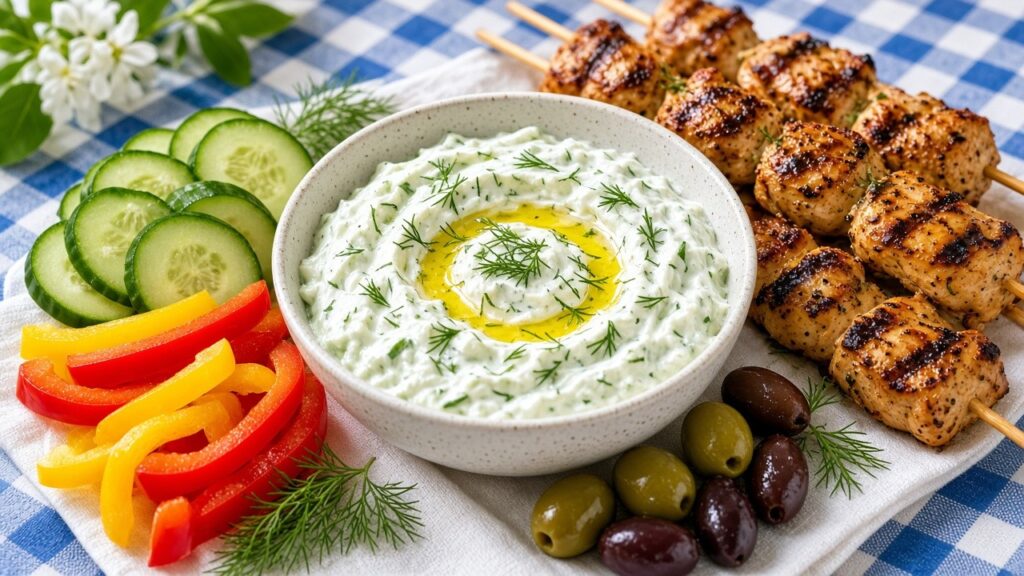
Tzatziki is one of the easiest Greek foods to keep on a keto plate. It’s mostly yogurt, cucumber, garlic, olive oil and herbs, and a normal serving is just a couple of tablespoons. The details matter, though: the type of yogurt and a store-bought brand’s added ingredients can change the carb count noticeably.
Yes, tzatziki is generally keto-friendly. Homemade tzatziki made with full-fat plain Greek yogurt has roughly 1 to 2 grams of net carbs per 2-tablespoon serving. Carbs come mainly from the yogurt’s natural milk sugar, plus a little from cucumber, garlic and lemon. Choose full-fat, unsweetened Greek yogurt, squeeze the cucumber well and check store-bought labels for added sugar or starch.
The numbers in this article are estimates calculated from typical nutrition labels and standard database values for each ingredient. Brands vary, so check the labels on what you buy. This is cooking information, not medical or diet advice.
Is tzatziki keto? Carbs per serving
| Tzatziki type | Serving | Approx. net carbs |
|---|---|---|
| Homemade, full-fat Greek yogurt (recipe below) | 2 tablespoons | ~1.2 g |
| Homemade, full-fat Greek yogurt | ¼ cup | ~2.5 g |
| Homemade with sour cream base | 2 tablespoons | ~1 g |
| Typical store-bought | 2 tablespoons | 1–3 g (check label) |
| Restaurant side cup | ~¼ to ⅓ cup | 2–5 g (estimate) |
| Made with non-fat or flavored yogurt | 2 tablespoons | Higher; flavored yogurt can add several grams of sugar |
At about 1 to 2 grams per spoonful, tzatziki fits comfortably into most keto plans. The issue is usually what you eat it with: pita, rice and potatoes are what push a Greek meal off keto.
Where the carbs come from
Yogurt type
Yogurt is the biggest source. Milk contains lactose, a natural sugar; straining Greek yogurt removes some of the whey and lactose, which is why Greek yogurt typically has fewer carbs than regular yogurt per serving.
- Full-fat plain Greek yogurt: lowest carb per serving among common yogurts and the richest, thickest texture. Best choice.
- Low-fat or non-fat Greek yogurt: often slightly higher in carbs per serving, and some brands add thickeners.
- Regular (unstrained) yogurt: more carbs and a runny dip.
- Flavored or vanilla yogurt: avoid; added sugar.
Fermentation reduces some lactose over time, but you shouldn’t rely on that when counting; use the label.
Cucumber
Cucumber is very low in carbs, around 3 to 4 grams per 100 grams before squeezing, and most of its weight is water. In a batch of tzatziki the cucumber adds only a few grams total.
Garlic, lemon and herbs
Garlic has about 1 gram of carbs per clove. Lemon juice adds about 1 gram per tablespoon. Dill and mint add almost nothing. Olive oil has zero carbs.
Store-bought tzatziki: what to check on the label
- Total carbs and fiber per 2 tablespoons; most are 1 to 3 grams.
- Added sugars: should be 0 g.
- Starches and thickeners: modified food starch, cornstarch, or gums. Small amounts don’t change much, but starch adds carbs.
- Yogurt type: “Greek yogurt” or “strained yogurt” listed first is a good sign.
- Serving size: some brands list 1 tablespoon, which makes carbs look lower.
Dairy-free tzatziki made from coconut or nut “yogurts” can vary a lot; some are sweetened.
My keto tzatziki recipe
This is the same tzatziki I serve with Greek dishes, just made with full-fat yogurt and no sugar. It’s naturally keto.
Makes about 1½ cups (12 servings of 2 tablespoons)
- 1 cup (225 g) full-fat plain Greek yogurt
- 1 medium cucumber (about 8 oz/225 g), grated
- 2 garlic cloves, finely grated or pressed
- 1 tablespoon extra-virgin olive oil
- 1 tablespoon fresh lemon juice or white wine vinegar
- 2 tablespoons chopped fresh dill (or 1 tablespoon mint)
- ½ teaspoon salt
- Black pepper
Instructions
- Grate the cucumber on the large holes of a box grater. Toss with ¼ teaspoon of the salt and let it sit 10 minutes.
- Squeeze the cucumber hard in a clean kitchen towel or cheesecloth until very little liquid comes out.
- Stir together yogurt, garlic, olive oil, lemon juice, dill, remaining salt and pepper.
- Fold in the cucumber.
- Refrigerate at least 1 hour so the garlic mellows and flavors blend. Drizzle with olive oil to serve.
Estimated nutrition per 2 tablespoons: about 1.2 g net carbs, 2.5 g fat, 2 g protein. Calculated from typical full-fat Greek yogurt labels and standard values for the other ingredients.
Full-fat Greek yogurt vs sour cream
| Base | Net carbs (2 tbsp, approx.) | Texture | Flavor |
|---|---|---|---|
| Full-fat Greek yogurt | ~1.2 g | Thick, tangy | Classic |
| Sour cream | ~1 g | Rich, looser | Milder, less tangy |
| Half yogurt, half sour cream | ~1.1 g | Creamy | Balanced |
| Labneh | ~1 g | Very thick | Tangy |
Sour cream makes a slightly lower-carb, richer tzatziki. It’s not traditional, but it’s delicious.
Squeezing the cucumber
This step matters more than any other for texture. Unsqueezed cucumber releases water into the dip, turning it thin and watery within hours. Salting first draws water out; squeezing removes it. You can also scoop out the seeds before grating for an even thicker dip.
Tzatziki vs other Greek dips on keto
| Dip | Main ingredients | Keto-friendliness (approx. net carbs, 2 tbsp) |
|---|---|---|
| Tzatziki | Yogurt, cucumber, garlic | Very good (~1–2 g) |
| Tirokafteri / htipiti | Feta, peppers, olive oil | Very good (~1 g) |
| Melitzanosalata | Roasted eggplant, olive oil | Good (~1.5–2.5 g) |
| Taramosalata | Fish roe, bread or potato | Poor to moderate; bread or potato base adds carbs |
| Skordalia | Garlic with potato or bread | Poor (~5 g or more) |
| Hummus (not Greek, often served alongside) | Chickpeas, tahini | Moderate (~3–4 g) |
If you’re ordering a meze platter, tzatziki and feta-based dips are the safest choices. Ask what thickens taramosalata and skordalia; both traditionally rely on bread or potato.
Keto tzatziki variations
- Herb-heavy: double the dill and add parsley and chives.
- Mint and lemon zest: brighter and great with lamb.
- Feta tzatziki: crumble 2 tablespoons feta into the finished dip for extra saltiness.
- Avocado tzatziki: mash ½ ripe avocado into the yogurt; adds fat and a little fiber. Eat within a day.
- Spicy: a pinch of Aleppo pepper or red pepper flakes on top.
Each of these keeps the carb count within about half a gram of the base recipe per serving.
How long homemade tzatziki keeps
Stored in a covered container in the fridge, homemade tzatziki is best within 3 to 4 days. It gets more garlicky over time and may release a little liquid; just stir it back in or pour it off. Don’t leave it at room temperature for more than 2 hours, and don’t freeze it (the yogurt turns grainy and the cucumber goes limp).
What to eat tzatziki with on keto
- Grilled meats: chicken or pork souvlaki without the pita, lamb chops, kofta
- Moussaka: a spoonful alongside keto moussaka
- Vegetables: cucumber rounds, bell pepper strips, radishes, celery, endive leaves
- Eggs: dolloped on fried or scrambled eggs
- Salmon or white fish
- Lettuce wraps with gyro-style meat
- Burger bowls or as a sauce for roasted cauliflower
For a full menu of Greek dishes, see Greek dishes to make at home, and for the meat question, souvlaki vs gyro.
Troubleshooting
- Watery: cucumber wasn’t squeezed enough, or the yogurt wasn’t thick. Strain the finished dip through cheesecloth for 30 minutes.
- Too garlicky: let it rest less time next batch, or add more yogurt.
- Bitter: cucumber peel can be bitter; peel it, or use English cucumbers.
- Bland: add salt and lemon; flavors develop after an hour.
Tzatziki ingredients on keto, ranked
| Ingredient | Keto-friendliness | Tip |
|---|---|---|
| Full-fat plain Greek yogurt | Good in moderation | The main carb source; check the label per serving |
| Sour cream or labneh | Very good | Use for some or all of the yogurt to cut carbs further |
| Cucumber | Very good | Low carb; squeeze well so the dip stays thick |
| Garlic | Good | Small amounts add few carbs |
| Lemon juice | Good | A tablespoon is plenty |
| Olive oil | Excellent | Zero carbs, adds richness |
| Dill and mint | Excellent | Negligible carbs |
| Honey or sugar (some store brands) | Avoid | Skip any recipe or brand that adds sweetener |
| Low-fat or flavored yogurt | Avoid | More carbs, often thickeners and sugar |
Reading a Greek yogurt label for keto
Look at total carbohydrates and sugars per serving and compare brands; plain full-fat strained yogurt usually has fewer carbs than regular yogurt because much of the whey (and lactose) is drained off. Ingredients should be milk, cream and live cultures. Avoid added sugar, fruit, starch, gelatin or pectin. If carbs matter a lot to you, mix the yogurt half and half with full-fat sour cream.
A keto Greek meal built around tzatziki
- Protein: keto chicken souvlaki, grilled lamb chops or salmon.
- Vegetables: cucumber, bell pepper and celery sticks for dipping; a Greek salad with olives and feta.
- Casserole: keto moussaka or keto spanakopita with a spoonful of tzatziki on the side.
- Bread swap: a cloud bread or a lettuce wrap instead of pita.
If you love the original versions, see Greek dishes to make at home and, for restaurant ordering, souvlaki vs gyro and the Greektown Chicago food guide.
Ordering tzatziki when eating out
Restaurant tzatziki is usually yogurt, cucumber and garlic, so it’s typically fine in normal portions. The carbs on a Greek plate hide in the pita, the rice, the potatoes and sometimes in a sweetened dressing. Ask for extra salad instead of rice or fries, and the tzatziki on the side.
Tzatziki, raita and cacık
Similar yogurt-cucumber sauces exist across the region. Turkish cacık is often thinner, almost soup-like, and may be served with ice; Indian raita usually uses regular yogurt and may include cumin, onion or fruit. On keto, the same rule applies to all of them: plain full-fat yogurt, no sugar, and watch the portion.
FAQ
Is tzatziki dip at restaurants keto?
Usually, yes, the dip itself is low-carb. Watch for pita, rice and fries served with it, and ask whether the restaurant makes its own (some add sugar or use thinner yogurt).
Is there a dairy-free option?
Yes: use unsweetened coconut or almond-based plain “yogurt.” Check the label for added sugar and starch, which vary a lot between brands. Carb counts will differ from the dairy version.
Can I use regular yogurt?
You can, but strain it first through cheesecloth for 1 to 2 hours to thicken it. It will be slightly higher in carbs per serving.
How much tzatziki can I eat on keto?
That depends on your personal daily carb target. At roughly 1.2 g net carbs per 2 tablespoons, a generous ¼-cup portion is about 2.5 g. Measure a few times so you know what your usual scoop really holds.
Can I make tzatziki without cucumber?
Yes. It becomes a garlicky yogurt sauce, still keto. Zucchini, grated and squeezed, is another low-carb option.
Is tzatziki good for keto meal prep?
Yes. Make a batch on the weekend and use it with proteins and vegetables for 3 to 4 days.
Keep it full-fat, keep it unsweetened, and squeeze that cucumber. Tzatziki is one Greek favorite you don’t have to give up on keto.