
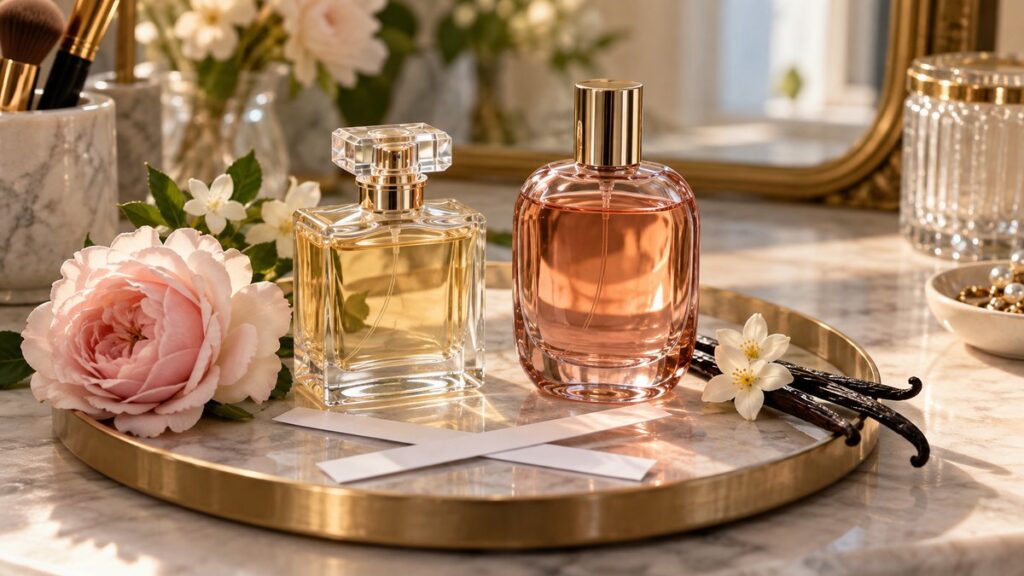
Perfume layering is the best way to make a perfume feel new without buying a new bottle. A little citrus over vanilla for a summer afternoon, something warm over a fresh floral for a night out dancing. It’s creative, it’s personal, and it’s much easier than it sounds when you follow a simple method.
To layer perfume, choose a main scent you want to keep and an accent that adds freshness, sweetness or warmth. Apply one spray of the main scent, let it dry, then add one light spray of the accent. Test on your arm first, wait 15 minutes, and adjust the amounts and order until you love it.
What is perfume layering?
Perfume layering means wearing two (or more) fragrances together to create a combination that’s yours. You can apply them on the same spot, so they mix on your skin, or on different spots, so they blend in the air around you. You can also layer scented body products, like a body wash, lotion and perfume from the same scent family.
Why do it?
- Make your scent unique. Your combination won’t smell like anyone else’s.
- Change a perfume for the season or the moment: fresher for summer, warmer for winter, richer for night.
- Rescue a perfume you don’t love anymore by adding something it’s missing.
- Make light perfumes feel richer by pairing them with a deeper base.
Step by step: how to layer perfume
1. Choose your main scent and your accent
Think in roles, not in order:
- Main scent: the one whose character you want to keep. Usually your favorite.
- Accent: the one that adds a specific effect: a twist of citrus, a touch of sweetness, warmth, freshness.
Ask yourself: “What do I want to change about my main perfume?” More fresh? More cozy? More sexy? That answer chooses your accent.
2. Test on your arms first
Before you commit, spray the main scent on one forearm and the accent next to it. Smell each, then smell them together by bringing your arms close. This shows you what each one adds.
3. Apply in the right amounts
Start with one spray of your main scent, let it dry for a moment, then one light spray of the accent on the same spot. Strength matters more than order: a strong second perfume can easily cover a delicate first one. If the accent takes over, use less of it, or spray it on a different spot (like your clothes or the back of your neck).
4. Wait and smell again
Perfumes change over time as the top notes fade. Smell your layering after about 15 minutes, one hour and a few hours. The combination you love at the 1-hour mark is the one you’ll live with.
5. Try the reverse order another day
Is it better to put the heavy one first or the light one? There’s no universal rule. Jo Malone London, whose colognes are designed for layering, suggests starting with lighter scents as a base and building richer notes on top. Other perfume experts say the order matters less than the amounts. My tip: test both orders on different days, with the same number of sprays, and keep what you like.
6. Write it down
When you find a combination you love, write it down: perfumes, sprays, order and where you applied them. You’ll forget, ¡créeme!
Perfume layering pairings by scent family
Families that share something usually layer well. Here are reliable starting points:
| Main scent | Add | Effect |
|---|---|---|
| Vanilla | Citrus (bergamot, orange, grapefruit) | Brighter and fresher, less heavy |
| Vanilla | Coffee or tonka | Cozy, gourmand, perfect for winter |
| Rose | Oud or incense | Deep, dramatic, evening |
| Rose | Citrus or tea | Fresh, modern, daytime |
| Jasmine or white florals | Sandalwood or musk | Creamy, soft and sensual |
| Fresh floral | Amber or warm suede | Warmer and richer, from day to night |
| Citrus | Woody (cedar, vetiver) | Long-lasting freshness with depth |
| Woody | Fresh fruit (pear, apple) | Lighter, more playful |
| Musk (“skin scent”) | Almost anything | Softens and extends your main perfume |
| Coconut | Vanilla or tropical florals | Beachy, tropical, vacation mood |
As a Panamanian, I love tropical notes, and coconut, citrus and white florals together feel like a beach day, even on a Chicago afternoon.
Easy “layering helpers”
Affiliate disclosure: Some links in this section are affiliate links. If you buy through them, I may earn a commission. As an Amazon Associate I earn from qualifying purchases.
Some scents are especially easy to layer because they’re simple:
- Single-note perfumes (just vanilla, just musk, just sandalwood) work with almost anything.
- Musks and skin scents add softness and help a perfume last.
- Citrus colognes add a fresh lift to almost any perfume.
Some brands design their scents to be layered. Jo Malone London, for example, names three “combiners”: Peony & Blush Suede to add warmth, Grapefruit to add a twist of citrus, and English Oak & Hazelnut for freshness, and suggests pairings like Wood Sage & Sea Salt with Peony & Blush Suede.
As an Amazon Associate I earn from qualifying purchases. If you want to experiment without buying full bottles, perfume discovery sets are perfect for testing combinations.
Layering with body products
The easiest kind of layering:
- Body wash in a similar scent (or unscented).
- Body lotion: let it absorb first. Unscented lotion helps perfume last on hydrated skin; a scented lotion becomes part of your combination.
- Perfume on top.
Matching body products and perfume from the same line create a stronger, longer-lasting version of one scent. Mixing families (a vanilla lotion with a citrus perfume) is a gentle way to try layering.
Perfume layering mistakes to avoid
- Too many sprays. Two perfumes means more perfume. Use fewer sprays of each than you would alone.
- Mixing two very strong perfumes. Two “loud” perfumes usually fight. Pair a strong one with a soft one.
- Too many perfumes at once. Start with two. Three is advanced.
- Clashing families without testing. A sharp marine scent over a heavy gourmand can smell strange. Test first.
- Judging too fast. Wait at least 15 minutes before deciding.
- Forgetting nose blindness. After a few minutes, you’ll smell your combination less. Don’t keep adding more. Here’s why you can’t smell your own perfume.
How to start if you’re new to perfume
If you’re still finding your style, start with my guide to how to choose a perfume that suits you, which explains the scent families. Shopping online? Here’s how to pick a perfume without smelling it first.
FAQ
Which perfume goes first when layering?
There’s no universal rule. Many people start with the lighter scent and add a richer one on top, as Jo Malone suggests, but amounts matter more than order. Test both orders on different days.
Can you layer any two perfumes?
You can try any combination, but perfumes that share a note or family layer more easily. Test on your arms before wearing them together.
How many sprays should I use when layering?
Start with one spray of each. Add more of your main scent if needed, but keep the accent light.
Should I layer on the same spot or different spots?
Both work. The same spot mixes the scents on your skin; different spots let each perfume develop separately while blending in the air around you.
Does layering make perfume last longer?
It can feel longer-lasting, especially when you add a musky or woody base, or apply perfume over unscented lotion.
Can I layer perfume with body lotion?
Yes. Let the lotion absorb first, then apply perfume. Unscented lotion keeps your perfume’s character; scented lotion becomes part of your combination.
Have fun with it. Your next favorite perfume might already be on your vanity, waiting for a partner. ¡A jugar con los aromas!