
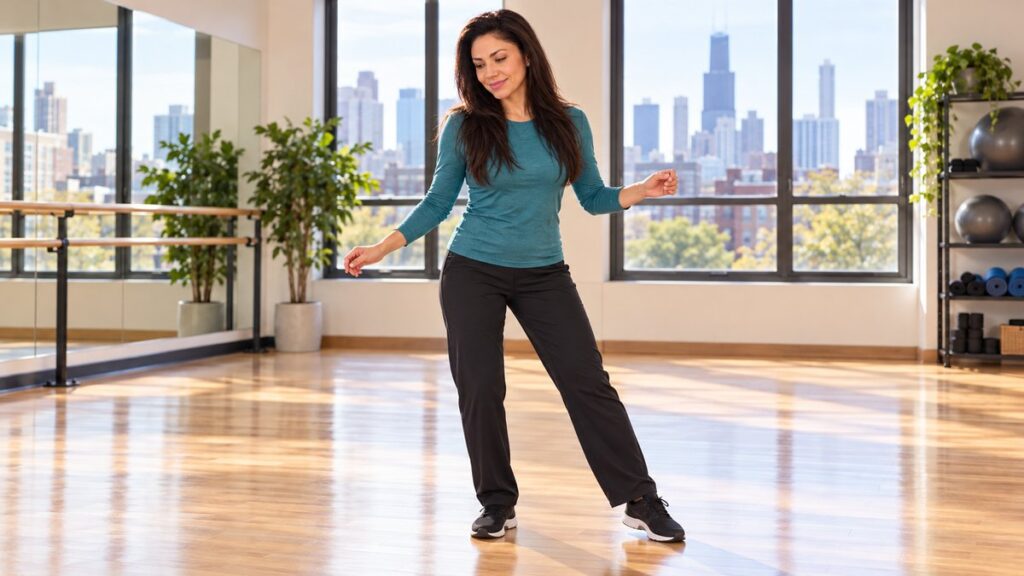
When I tell people I take belly dance, they always ask: “Isn’t that really hard?” My answer: it’s easy to start and wonderfully challenging to master. The first moves feel natural within one class. Then you discover that making them small, smooth and controlled is an art. That’s exactly why I love it.
Belly dancing isn’t hard to start: most beginners learn hip drops, hip circles and basic arms in their first class. What takes time is isolation (moving one body part while the rest stays still), a relaxed shimmy and layering moves. With weekly classes, most people feel comfortable in a few months.
What’s easy and what’s hard in belly dance
| Skill | Difficulty for beginners | Why |
|---|---|---|
| Posture | Easy to learn, takes reminders | Soft knees, neutral pelvis, lifted chest |
| Hip drops and lifts | Easy | Natural movement from the knees |
| Hip slides and circles | Easy to medium | Easy to do; harder to keep the shoulders still |
| Snake arms | Medium | Coordination of shoulder, elbow, wrist and fingers |
| Figure eights | Medium | Smoothness and control take practice |
| Chest isolations | Medium to hard | Most people have never moved their ribcage separately |
| Shimmy | Medium to hard | Needs relaxed knees and hips; tension kills it |
| Undulations (camel) | Hard at first | A rolling wave through the torso |
| Layering (two moves at once) | Hard | Like patting your head and rubbing your belly |
| Musicality and improvisation | Lifelong | There’s always more to discover |
Why belly dance feels hard at first
Isolations are new for your body
In daily life, we move our hips, ribs and shoulders together. Belly dance asks you to separate them: hips move, shoulders stay calm. That takes body awareness, and it builds with practice. The first time your ribcage slides without your hips moving, it feels like magic.
Small moves are harder than big ones
Big, sloppy hip moves are easy. Small, precise ones need control. Beginners often try too hard and too big; teachers usually say “smaller, softer.”
The shimmy needs relaxation
A shimmy comes from quickly alternating soft knees. If you tense your legs or glutes, it stops. Learning to relax while moving fast is the challenge.
The music is different
If you’re new to Middle Eastern music, the rhythms (maqsum, baladi, saidi) and instruments take some listening before you feel where to put your moves.
Is belly dance harder than other styles?
Every style has its own challenge. Here’s how I’d compare them, as someone who dances everything:
| Style | Hardest part for beginners | Compared to belly dance |
|---|---|---|
| Zumba | Following fast choreography | Easier to start; less technique |
| Salsa | Timing and partner work | Harder at first because of the partner and fast footwork |
| Hip hop | Grooves and attitude | Similar beginner level; different body use |
| Ballet | Technique, turnout, terminology | Ballet’s technique is more demanding early on |
| Belly dance | Isolations and shimmy | Easy start, deep to master |
Fun fact: if you dance Latin styles, you’ll recognize some hip work, but belly dance isolates and refines it. And belly dance makes your salsa and Zumba hips much more controlled.
How long does it take to learn belly dance?
It depends on how often you practice, but a typical path with one class a week plus a little home practice:
| Time | What you can usually do |
|---|---|
| First class | Posture, hip drops, hip slides, basic arms |
| First month | Hip circles, figure eights, a slow shimmy, a short combination |
| 3 months | Chest isolations, a smoother shimmy, simple choreography to music |
| 6 months | Undulations, layering simple moves, dancing a full routine |
| 1 year+ | Musical interpretation, improvisation, maybe props or performing |
Is belly dance a good workout?
It’s a gentle-to-moderate workout that challenges coordination, posture and the muscles that keep you upright and stable, especially the core, legs and back. Cardio belly dance classes are more energetic. The best part: you’re so focused on the moves and music that it never feels like exercise.
What to expect in your first belly dance class
A first class is usually gentle and fun. Most teachers start with a warm-up (neck, shoulder and hip rolls), then teach the posture and three or four basic moves: hip drops, hip slides, hip circles and simple arm positions. Near the end, many classes put the moves together into a short combination to music. You’ll probably dance barefoot, and the teacher may lend you a hip scarf. Expect to laugh at your shoulders moving when they shouldn’t. Everyone’s do!
The most common beginner mistakes
- Locked knees: they make hip moves stiff and the shimmy impossible.
- Moving the shoulders with the hips: keep your upper body calm and lifted.
- Going big and fast: smaller and slower looks (and feels) better.
- Looking at the floor: look up and out, and the posture follows.
Tips that make belly dance easier
- Start with posture every time. Soft knees fix half the problems.
- Use a mirror. You’ll see isolations you can’t feel yet.
- Wear a hip scarf. It makes hip movement visible (and the coins make noise when you shimmy, a nice reward).
- Go slow. Slow and smooth first; speed later.
- Breathe. Holding your breath makes everything stiff.
- Practice 10–15 minutes a few times a week between classes. Short, regular practice is better than long and rare.
- Learn one move at a time. Don’t layer until each move feels easy alone.
- Take a real class with a teacher who gives corrections and teaches the cultural context of the dance.
Want the full beginner guide? My post on how to belly dance for beginners has the posture, the first 10 moves, a 4-week practice plan and Chicago classes.
Where to try belly dance in Chicago
- Raks Geek offers Fusion Bellydance Level 1 at the Newport Theater (956 W Newport Ave) on Wednesdays, 6:15–7:45 p.m., in 8-week sessions for complete beginners ($160 per session).
- Bellydance by Phaedra teaches “Raqs Sharqi from the Ground Up” on Mondays, 7–8 p.m., on Chicago’s Northwest Side, with drop-ins welcome ($30 drop-in).
- The Old Town School of Folk Music (4544 N Lincoln Ave) includes belly dance in its adult dance program.
For more styles and studios, see my guide to adult dance classes in Chicago. Nervous about your first class? Read how to not feel awkward dancing.
FAQ
Is belly dancing hard for beginners?
No. The basic moves are easy to learn in a first class. What takes time is controlling isolations, relaxing into a shimmy and layering moves together.
Can anyone learn belly dance?
Yes. Belly dance welcomes every body type and experience level. Many classes say it directly: all bodies welcome.
Is belly dance harder than salsa?
For most beginners, belly dance is easier to start because there’s no partner and the first moves are simple. Salsa’s timing and partner turns are often harder at first.
Why can’t I shimmy?
Usually tension. Bend your knees, relax your glutes and thighs, and alternate your knees slowly, then faster. The shimmy comes when you stop trying so hard.
How often should I practice belly dance?
One class a week plus 10–15 minutes of home practice two or three times a week is a great rhythm for beginners.
Do I need to be flexible for belly dance?
No. Belly dance is about control and isolation, not flexibility.
Is it hard? A little, in the best way. Tie on a hip scarf and see for yourself. ¡Te va a encantar!