
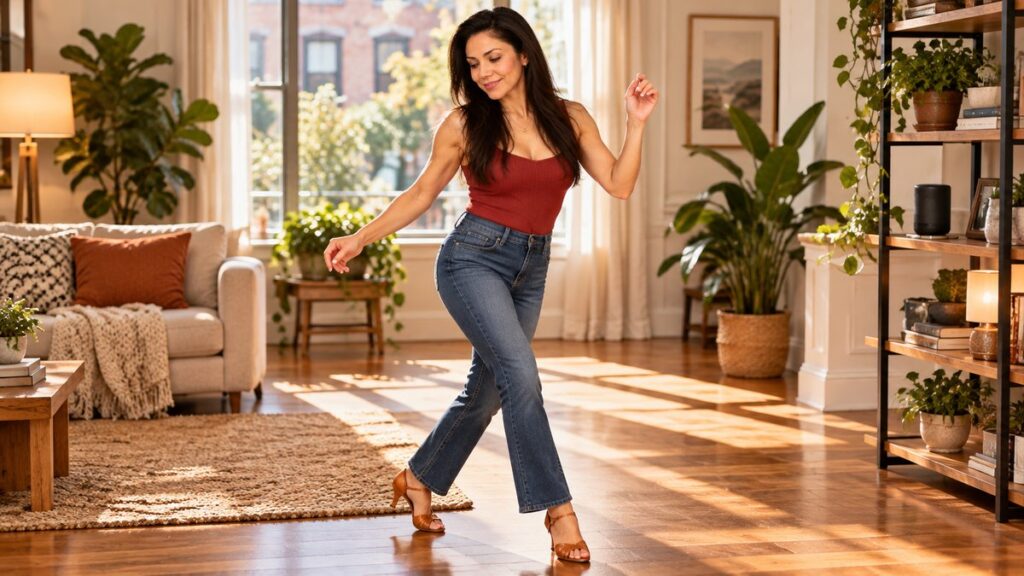
“I’d love to learn salsa, but I don’t have a partner.” It’s one of the most common worries about salsa, and here’s the truth: most people in a salsa class come alone. You don’t need a partner to start, and some of the most important skills you’ll practice by yourself.
Yes, you can learn salsa without a partner. Most group classes rotate partners, so you dance with everyone, and socials are made for dancing with different people. At home, you can practice the basic step, timing, turns and solo footwork called shines on your own.
Do I need a partner to take a salsa class?
No. In most salsa group classes, students rotate partners every few minutes. Leaders move one place around the circle, and everyone dances with everyone. It’s the best way to learn, because each partner feels different, and you learn to adapt.
Many studios say it clearly. In Chicago, for example, Dennis PaSamba Dance Studio says no partner is needed for its group classes. If you’re not sure, call the studio and ask; it’s a very normal question.
What if there are more leaders than followers (or the opposite)?
It happens. Good teachers rotate so nobody sits out for long, or they invite someone to dance the other role. Some studios ask students to register by role to keep the class balanced. And remember: anyone can learn either role.
Why rotating partners is actually better
- You learn real leading and following, not a routine with one person.
- You get used to different heights, styles and energies.
- You meet people, and they become your dance friends at socials.
- You’re ready for socials, where you dance with a new partner every song or two.
Couples who only dance together often find socials harder, because they’re used to one person.
What can I practice alone?
A lot! Solo practice is the secret of good dancers:
- Basic step on the beat. Step 1-2-3, pause 4, 5-6-7, pause 8. Do it to music until you don’t have to think.
- Timing. Clap or tap on the beat, count out loud, find the 1. Here’s how to find the beat in salsa.
- Turns. Practice right and left turns slowly, on a smooth floor, with good balance. Spot (keep your eyes on one point) to avoid dizziness.
- Shines. Solo footwork patterns that salsa dancers do apart from their partner: suzie-Q, cross-over, side-to-side. Many studios have shines or “salsa footwork” classes, no partner needed.
- Body movement and styling. Arms, shoulders, hips. A mirror helps.
- Listening to salsa every day, to build your musical ear.
A 15-minute solo salsa practice routine
Do this three or four times a week, in socks or smooth shoes on a smooth floor:
| Minutes | What to do | Why |
|---|---|---|
| 0 to 2 | Listen to one salsa song and clap on 1 and 5 | Train your ear to find the 1 |
| 2 to 5 | Basic step forward and back, counting out loud | Timing until it’s automatic |
| 5 to 7 | Side basic and back basic (the “Cuban basic”) | Two more basics you’ll use all the time |
| 7 to 10 | Right turns and left turns, slowly, spotting a point on the wall | Balance and clean turns |
| 10 to 13 | Two shines (Suzie Q and cross-over), 8 counts each, then join them | Footwork and musicality |
| 13 to 15 | Freestyle: dance a full song mixing everything | Dancing, not just practicing |
Record yourself once a week. You’ll see things a mirror doesn’t show, like a step that lands late or shoulders that go up.
Salsa shines you can learn alone
| Shine | What it is |
|---|---|
| Suzie Q | A crossing step with a little twist of the heel; one of the most famous shines |
| Cross-over | Step across in front of the other foot, back to center, and repeat on the other side |
| Pachanga | A bouncy step with bent knees from the 1960s pachanga craze, still a social-floor favorite |
| Back basic | The basic step going back and forth instead of forward and back, great for open position |
| Hook turn | Hook one foot behind the other and turn on the spot |
| Side basic | The basic step moving side to side |
Start with one shine a week. Join two together and you already have an 8-count combination for the instrumental parts of a song.
Practicing partner skills without a partner
You can’t learn connection alone, but you can prepare for it:
- Practice your frame. Arms soft but ready, elbows in front of your body, shoulders down. Hold it through a whole song.
- Leaders: think ahead. Say the next move in your head on the 5-6-7 before the next 1. That’s when you’d prepare your partner.
- Followers: wait for the lead. Dance your basic and practice turns that start exactly on the count, not before.
- Watch social dancing. Watch how couples connect, and notice how the lead “asks” for a turn.
Salsa classes in Chicago where you don’t need a partner
- Dennis PaSamba Dance Studio (4820 W. Irving Park Rd.): no partner needed for group classes.
- Latin Street Music & Dancing (600 W. Roosevelt Rd.): salsa by level, plus technique classes and Cuban rueda, a circle dance where you change partners constantly.
- Old Town School of Folk Music (4544 N. Lincoln Ave.): Latin Dance 1 to 3, with partner rotation, and Saturday Latin Dance Practice Parties ($15, $12 for members).
- Chicago Park District: fall 2026 included a Tuesday evening salsa class at Humboldt Park ($50) and Latin dance at Armour Square Park ($30).
Compare these and more in my guide to adult dance classes in Chicago.
Can I learn salsa online by myself?
Online lessons and videos are great for footwork, shines, timing and styling. But partner skills (leading, following, connection) need a real partner and a teacher’s feedback. The best mix: a group class for partner work, and solo practice at home with videos.
Is it weird to go to a salsa class alone?
Not at all. It’s the most normal thing. Many people come alone, and many come from work, a little nervous, just like you. Say hello to the people next to you, laugh at your mistakes, and you’ll leave with new friends. If you feel shy, here’s how to dance when you feel too awkward.
Can I go to a salsa social without a partner?
Yes! Socials are made for this. You ask people to dance (or they ask you), you dance a song or two, say thank you, and change partners. Here’s everything about what a salsa social is and what to expect.
Should I learn to lead or follow?
Traditionally, men led and women followed, but today anyone can learn either role. Choose the one that interests you. Some people learn both, which makes you a better dancer and means you’ll never sit out.
Can you learn salsa without a partner FAQ
Do I need to bring a partner to salsa class? No. Most classes rotate partners.
Can I practice salsa alone at home? Yes: basic step, timing, turns, shines and styling.
What are salsa shines? Solo footwork patterns danced apart from your partner, often during instrumental parts of a song.
Is it better to take salsa classes with a partner? Not necessarily. Rotating partners helps you learn faster and prepares you for socials.
How long until I’m ready to dance with partners at a social? Usually four to six classes, when you can do the basic, a right turn and a cross-body lead to music. More in how long it takes to learn salsa.
What is rueda? Rueda de casino is a Cuban style of salsa danced in a circle, where a caller shouts moves and partners change all the time. It’s a fun way to dance with everyone.
Can I dance salsa solo? Yes. Shines and solo salsa (and Zumba!) let you dance salsa on your own.
Start solo, dance with everyone
Don’t wait for a partner. Find a beginner class this week. Here’s how to learn salsa dancing as a beginner, and where to dance salsa in Chicago.
¡Ven sola, ven solo, pero ven! — MarGo