
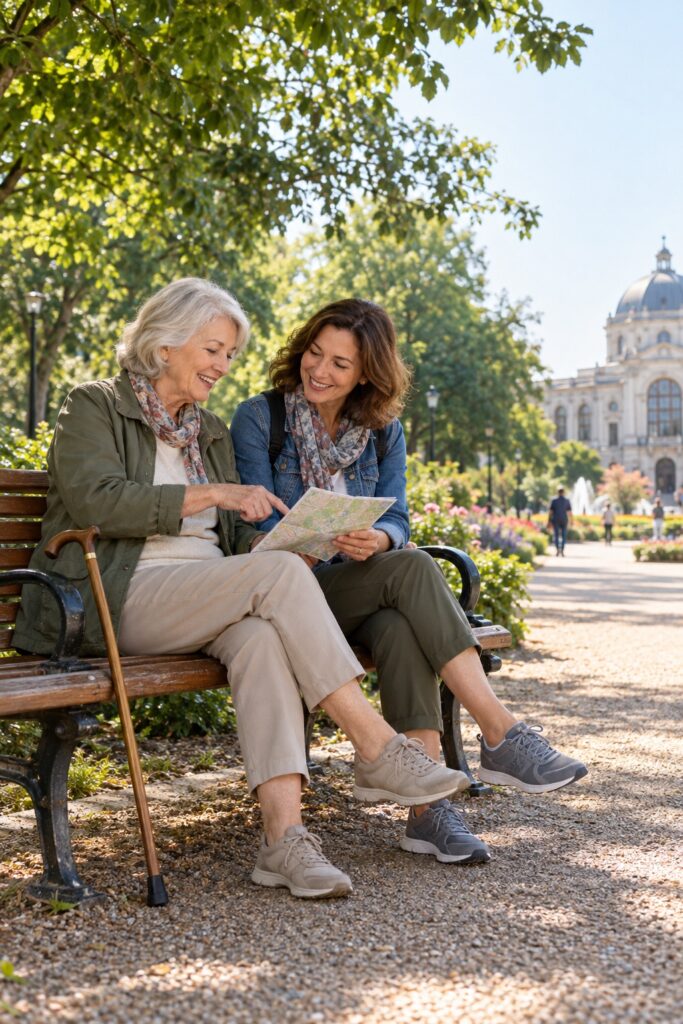
A route can look wonderfully simple on a map and still miss the details that make an outing possible. I want to bring those details into view: a seat you can actually use, a toilet open at the right time, a manageable crossing and a way to get home.
I’m discussing planning, not deciding how far you should walk. Your own requirements and any individual professional guidance come first. The examples below are fictional routes, not checked places or instructions to travel a particular distance.
Begin with what the outing needs to do
Is the purpose to collect something, meet a friend or spend a little time outdoors? That purpose helps separate essentials from nice extras. A park visit might achieve everything you wanted with one small loop and a conversation. A market errand needs a plan for the purchase as well as the walk.
Write the essential conditions in ordinary words. “I need a usable toilet at the meeting point” is clearer than “some facilities nearby.” “I need to be able to finish before the optional loop” tells a companion more than “let’s take it easy.”
Ask whether the support is usable, not just present
A bench symbol does not tell you about its height, back, arms, approach or condition. Active Travel England’s design guidance discusses these features because resting places serve different needs. I use that guidance to frame questions, not to turn infrastructure spacing into a personal exercise schedule.
For a toilet, check opening hours, entrance, steps or thresholds, payment or access requirements, and the facilities relevant to you. “Accessible” on a listing is a starting point for questions rather than a guarantee of individual fit. Ask the operator about the actual day and time where possible.
Keep the source and date beside important information. An operator’s current answer, a recent visit and an old map listing are different kinds of evidence. If they disagree, leave the uncertainty visible until the point that matters is resolved.
Compare route shapes as well as length
Imagine a fictional visitor centre with a garden loop returning to it and a separate optional lawn loop. If the centre’s essential facilities and the return arrangement are confirmed, returning after the garden loop creates a genuine decision point. You can finish without being stranded halfway around a larger circuit.
Now imagine the attractive outer path has an unverified gate shortcut and no suitable resting point along the relevant section. A shorter line across the map does not establish an available route. I would leave that shortcut out of the plan until its access is known.
Include crossings and the return journey
Consider the approach, kerbs, visibility, traffic arrangement and what happens on the far side. Follow local crossing rules. A walking-speed result from a hallway cannot certify that a particular road crossing will be manageable in real conditions.
If a lift is part of the return plan, agree the precise pickup entrance, waiting location and contact method. Check vehicle suitability and any needed assistance. “Someone can probably collect us” is different from an arrangement. The cost of transport and other practical demands can also go into my door-to-door comparison.
Allow a verified plan to change
In a second fictional example, Mara plans a library stop on the way to a market. The library toilet is essential, the café stop is optional, and a suitable pickup is agreed at the library or market. If the toilet closes unexpectedly, the café does not become a confirmed substitute merely because it serves drinks.
Mara can use an established alternative if it meets the requirement, or change the outing using an appropriate return arrangement. The errand can wait. Recent checks were still worthwhile; they simply could not guarantee that nothing would change.
Weather, crowding and a cancelled lift can also change the conditions. Reassess the affected part instead of assuming a route remains suitable because it worked previously. Urgent symptoms require appropriate emergency help, not just a transport adjustment.
Keep the route card short and useful
- Purpose and chosen route, including the return.
- Essential facilities, their exact entrances and when checked.
- Known resting points and crossings relevant to your needs.
- Optional sections that can be omitted without pressure.
- Agreed pickup, contact details and unresolved questions.
Use a format you can read or hear easily, and share only the information a companion needs for their role. After the outing, note what changed. “The usual entrance was blocked” is useful for next time; “I should have managed better” tells you nothing about access.
I would call the plan successful when it helps you participate and keep a real choice about stopping. It does not need to end with a bigger distance target.
MarGo! Moments is a non-medical lifestyle publication. This article is general information, not individualized medical advice or an exercise prescription. Consult an appropriately qualified professional for advice about your own health.
MarGo! editorial feature · AI-assisted, in the MarGo! first-person voice. Not a personal experience or product test unless stated.