
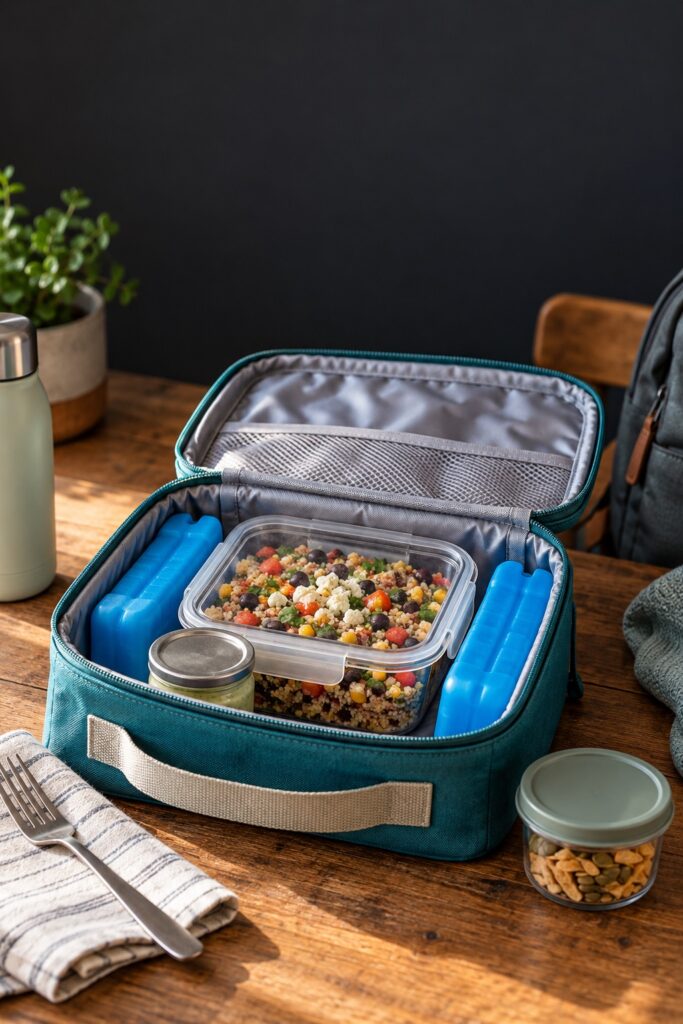
For a lunch that travels well, I want three things to arrive together: safe temperature, a secure container and food whose texture still makes sense. A sealed lid handles leaks; it does not keep a perishable meal safely cold by itself.
Let me start with the journey, then work back to the food. These are illustrative packing ideas, not tested claims about a particular bag or flask.
Choose the temperature route first
How long is the trip? When will you eat? Is there a dependable refrigerator at the destination? A microwave at lunchtime does not replace safe cold storage during the morning.
You have three routes: keep perishable food cold, keep a suitable hot meal hot, or choose products whose labels allow ambient storage. A mixed meal follows the requirements of its perishable parts. Bread around a refrigerated filling does not turn the sandwich into shelf-stable food.
For a cold lunch, pack food that is already cold
USDA’s packed-lunch guidance recommends an insulated lunch bag and at least two cold sources, such as frozen gel packs or an appropriate frozen water bottle. Keep perishable food at 40°F/4°C or below and refrigerate on arrival when possible.
Chill cooked ingredients safely before packing. An ice pack is there to maintain a cold meal, not to cool a large warm bowl inside a closed bag. Divide cooked food into shallow containers and refrigerate promptly during preparation.
Pack shortly before leaving, arrange cold sources around the perishables, and keep the bag away from direct sun and hot vehicles. Two packs are not a guarantee for every journey. Assess the actual temperature and improve the arrangement if it cannot hold the food safely cold.
For a hot lunch, reheating comes before holding
Use an insulated food container suitable for the meal and follow its directions. USDA advises preheating a suitable container with boiling water for a few minutes, emptying it carefully, then filling with piping-hot food and keeping it closed until lunch.
Leftovers need reheating to 165°F/74°C before packing. Soups, sauces and gravies should reach a rolling boil during reheating. Hot holding then needs at least 140°F/60°C. The holding temperature is not the reheating target. See USDA’s reheating guidance.
Check that the container maintains the required temperature over your actual interval. Keep chilled toppings separately cold rather than adding them to the hot food before its journey. Do not assume a container’s advertised maximum time fits every quantity and meal.
When there is no reliable cooling or hot holding
Choose genuinely shelf-stable products, intact and stored as their labels direct: for example, suitable crackers, whole fruit and a commercially packaged item explicitly labeled for ambient storage. Check the exact product, not just the food’s familiar name.
An unopened shelf-stable carton may need refrigeration after opening. Pack an amount you expect to open and eat, with the required utensils. If a desired ingredient needs chilling, provide that chilling or choose something else.
Keep wet, crisp and hot components from fighting
I’ll use an illustrative cold bowl: cooked beans, a cooked grain, prepared vegetables, a chilled dressing and a crisp topping. Chill the cooked components promptly, store the dressing separately, and carry all perishable parts with adequate cold sources. Keep the crisp topping dry until eating.
A wide container with spare room is easier to stir than a narrow jar packed to the lid. Cut pieces for the utensils you will have. If reheating, remove the cold dressing and topping first, then reheat the cooked leftovers to 165°F/74°C, stirring and checking several places as appropriate.
For sandwiches, drain suitable wet fillings and consider carrying juicy additions separately. For soup, use a container designed for liquids and the intended temperature; inspect the seal and respect its fill line. A secondary bag can protect your belongings, but it does not improve food safety.
Plan for a late lunch
Perishable food must not stay outside safe temperature control for more than two hours, or one hour above 90°F/32°C. Time during preparation, travel and sitting on a desk all matters. Returning food to the refrigerator does not erase earlier unsafe handling, and reheating does not reliably repair it.
If you cannot establish safe holding after a delay, choose another meal. Do not use smell or a taste as proof of safety. USDA advises packing only the perishable amount you will eat and discarding leftover lunch food afterward rather than repeatedly commuting the same meal.
After lunch, notice the useful adjustment: a wider bowl, a separate sauce or better cold capacity. Then clean and dry the containers and bag as directed. My small-sauce guide can help with the dressing, but the journey decides how that dressing travels.
Food-safety temperatures and storage limits here follow US household guidance; follow applicable local guidance and product instructions.
MarGo! editorial feature · AI-assisted, in the MarGo! first-person voice. Not a personal experience or product test unless stated.