
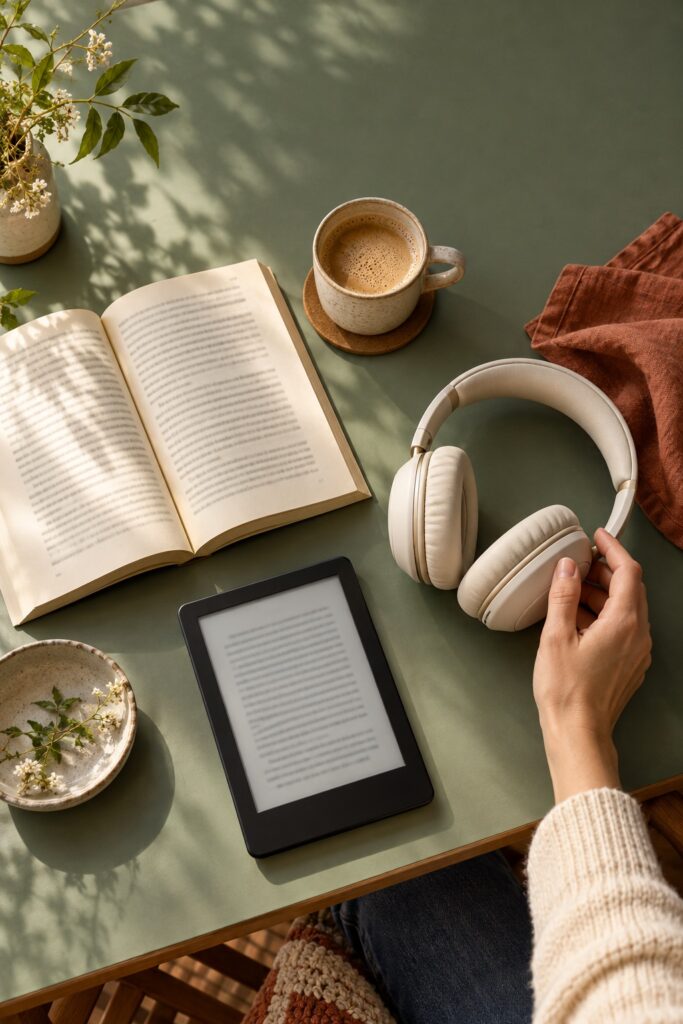
I wouldn’t ask you to choose a permanent side in the print-versus-digital debate. I’d ask where you want to read this particular book, what makes it comfortable, and which version lets you enjoy the story with the least friction.
You might want adjustable text, an appealing narrator, easy page-flipping, or a copy available through your library. Start with that requirement. The format is there to help you, not to define what kind of reader you are.
Print: check the pages as well as the cover
A printed book gives you fixed pages and a physical place to return to. That can be helpful when you want to revisit a conversation or compare nearby passages.
The actual edition matters. A paperback, hardcover, and large-print copy can differ in type, weight, dimensions, and how easily they stay open. If possible, look at a representative page and consider how you will hold the book during a normal session.
I’d put comfortable reading ahead of an attractive cover when those two wishes conflict. A beautiful edition can be a pleasure, but you still have to spend time with its pages.
Ebooks: test the file on the device you will use
Many ebook systems let you adjust text presentation, but the app, device, and file determine the options. Reflowable text behaves differently from a fixed-layout page or an image of text.
Open a sample and test your preferred size. Look at dialogue, italics, chapter headings, and any letters or messages reproduced in the story. Can you navigate back to a chapter and save your place without a struggle?
If an accessibility feature is essential, ask about that specific feature and edition. “I need adjustable text and usable chapter navigation” is a practical request; you need not explain a diagnosis. A general accessibility label cannot answer every question about assistive technology or image descriptions.
Audio: choose the performance, not just the premise
Listen to a sample of the exact audiobook. A narrator’s pacing, pauses, and character voices help shape the experience. You can decide that a performance does not suit you without declaring it poor work.
I’d check whether speakers are easy to distinguish and whether the humor or tenderness lands comfortably. If the player offers speed adjustments, try a small change because it improves your experience, not because you feel obliged to finish faster.
Check whether the edition is unabridged, abridged, or a dramatized adaptation. Those descriptions are not interchangeable. Multiple performers do not, by themselves, tell you whether you are hearing the complete text.
Hands-free still requires attention. Choose listening situations where it is appropriate and safe, and pause when another task needs your awareness. Replaying a passage is an ordinary part of using audio.
Check the library route before choosing an ereader
Here is the practical detail I would settle before buying a device: can your own library’s copy of the book open on that exact model?
- Kindle ereaders: OverDrive’s Kindle borrowing route is for U.S. libraries. Check that the particular ebook offers a Kindle reading option; not every Libby loan does. A library outside the U.S. offering Libby does not establish Kindle compatibility. See OverDrive’s Kindle guidance and Libby’s Kindle borrowing steps.
- Kobo ereaders: supported models can borrow through their built-in library feature or sync compatible ebook loans borrowed in Libby. Use the same library card on the Kobo and in Libby. Some ebooks will not sync, and Libby audiobooks and magazines are not supported on Kobo ereaders. Check Libby’s Kobo guidance and Kobo’s supported countries rather than assuming every model and location works.
- Other compatible ereaders: an eligible EPUB or PDF loan may have a computer-transfer route using Adobe Digital Editions. The device must support that route, and file options vary by title. Follow Libby’s transfer instructions; a file extension alone is not proof of compatibility.
These official compatibility sources were rechecked on 21 October 2026. Support, collections, and service availability can change.
My suggested pre-purchase test is to choose one romance from your own library, confirm its format and exact device support, and check the required account or transfer steps. If the route is unclear, try an available library reading option on a device you already own first. You need not buy an ereader merely to experiment with an ebook.
Check access and navigation before settling in
A library may have print without audio, or audio without an ebook. Separate formats can have separate queues. Libby’s official guide confirms that participating libraries choose their own titles and formats.
A loan, a subscription catalogue, and a purchased edition also offer different access arrangements. Read the current terms rather than assuming a download can be kept or transferred indefinitely.
Before travel, test offline access on the device you will take, if the service supports it. A visible cover does not prove the full file is downloaded. When switching between formats, use a chapter heading to find your place; page numbers may not match, and progress may not synchronize.
Let one small comparison answer one question
Try samples in two formats if they are available. Ask something concrete: “Can I read this comfortably?” “Do I enjoy this narrator?” “Can I return to a passage easily?”
A mixed answer is useful. You may enjoy audio for this story and prefer text when discussing it with a group. I’d let the result guide this choice, not every book you will ever read. The best version is the one that makes you want to continue.
If cost is the deciding factor, my guide to reading on a budget compares borrowing, subscriptions and buying.
MarGo! editorial feature · AI-assisted, in the MarGo! first-person voice. Not a personal experience or product test unless stated.