
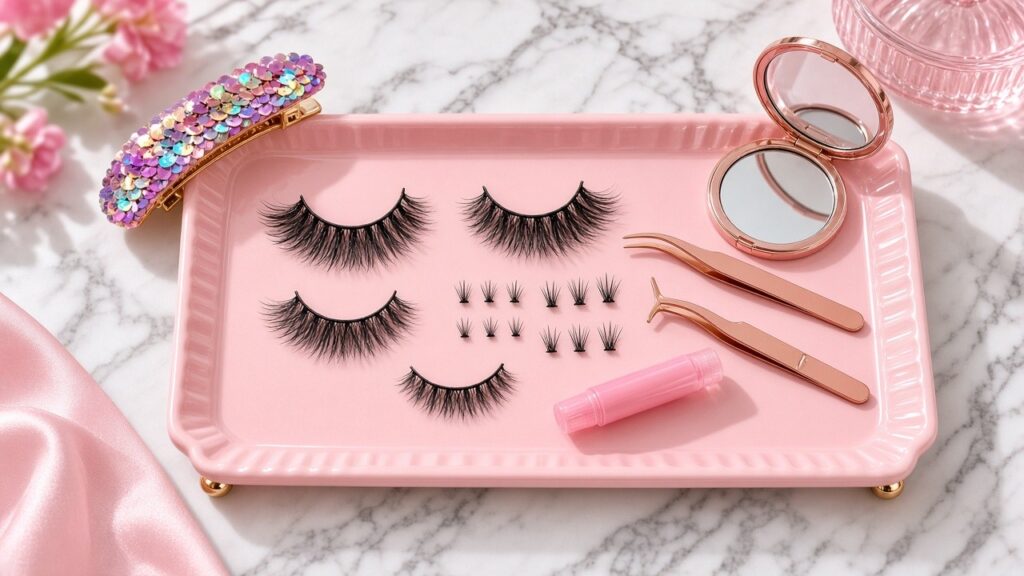
False lashes make your eyes readable from the back row of a theater, but a lash that peels off mid-turn is a performer’s nightmare. The right type of lash, the right glue and the right application make the difference between lashes that last through a whole recital and lashes you find stuck to your cheek after the first number.
For most dancers, the best false lashes are lightweight strip lashes with a thin, flexible band, or demi (half) lashes for a more natural look and better hold at the outer corners. Choose fuller, longer lashes for stage and competitions and lighter ones for class or photos. Use a latex-based or latex-free strong-hold lash glue (patch test first), let it get tacky before you apply, press the lash right at the base of your natural lashes, and secure the corners. Remove gently with an oil-based remover so you don’t pull out your real lashes.
Below: the lash types compared, stage versus everyday lashes, glues that hold through sweat, step-by-step application, what to wear for recitals, competitions and class, how to remove and reuse them, and troubleshooting. For the rest of your face, see sweat-proof makeup for dance.
Best false lash types for dancers
| Lash type | What it is | Pros for dancers | Cons |
|---|---|---|---|
| Full strip lashes | One band that spans the whole lash line | Biggest impact for stage; easy to apply in one piece | Can lift at the inner or outer corner; heavy styles feel stiff |
| Demi (half) lashes | A shorter strip for the outer half of the eye | Lighter, more comfortable, less likely to lift at the inner corner; good for smaller or hooded eyes | Less dramatic from far away |
| Cluster or individual lashes | Small groups of lashes applied one by one | Very customizable and natural; flexible as you move | Slower to apply; one cluster can fall off without you noticing |
| Magnetic lashes | Lashes that attach to magnetic eyeliner or between magnets | No glue; quick | Can shift with heavy sweat or vigorous movement; heavier |
| Pre-glued or self-adhesive strips | Strips with adhesive already on the band | Convenient | Hold is often weaker for sweat and long shows |
What to look for
- A thin, flexible band. A soft cotton-thread or clear band bends with your eyelid and stays on better than a stiff, thick band.
- Lightweight fibers. Synthetic lashes are common and hold their curl; faux mink and silk-style fibers are soft and light. Heavy lashes pull on the band and lift.
- The right length for the venue. Longer and fuller for large stages, shorter for small studios, close-up photos or class.
- A shape that suits your eye. Lashes that are longer at the outer corner lift and widen the eye; evenly long lashes make eyes look rounder.
Stage vs everyday lashes
Stage lights wash out features, and audiences are far away, so stage lashes need more volume and length than everyday lashes. Think of it in three levels:
| Setting | Lash style |
|---|---|
| Large theater or competition | Full, dramatic strip lashes with length and volume |
| Small studio show or recital | Medium-volume strip or demi lashes |
| Class, rehearsal or photos up close | Natural demi or clusters, or just mascara |
Many studios and companies set rules for lashes in recitals so a group looks uniform. Always follow your teacher’s instructions on style, length and brand. More on stage looks in my stage makeup vs regular makeup guide.
Glue that holds through sweat
Glue matters as much as the lash. Common types:
- Latex-based strong-hold glue: tends to grip very well and is widely used for performances. Not for anyone with a latex allergy.
- Latex-free glue: usually based on acrylates or other adhesives. Many hold well; some are gentler for sensitive eyes.
- Clear vs dark glue: clear glue dries invisible; dark or black glue blends with eyeliner and hides the band. Dark glue is forgiving under stage makeup.
- Brush-on vs tube: brush-on gives a thin, even layer; a tube lets you control the amount.
Patch test first
Eyes are sensitive. Before a show:
- Apply a little glue to your inner arm or behind your ear.
- Wait 24 hours and look for redness, itching or swelling.
- Do a full trial at a rehearsal, not on show day.
If your eyes itch, burn or swell, remove the lashes and stop using that glue. Never put glue directly on your eyelid or lashes, and never use non-cosmetic glue near your eyes.
How to apply false lashes so they stay
- Prep the lid. Clean the lid and lash line so there’s no oil or moisturizer. Apply eyeshadow and eyeliner first.
- Curl your natural lashes and add a coat of mascara so they blend with the false lashes.
- Measure the lash. Hold the strip against your lash line. It should start a few millimeters from the inner corner. Trim extra length from the outer end, not the inner end.
- Bend the band. Curve the strip around your finger a few times so it follows the shape of your eye.
- Apply a thin line of glue along the band, adding a tiny bit more at both ends.
- Wait 30 to 60 seconds until the glue becomes tacky. This is the step most people skip, and it’s the key to a lash that stays.
- Place the lash on top of your natural lashes, as close to the roots as possible, starting from the middle, then the outer corner, then the inner corner.
- Press the band with tweezers or a lash applicator, and pinch your real and false lashes together gently.
- Let it dry fully before you open your eyes wide or move a lot.
- Cover the band with eyeliner if any gap shows.
Tips for extra hold
- Apply a second thin layer of glue at the corners if they lift.
- Keep lashes away from your tear duct. A lash that touches the inner corner of the eye is irritating and lifts quickly.
- Use demi lashes or cut a strip in half if full strips keep lifting.
- Finish with setting spray, holding it far away with eyes closed. See setting spray vs powder.
- Don’t rub your eyes. Blot sweat with a tissue below the eye.
Lashes for recitals vs competitions vs class
- Recitals: follow the studio’s rules for a uniform look. Medium to full strip lashes are typical. Children’s recital lashes are often smaller and lighter.
- Competitions: dramatic lashes are common, and dancers often wear them for long days with several routines. Use strong-hold glue, and pack spare lashes and glue in your kit.
- Class: you usually don’t need false lashes. If you want them, choose a natural demi or a few clusters.
- Photos and video: cameras pick up detail, so natural, well-blended lashes look best close up.
- Latin and ballroom dance: typically bold, glamorous lashes to match bold makeup.
Removing and reusing
Removing without damage
- Soften the glue first. Hold a cotton pad soaked in an oil-based makeup remover or micellar water on your closed eye for 30 seconds.
- Peel slowly from the outer corner, holding the band, not the lashes.
- Stop if you feel resistance and soften the glue again.
- Remove glue left on your lash line with remover.
- Wash your face and remove the rest of your makeup.
Never pull false lashes off dry. You can pull out your natural lashes with them.
Reusing lashes
Good strip lashes can often be worn several times if you care for them:
- Peel dried glue off the band with tweezers.
- Clean gently with a cotton swab and a bit of remover, if the lash type allows.
- Let them dry and return them to their case to keep their shape.
- Throw them out if the band is bent, the fibers are matted or they’ve been near an eye infection.
Don’t share false lashes, and don’t reuse lashes with old mascara clumps or dried glue that won’t come off.
Lash safety
- Keep everything clean. Wash your hands before you touch your eyes, and clean tweezers and lash tools after each use.
- Don’t apply lashes over irritated or infected eyes. Wait until your eyes are completely healed.
- Check the glue’s expiration date. Old glue can thicken, irritate or hold poorly. Close the tube tightly after each use.
- Don’t sleep in false lashes. Remove them every night, even after a late show.
- Watch for allergy signs such as redness, swelling, itching or watery eyes, and stop using the product if they appear. See a doctor if symptoms don’t go away.
- Give your natural lashes a break between show weekends and avoid pulling or rubbing them.
Troubleshooting
| Problem | Fix |
|---|---|
| Inner corner lifts | Trim the inner end; start the lash a few millimeters from your inner corner; add a dot of glue there |
| Outer corner lifts | Trim the lash to fit; bend the band before applying; try demi lashes |
| Lashes feel heavy | Choose lighter fibers and a thinner band |
| Glue shows | Use dark glue or cover the band with eyeliner |
| Lashes fall off during a show | Use strong-hold glue, wait until tacky, and press firmly at the base |
| Eyes water or itch | Remove the lashes; the glue or lash may be irritating your eye |
| Lashes look crooked | Apply from the middle first, then the corners |
Your lash kit for shows
- Two pairs of lashes (one spare)
- Lash glue (the one you tested)
- Tweezers or lash applicator
- Small scissors for trimming
- Mascara and eyeliner
- Cotton swabs and makeup remover
- A small mirror
- Setting spray
FAQ
Strip, demi or cluster lashes: which is best for dancers?
For stage, strip lashes give the most impact and are fastest to apply. Demi lashes are more comfortable and less likely to lift at the inner corner. Clusters look natural and flex well but take longer to apply. Many dancers use strips or demis for shows and clusters or nothing for class.
Are magnetic lashes good for dance?
They’re glue-free and quick, but many dancers find they shift with heavy sweat or fast movement, and they can be heavier than glued lashes. For performances, glued strip lashes are usually more secure.
How do I keep stage lashes on through sweat?
Start with clean, oil-free lids, use strong-hold glue, wait until it’s tacky, place the lash close to the roots, add a little extra glue at the corners and avoid rubbing your eyes. A setting spray over your makeup helps too.
Can I reuse stage lashes?
Yes, often several times. Remove them gently, peel off old glue, clean them and store them in their case. Throw them away if they’re damaged, matted or dirty.
How do I take them off without pulling my real lashes?
Soften the glue with an oil-based remover first, then peel from the outer corner holding the band. Never yank them off dry.
Are false lashes safe for kids in recitals?
Many studios use them for children’s recitals. Choose small, light lashes, patch test the glue, and have an adult apply and remove them gently. Follow the studio’s rules, and skip them if the child’s eyes are irritated.